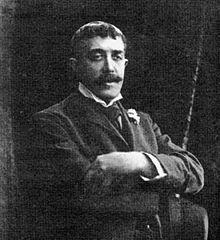
Quotessence
Home / Authors / Jean Lorrain
Jean Lorrain

Jean Lorrain Quotes

Poet

Filter quotes by topic

Famous Jean Lorrain Quotes

“There is nothing to be found in human eyes, and that is their terrifying and dolorous enigma, their abominable and delusive charm. There is nothing but that which we put there ourselves. That is why honest gazes are only to be found in portraits. The faded and weary eyes of martyrs, expressions tortured by ecstasy, imploring and suffering eyes, some resigned, others desperate... the gazes of saints, mendicants and princesses in exile, with pardoning smiles... the gazes of the possessed, the chosen and the hysterical... and sometimes of little girls, the eyes of Ophelia and Canidia, the eyes of virgins and witches... as you live in the museums, what eternal life, dolorous and intense, shines out of you! Like precious stones enshrined between the painted eyelids of masterpieces, you disturb us across time and across space, receivers of the dream which created you! You have souls, but they are those of the artists who wished you into being, and I am delivered to despair and mortification because I have drunk the draught of poison congealed in the irises of your eyes. The eyes of portraits ought to be plucked out.”

“This Sarah Perez had the most beautiful eyes in the world, those green eyes spangled with gold that you love so much: the eyes of Antinous. In Rome, such eyes would have made her a concubine of Adrian; in Madrid they helped her become the princess of Eboli ensconced in the bed of the king. But Philip II was extremely jealous of those wonderful emerald eyes and their delicate transparency, and the princess - who was bored with the funereal palace and the even more funereal society of the king - had the fancy and the misfortune to cast her admirable gaze upon the Marquis de Posa while she was leaving church one day. It was on the threshold of the chapel, and the princess believed herself to be alone with her camarera mayor, but the vigilance of the clergy was equal to the challenge. She was betrayed, and that very evening, in the intimacy of their bedroom, in the course of some violent argument or tempestuous tussle, Philip threw his mistress to the floor. Blind with rage he leapt upon her, tore out her eye and devoured it in a single gulp. 'Thus was the princess covered in blood - a good title for a conte cruel, that, which Villiers de l'Isle Adam has somehow omitted to write! The princess was henceforth one-eyed: the royal pet had a gaping hole in her face. Philip II, who had the Jewess in his blood, could not cleave so closely to a princess who had only one eye. He made amends to her with some new titles and estates in the provinces and - regretful of the beautiful green eye that he had spoiled - he caused to be inserted into the empty and bloody orbit a superb emerald enshrined in silver, upon which surgeons then inscribed the semblance of a gaze. Oculists have made progress since then; the Princess of Eboli, already hurt by the ruination of her eye, died some little time afterwards, of the effects of the operation. The ways of love and surgery were equally barbarous in the time of Philip II! 'Philip, the inconsolable lover, gave the order to remove the emerald from the face of the dead princess before she was laid in the tomb, and had it mounted in a ring. He wore it about his finger, and would never take it off, even when he went to sleep - and when he died in his turn, he had the ring bearing the green tear clasped in his right hand.”

“In the course of my life I have had pre-pubescent ballerinas; emaciated duchesses, dolorous and forever tired, melomaniac and morphine-sodden; bankers' wives with eyes hollower than those of suburban streetwalkers; music-hall chorus girls who tip creosote into their Roederer when getting drunk... I have even had the awkward androgynes, the unsexed dishes of the day of the *tables d'hote* of Montmartre. Like any vulgar follower of fashion, like any member of the herd, I have made love to bony and improbably slender little girls, frightened and macabre, spiced with carbolic and peppered with chlorotic make-up. Like an imbecile, I have believed in the mouths of prey and sacrificial victims. Like a simpleton, I have believed in the large lewd eyes of a ragged heap of sickly little creatures: alcoholic and cynical shop girls and whores. The profundity of their eyes and the mystery of their mouths... the jewellers of some and the manicurists of others furnish them with *eaux de toilette*, with soaps and rouges. And Fanny the etheromaniac, rising every morning for a measured dose of cola and coca, does not put ether only on her handkerchief. It is all fakery and self-advertisement - *truquage and battage*, as their vile argot has it. Their phosphorescent rottenness, their emaciated fervour, their Lesbian blight, their shop-sign vices set up to arouse their clients, to excite the perversity of young and old men alike in the sickness of perverse tastes! All of it can sparkle and catch fire only at the hour when the gas is lit in the corridors of the music-halls and the crude nickel-plated decor of the bars. Beneath the cerise three-ply collars of the night-prowlers, as beneath the bulging silks of the cyclist, the whole seductive display of passionate pallor, of knowing depravity, of exhausted and sensual anaemia - all the charm of spicy flowers celebrated in the writings of Paul Bourget and Maurice Barres - is nothing but a role carefully learned and rehearsed a hundred times over. It is a chapter of the MANCHON DE FRANCINE read over and over again, swotted up and acted out by ingenious barnstormers, fully conscious of the squalid salacity of the male of the species, and knowledgeable in the means of starting up the broken-down engines of their customers. To think that I also have loved these maleficent and sick little beasts, these fake Primaveras, these discounted Jocondes, the whole hundred-franc stock-in-trade of Leonardos and Botticellis from the workshops of painters and the drinking-dens of aesthetes, these flowers mounted on a brass thread in Montparnasse and Levallois-Perret! And the odious and tiresome travesty - the corsetted torso slapped on top of heron's legs, painful to behold, the ugly features primed by boulevard boxes, the fake Dresden of Nina Grandiere retouched from a medicine bottle, complaining and spectral at the same time - of Mademoiselle Guilbert and her long black gloves!... Have I now had enough of the horror of this nightmare! How have I been able to tolerate it for so long? The fact is that I was then ignorant even of the nature of my sickness. It was latent in me, like a fire smouldering beneath the ashes. I have cherished it since... perhaps since early childhood, for it must always have been in me, although I did not know it!”

“8 April 1891 The obscenity of nostrils and mouths; the ignominious cupidity of smiles and women encountered in the street; the shifty baseness on every side, as of hyenas and wild beasts ready to bite: tradesmen in their shops and strollers on their pavements. How long must I suffer this? I have suffered it before, as a child, when, descending by chance to the servant's quarters, I overheard in astonishment their vile gossip, tearing up my own kind with their lovely teeth. This hostility to the entire race, this muted detestation of lynxes in human form, I must have rediscovered it later while at school. I had a repugnance and horror for all base instincts, but am I not myself instinctively violent and lewd, murderous and sensual? Am I any different, in essence, from the members of the riotous and murderous mob of a hundred years ago, who hurled the town sergeants into the Seine and cried, 'String up the aristos!' just as they shout 'Down with the army!' or 'Death to the Jews!”

“March 1898 What a strange dream I had last night! I wandered in the warm streets of a port, in the low quarter of some Barcelona or Marseille. The streets were noisome, with their freshly-heaped piles of ordure outside the doors, in the blue shadows of their high roofs. They all led down towards the sea. The gold-spangled sea, seeming as if it had been polished by the sun, could be seen at the end of each thoroughfare, bristling with yard-arms and luminous masts. The implacable blue of the sky shone brilliantly overhead as I wandered through the long, cool and sombre corridors in the emptiness of a deserted district: a quarter which might almost have been dead, abruptly abandoned by seamen and foreigners. I was alone, subjected to the stares of prostitutes seated at their windows or in the doorways, whose eyes seemed to ransack my very soul. They did not speak to me. Leaning on the sides of tall bay-windows or huddled in doorways, they were silent. Their breasts and arms were bare, bizarrely made up in pink, their eyebrows were darkened, they wore their hair in corkscrew-curls, decorated with paper flowers and metal birds. And they were all exactly alike! They might have been huge marionettes, or tall mannequin dolls left behind in panic - for I divined that some plague, some frightful epidemic brought from the Orient by sailors, had swept through the town and emptied it of its inhabitants. I was alone with these simulacra of love, abandoned by the men on the doorsteps of the brothels. I had already been wandering for hours without being able to find a way out of that miserable quarter, obsessed by the fixed and varnished eyes of all those automata, when I was seized by the sudden thought that all these girls were dead, plague-stricken and putrefied by cholera where they stood, in the solitude, beneath their carmine plaster masks... and my entrails were liquefied by cold. In spite of that harrowing chill, I was drawn closer to a motionless girl. I saw that she was indeed wearing a mask... and the girl in the next doorway was also masked... and all of them were horribly alike under their identical crude colouring... I was alone with the masks, with the masked corpses, worse than the masks... when, all of a sudden, I perceived that beneath the false faces of plaster and cardboard, the eyes of these dead women were alive. Their vitreous eyes were looking at me... I woke up with a cry, for in that moment I had recognised all the women. They all had the eyes of Kranile and Willie, of Willie the mime and Kranile the dancer. Every one of the dead women had Kranile's left eye and Willie's right eye... so that every one of them appeared to be squinting. Am I to be haunted by masks now?”

“The other evening, in that cafe-cabaret in the Rue de la Fontaine, where I had run aground with Tramsel and Jocard, who had taken me there to see that supposedly-fashionable singer... how could they fail to see that she was nothing but a corpse? Yes, beneath the sumptuous and heavy ballgown, which swaddled her and held her upright like a sentry-box of pink velvet trimmed and embroidered with gold - a coffin befitting the queen of Spain - there was a corpse! But the others, amused by her wan voice and her emaciated frame, found her quaint - more than that, quite 'droll'... Droll! that drab, soft and inconsistent epithet that everyone uses nowadays! The woman had, to be sure, a tiny carven head, and a kind of macabre prettiness within the furry heap of her opera-cloak. They studied her minutely, interested by the romance of her story: a petite bourgeoise thrown into the high life following the fad which had caught her up - and neither of them, nor anyone else besides in the whole of that room, had perceived what was immediately evident to my eyes. Placed flat on the white satin of her dress, the two hands of that singer were the two hands of a skeleton: two sets of knuckle-bones gloved in white suede. They might have been drawn by Albrecht Durer: the ten fingers of an evil dead woman, fitted at the ends of the two overlong and excessively thin arms of a mannequin... And while that room convulsed with laughter and thrilled with pleasure, greeting her buffoonery and her animal cries with a dolorous ovation, I became convinced that her hands no more belonged to her body than her body, with its excessively high shoulders, belonged to her head... The conviction filled me with such fear and sickness that I did not hear the singing of a living woman, but of some automaton pieced together from disparate odds and ends - or perhaps even worse, some dead woman hastily reconstructed from hospital remains: the macabre fantasy of some medical student, dreamed up on the benches of the lecture-hall... and that evening began, like some tale of Hoffmann, to turn into a vision of the lunatic asylum. Oh, how that Olympia of the concert-hall has hastened the progress of my malady!”

“Freneuse is an oddball, an idler, without any aim in life! If you ask me, he has smoked too much opium in the East, and that explains his somnolence, his morbid lethargies. It's the hazardous legacy of bad habits! He has been comprehensively undone; the heavy influence of poisonous opiates never ceases to oppress him. Besides which, his steel-blue eyes are surely the eyes of a smoker of opium. He carries the drunken burden of hemp in his veins. Opium is like syphilis' - le Mazel released the word carelessly - 'it is a thing which stays for years and years in the blood, because the body is unable to purge itself. It must be absorbed, in the long run, by iodide.”

“There were charming ones as well as terrible ones, that I must admit. The painter was particularly entranced by Japanese masks: warriors', actors' and courtesans' masks. Some of them were frightfully contorted, the bronze cheeks creased by a thousand wrinkles, with vermilion weeping from the corners of the eyes and long trails of green at the corners of the mouths like splenetic beards. 'These are the masks of demons,' said the Englishman, caressing the long black swept-back tresses of one of them. 'The Samurai wore them in battle, to terrify the enemy. The one which is covered in green scales, with two opal pendants between the nostrils, is the mask of a sea-demon. This one, with the tufts of white fur for eyebrows and the two horsehair brushes beside the lips, is the mask of an old man. These others, of white porcelain - a material as smooth and fine as the cheeks of a Japanese maiden, and so gentle to the touch - are the masks of courtesans. See how alike they all are, with their delicate nostrils, their round faces and their heavy slanted eyelids; they are all effigies of the same goddess. The black of their wigs is rather beautiful, isn't it? Those which bubble over with laughter even in their immobility are the masks of comic actors.' That devil of a man pronounced the names of demons, gods and goddesses; his erudition cast a spell. Then: 'Bah! I have been down there too long!' Now he took up the light edifices of gauze and painted silk which were Venetian masks. 'Here is a Cockadrill, a Captain Fracasse, a Pantaloon and a Braggadocio. Only the noses are different - and the cut of their moustaches, if you look at them closely. Doesn't the white silk mask with enormous spectacles evoke a rather comical dread? It is Doctor Curucucu, an actual marionette featured in the Tales of Hoffmann. And what about that one, with all the black horsehair and the long spatulate nose like a stork's beak tipped with a spoon? Can you imagine anything more appalling? It's a duenna's mask; amorous young women were well-guarded when they had to go about flanked by old dragons dressed up in something like that. The whole carnival of Venice is put on parade before us beneath the cape and the domino, lying in ambush behind these masks... Would you like a gondola? Where shall we go, San Marco or the Lido?”

“Then Chameroy spoke. 'You always put the blame on opium, but as I see it the case of Freneuse is much more complicated. Him, an invalid? No - a character from the tales of Hoffmann! Have you never taken the trouble to look at him carefully? That pallor of decay; the twitching of his bony hands, more Japanese than chrysanthemums; the arabesque profile; that vampiric emaciation - has all of that never given you cause to reflect? In spite of his supple body and his callow face Freneuse is a hundred thousand years old. That man has lived before, in ancient times under the reigns of Heliogabalus, Alexander IV and the last of the Valois. What am I saying? That man is Henri III himself. I have in my library an edition of Ronsard - a rare edition, bound in pigskin with metal trimmings - which contains a portrait of Henri engraved on vellum. One of these nights I will bring the volume here to show you, and you may judge for yourselves. Apart from the ruff, the doublet and the earrings, you would believe that you were looking at the Due de Freneuse. As far as I'm concerned, his presence here inevitably makes me ill - and so long as he is present, there is such an oppression, such a heaviness...”

“Against a set of desolate scenery, amid spectral crags and livid mountains of ash, beneath the funereal daylight of slopes illuminated in blue, she personified the spirit of the witches' sabbat. Morbid and voluptuous, sometimes with extenuated grace and infinite lassitude, she seemed to carry the burden of a criminal beauty, a beauty charged with all the sins cf the multitude. She fell again and again upon her pliant legs, and as she outlined the symbolic gestures of her two beautiful dead arms she seemed to be towing them behind her. Then, the vertigo of the abyss took hold of her again, and like one possessed she stood on point, holding herself fully erect from top to toe, like a spike of flesh and shadows. Her arms, weighed down just a few moments earlier, became menacing, demoniac, and audacious. Twisting like a screw, she whirled around, like a winnowing-machine - no, like a great lily stirred by a storm-wind. Clownish and macabre, a nacreous gleam showed between her lips... oh, that cruel and sardonic smile, and the two deep pools of her terrible eyes! Ize Kranile!”

“Look, de Mazel, you've known him for years - hasn't he been known to sleep for forty hours in two days?' 'Forty hours?' 'Certainly. He awoke at meal times, just to take nourishment, and afterwards fell again into his torpor. And Freneuse had a strange horror of sleep; there was some abnormal phenomenon associated with it, some lesion of the brain or neurotic depression.' 'The troublesome cerebral anaemia which results from excessive debauchery. Another myth! I've never believed, myself, in the supposed debauchery of that poor gentleman. Such a frail chap, with such a delicate complexion! Quite frankly, there was no scope in him for debauchery. 'Pooh! About as much as Lorenzaccio!' 'You associate him with the Medicis! Lorenzaccio was a Florentine impassioned by rancour, a man of energy slowly brooding over his vengeance, caressing it as he might caress the blade of a dagger! There is not the slightest comparison to be drawn between Lorenzaccio and that gall-green, liverish creature Freneuse.”