Quotessence
Home / Authors / Joseph de Maistre Books
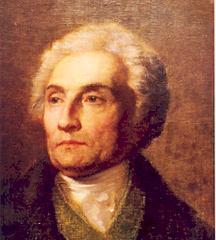
Joseph de Maistre

Joseph de Maistre Books

Philosopher

The Executioner

A source page for quotes linked to Joseph de Maistre.
0 quotes

Related Quotes

“This world is a military expedition, an eternal combat. No doubt all chose who fought courageously in a battle are worthy of praise, but also there is no doubt that the greatest glory goes to the one who returns wounded.”

“However, Christianity has come to present us a new idea, all the more powerful in that it rests on a universal idea as old as the world, and that we needed to be rectified and sanctioned by revelation. So when the guilty ask us it is why the innocent suffer in his world, we are not lacking in responses, as you have seen, but we can choose one that is more direct and perhaps more convincing than all the others. We can reply: Innocence suffers for you, if you wish it.”

“But just let the masters of the world -- princes, kings, emperors, powerful majesties, invincible conquerors -- let them only try to make the people dance on a certain day each year in a set place. This is not much to ask, but I dare swear that they will not succeed, whereas, if the humblest missionary comes to such a spot, he will make himself obeyed two thousand years after his death. Every year the people meet together around a rustic church in the name of St. John, St. Martin, St. Benedict, and so on; they come filled with boisterous yet innocent cheerfulness; religion sanctifies this joy and the joy embellishes religion: they forget their sorrows; at night, they think of the pleasure to come on the same day next year, and this date is stamped on their memory. By the side of this picture put that of the French leaders who have been vested with every power by a shameful Revolution and yet cannot organize a simple fete.”

“Human reason reduced to its own resources is perfectly worthless, not only for creating but also for preserving any political or religious association, because it only produces disputes, and, to conduct himself well, man needs not problems but beliefs. His cradle should be surrounded by dogmas, and when his reason is awakened, it should find all his opinions ready-made, at least all those relating to his conduct. Nothing is so important to him as prejudices, Let us not take this word in a bad sense. It does not necessarily mean false ideas, but only, in the strict sense of the word, opinions adopted before any examination. Now these sorts of opinions are man’s greatest need, the true elements of his happiness, and the Palladium of empires. Without them, there can be neither worship, nor morality, nor government. There must be a state religion just as there is a state policy; or, rather, religious and political dogmas must be merged and mingled together to form a complete common or national reason strong enough to repress the aberrations of individual reason, which of its nature is the mortal enemy of any association whatever because it produces only divergent opinions. All known nations have been happy and powerful to the extent that they have more faithfully obeyed this national reason, which is nothing other than the annihilation of individual dogmas and the absolute and general reign of national dogmas, that is to say, of useful prejudices. Let each man call upon his individual reason in the matter of religion, and immediately you will see the birth of an anarchy of belief or the annihilation of religious sovereignty. Likewise, if each man makes himself judge of the principles of government, you will at once see the birth of civil anarchy or the annihilation of political sovereignty. Government is a true religion: it has its dogmas, its mysteries, and its ministers. To annihilate it or submit it to the discussion of each individual is the same thing; it lives only through national reason, that is to say through political faith, which is a creed. Man’s first need is that his nascent reason be curbed under this double yoke, that it be abased and lose itself in the national reason, so that it changes its individual existence into another common existence, just as a river that flows into the ocean always continues to exist in the mass of water, but without a name and without a distinct reality.”

“In the whole vast dome of living nature there reigns an open violence. A kind of prescriptive fury which arms all the creatures to their common doom: as soon as you leave the inanimate kingdom you find the decree of violent death inscribed on the very frontiers of life. You feel it already in the vegetable kingdom: from the great catalpa to the humblest herb, how many plants die and how many are killed; but, from the moment you enter the animal kingdom, this law is suddenly in the most dreadful evidence. A Power, a violence, at once hidden and palpable. . . has in each species appointed a certain number of animals to devour the others. . . And who [in this general carnage] exterminates him who will exterminate all others? Himself. It is man who is charged with the slaughter of man. . . The whole earth, perpetually steeped in blood, is nothing but a vast altar upon which all that is living must be sacrificed without end, without measure, without pause, until the consummation of things, until evil is extinct, until the death of death.”

“All grandeur, all power, all subordination to authority rests on the executioner: he is the horror and the bond of human association. Remove this incomprehensible agent from the world and at that very moment order gives way to chaos, thrones topple and society disappears.”

“The savage cuts down the tree to gather its fruit, he unharnesses the ox that missionaries have just given him, and cooks it with the wood of the plough. He has known us for three centuries without having wanted anything from us, except gunpowder to kill his fellows and brandy to kill himself.”

“Man's destructive hand spares nothing that lives; he kills to feed himself, he kills to clothe himself, he kills to adorn himself, he kills to attack, he kills to defend himself, he kills to instruct himself, he kills to amuse himself, he kills for the sake of killing. Proud and terrible king, he needs everything and nothing resists him ... from the lamb he tears its guts and makes his harp resound ... from the wolf his most deadly tooth to polish his pretty works of art; from the elephant his tusks to make a toy for his child - his table is covered with corpses ... And who in all of this will exterminate him who exterminates all others? Himself. It is man who is charged with the slaughter of man ... So it is accomplished ... the first law of the violent destruction of living creatures. The whole earth, perpetually steeped in blood, is nothing but a vast altar upon which all that is living must be sacrificed without end, without measure, without pause, until the consummation of things, until evil is extinct, until the death of death.”

“All sciences have their mysteries and at certain points the apparently most obvious theory will be found in contradiction with experience. Politics, for example, offers several proofs of this truth. In theory, is anything more absurd than hereditary monarchy? We judge it by experience, but if government had never been heard of and we had to choose one, whoever would deliberate between hereditary and elective monarchy would be taken for a fool. Yet we know by experience that the first is, all things considered, the best that can be imagined, while the second is the worst. What arguments could not be amassed to establish that sovereignty comes from the people? However they all amount to nothing. Sovereignty is always taken, never given, and a second more profound theory subsequently discovers why this must be so. Who would not say the best political constitution is that which has been debated and drafted by statesmen perfectly acquainted with the national character, and who have foreseen every circumstance? Nevertheless nothing is more false. The best constituted people is the one that has the fewest written constitutional laws, and every written constitution is WORTHLESS.”

“Every time that a man who is not an absolute fool presents you with a question he considers very problematic after giving it careful thought, distrust those quick answers that come to the mind of someone who has considered it only briefly or not at all. These answers are usually simplistic views lacking in consistency, which explain nothing, or which do not bear examination.”

“False opinions are like false money, struck first of all by guilty men and thereafter circulated by honest people who perpetuate the crime without knowing what they are doing.”

“It can even come about that a created will cancels out, not perhaps the exertion, but the result of divine action; for in this sense, God himself has told us that God wishes things which do not happen because man does not wish them! Thus the rights of men are immense, and his greatest misfortune is to be unaware of them.”

“We are all bound to the throne of the Supreme Being by a flexible chain which restrains without enslaving us. The most wonderful aspect of the universal scheme of things is the action of free beings under divine guidance.”

“War is thus divine in itself, since it is a law of the world. War is divine through its consequences of a supernatural nature which are as much general as particular. War is divine in the mysterious glory that surrounds it and in the no less inexplicable attraction that draws us to it. War is divine by the manner in which it breaks out.”

“We are tainted by modern philosophy which has taught us that all is good, whereas evil has polluted everything and in a very real sense all is evil, since nothing is in its proper place.”

“Man is so muddled, so dependent on the things immediately before his eyes, that every day even the most submissive believer can be seen to risk the torments of the afterlife for the smallest pleasure.”