Quotessence
Home / Authors / Khushwant Singh Books
Khushwant Singh

Khushwant Singh Books

Novelist

Delhi

A source page for quotes linked to Khushwant Singh.
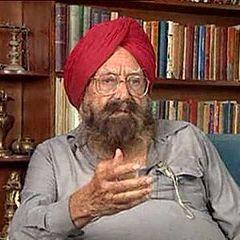
0 quotes

Related Quotes

“....they dressed for dinner and followed the strict discipline of upper class English families. The next morning they took me with them for the county fox hunt. Since I could not ride, I asked to be excused. But I did get to see the ritual of dress, the hierarchy observed among hunting types, the blowing of horns, the handling of beagles, a poor fox being run to death and having its tail (brush) cut off. Having achieved their object, glasses of sherry were passed round like prasad after a religious service.”

“Take art and music. Why has contemporary Indian painting, music, architecture and sculpture been such a flop? Because it keeps harking back to BC. Harking back would be all right if it did not become a pattern—a deadweight. If it does, then we are in a cul-de-sac of art forms. We explain the unattractive by pretending it is esoteric. Or we break out altogether—like modern Indian music of the films. It is all tango and rhumba or samba played on Hawaiian guitars, violins, accordions and clarinets. It is ugly. It must be scrapped like the rest.”

“Bombay, you will be told, is the only city India has, in the sense that the word city is understood in the West. Other Indian metropolises like Calcutta, Madras and Delhi are like oversized villages. It is true that Bombay has many more high-rise buildings than any other Indian city: when you approach it by the sea it looks like a miniature New York. It has other things to justify its city status: it is congested, it has traffic jams at all hours of the day, it is highly polluted and many parts of it stink.”

“Indians abroad tend to stick together. They join Indian clubs, regularly visit mosques, temples and gurdwaras and eat Indian food at home or in Indian restaurants. Very rarely do they mix with the English on the same terms as they do with their own countrymen. This kind of island-ghetto existence feeds on stereotypes - the English are very reserved; they do not invite outsiders to their homes because they regard their homes as their castles; English women are frigid, etc. I discovered that none of this was true. In the years that followed, I made closer friends with English men and women than I did with Indians. I lived in dozens of English homes and shared their family problems. And I discovered to my delight that nothing was further from the truth that the canard that English women are frigid.”

“To know India and her peoples, one has to know the monsoon. one has to know the monsoon. It is not enough to read about it in books, or see it on the cinema screen, or hear someone talk about it. It has to be a personal experience because nothing short of living through it can fully convey all it means to a people for whom it is not only the source of life, but also their most exciting impact with nature.”

“I was under police security for 15 years because I was on their hit-list. I opposed Khalistan because I thought it would be suicide for the Sikh community to demand a separate state, and they heard me because they knew I was one of them. I think I turned round at least the intelligent Sikh's point of view and that gave me enormous satisfaction.”

“I still think that the point of reference for every Indian when he is in doubt on any political or social issue is to say, "What would [Mahatma] Gandhi have done under the circumstances?" I didn't subscribe to his fads - prohibition, celibacy, no doctors - but generally he was always right. He meant more to me than any of my gurus.”

“I had lots of time to read [being a lawyer] what I hadn't read in my school and college days. Being a bad student I barely passed my exams and I barely bothered about books. It was sports all the time. I started reading and got involved in literature and writing. The few cases I handled gave me the material for my early short stories.”

“If you look at things as they are, there does not seem to be a code either of man or of God on which one can pattern one's conduct. Wrong triumphs over right as much as right over wrong. Sometimes its triumphs are greater. What happens ultimately, you do not know. In such circumstances what can you do but cultivate an utter indifference to all values? Nothing matters. Nothing whatever.”