Quotessence
Home / Authors / Martin Luther King, Jr.
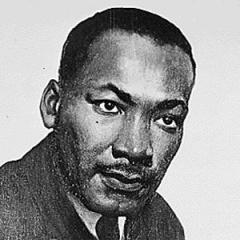
Martin Luther King, Jr.

Martin Luther King, Jr. Quotes

Civil rights activist

Filter quotes by topic

Famous Martin Luther King, Jr. Quotes

“The labor movement was the principal force that transformed misery and despair into hope and progress. Out of its bold struggles, economic and social reform gave birth to unemployment insurance, old age pensions, government relief for the destitute, and, above all, new wage levels that meant not mere survival but a tolerable life.”

“In our society it is murder, psychologically, to deprive a man of a job or an income. You are in substance saying to that man that he has no right to exist. You are in a real way depriving him of life, liberty, and the pursuit of happiness, denying in his case the very creed of his society.”

“The darkness of racial injustice will be dispelled only by the light of forgiving love. For more that three centuries American Negroes have been frustrated by day and bewilderment by night by unbearable injustice, and burdened with the ugly weight of discrimination. Forced to live with these shameful conditions, we are tempted to become bitter and retaliate with a corresponding hate. But if this happens, the new order we seek will be little more than a duplicate of the old order. We must in strength and humility meet hate with love.”

“We've been in the mountain of war. We've been in the mountain of violence. We've been in the mountain of hatred long enough. It is necessary to move on now, but only by moving out of this mountain can we move to the promised land of justice and brotherhood and the Kingdom of God. It all boils down to the fact that we must never allow ourselves to become satisfied with unattained goals. We must always maintain a kind of divine discontent.”

“They asked if our own nation wasn't using massive doses of violence to solve its problems, to bring about the changes it wanted. Their questions hit home, and I knew that I could never again raise my voice against the violence of the oppressed in the ghettos without having first spoken clearly to the greatest purveyor of violence in the world today-my own government. For the sake of those boys, for the sake of this government, for the sake of hundreds of thousands trembling under our violence, I cannot be silent.”

“There is something in this universe that justifies the biblical writer in saying, "You shall reap what you sow." This is a law-abiding universe. This is a moral universe. It hinges on moral foundations. If we are to make of this a better world, we've got to go back and rediscover that precious value that we've left behind.”

“The most dangerous type of atheism is not theoretical atheism, but practical atheism -that's the most dangerous type. And the world, even the church, is filled up with people who pay lip service to God and not life service. And there is always a danger that we will make it appear externally that we believe in God when internally we don't. We say with our mouths that we believe in him, but we live with our lives like he never existed. That is the ever-present danger confronting religion. That's a dangerous type of atheism.”

“You know, my friends, there comes a time when people get tired of being trampled over by the iron feet of oppression. There comes a time, my friends, when people get tired of being plunged across the abyss of humiliation, where they experience the bleakness of nagging despair. There comes a time when people get tired of being pushed out of the glittering sunlight of life’s July and left standing amid the piercing chill of an alpine November.”

“Whatever we do, we must keep God in the forefront. Let us be Christian in all of our actions. But I want to tell you this evening that it is not enough for us to talk about love, love is one of the pivotal points of the Christian face, faith. There is another side called justice. And justice is really love in calculation. Justice is love correcting that which revolts against love.”

“An individual has not begun to live until he can rise above the narrow horizons of his particular individualistic concerns to the broader concerns of all humanity. And this is one of the big problems of life, that so many people never quite get to the point of rising above self. And so they end up the tragic victims of self-centeredness. They end up the victims of distorted and disrupted personality.”

“My friends, all I'm trying to say is that if we are to go forward today, we've got to go back and rediscover some mighty precious values that we've left behind. That's the only way that we would be able to make of our world a better world, and to make of this world what God wants it to be and the real purpose and meaning of it.”

“The Christians who engaged in infamous persecutions and shameful inquisitions were not evil men but misguided men. The churchmen who felt they had an edict from God to withstand the progress of science, whether in the form of a Copernican revolution or a Darwinian theory of natural selection, were not mischievous men but misinformed men. And so Christ's words from the cross are written in sharp-edged terms across some of the most inexpressible tragedies of history: 'They know not what they do'.”

“We must work passionately and indefatigably to bridge the gulf between our scientific progress and our moral progress. One of the great problems of mankind is that we suffer from a poverty of the spirit which stands in glaring contrast to our scientific and technological abundance. The richer we have become materially, the poorer we have become morally and spiritually.”

“There is some good in the worst of us, and some evil in the best of us.”

“Somehow this madness must cease. We must stop now. I speak as a child of God and brother to the suffering poor of Vietnam. I speak for those whose land is being laid waste, whose homes are being destroyed, whose culture is being subverted. I speak for the poor in America who are paying the double price of smashed hopes at home and death and corruption in Vietnam. I speak as a citizen of the world, for the world as it stands aghast at the path we have taken. I speak as an American to the leaders of my own nation. The great initiative in this war is ours. The initiative to stop it must be ours.”

“I am disappointed with America. And there can be no great disappointment where there is not great love. I am disappointed with our failure to deal positively and forthrightly with the triple evils of racism, economic exploitation, and militarism. We are presently moving down a dead-end road that can lead to national disaster. America has strayed to the far country of racism and militarism.”

“Many of the ugly pages of American history have been obscured and forgotten. A society is always eager to cover misdeeds with a cloak of forgetfulness, but no society can fully repress an ugly past when the ravages persist into the present. America owes a debt of justice which it has only begun to pay. If it loses the will to finish or slackens in its determination, history will recall its crimes and the country that would be great will lack the most indispensable element of greatness — justice.”

“The majority of the Negroes who took part in the year-long boycott of Montgomery's buses were poor and untutored; but they understood the essence of the Montgomery movement; one elderly woman summed it up for the rest. When asked after several weeks of walking whether she was tired, she answered: "My feet is tired, but my soul is at rest.”

“Even when the polls are open to all, Negroes have shown themselves too slow to exercise their voting privileges. There must be a concerted effort on the part of Negro leaders to arouse their people from their apathetic indifference.... In the past, apathy was a moral failure. Today, it is a form of moral and political suicide.”

“As I like to say to the people in Montgomery: "The tension in this city is not between white people and Negro people. The tension is, at bottom, between justice and injustice, between the forces of light and the forces of darkness.”

“There is such a thing as the freedom of exhaustion. Some people are so worn down by the yoke of oppression that they give up. [...] The oppressed must never allow the conscience of the oppressor to slumber. [...] To accept injustice or segregation passively is to say to the oppressor that his actions are morally right.”

“I will always remember my delight when Mrs. Georgia Gilmore - an unlettered woman of unusual intelligence - told how an operator demanded that she get off the bus after paying her fare and board it again by the back door, and then drove away before she could get there. She turned to Judge Carter and said: "When they count the money, they do not know Negro money from white money.”