Quotessence
Home / Authors / Milton Friedman
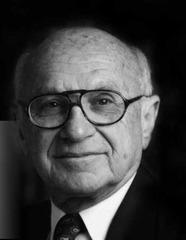
Milton Friedman

Milton Friedman Quotes

Economist

Filter quotes by topic

Famous Milton Friedman Quotes

“The strongest argument for free enterprise is that it prevents anybody from having too much power. Whether that person is a government official, a trade union official, or a business executive. If forces them to put up or shut up. They either have to deliver the goods, produce something that people are willing to pay for, are willing to buy, or else they have to go into a different business.”

“Government power must be dispersed. If government is to exercise power, better in the county than in the state, better in the state than in Washington. If I do not like what my local community does, be it in sewage disposal, or zoning, or schools, I can move to another local community, and though few may take this step, the mere possibility acts as a check. If I do not like what Washington imposes, I have few alternatives in this world of jealous nations.”

“If the government is to try and ban private consumption of alcohol and tobacco, it must surely ban such activities as hang-gliding, skiing, rock-climbing and so on. Where should it stop? Rugby? American Football? Ice Hockey? Insofar as the government has information not generally available about the merits or demerits of the items we ingest or the activities we engage in, let it give us the information. But let it leave us free to choose what chances we want to take with our own lives.”

“The argument for collectivism is simple if false; it is an immediate emotional argument. The argument for individualism is subtle and sophisticated; it is an indirect rational argument. And the emotional faculties are more highly developed in most men than the rational, paradoxically or especially even in those who regard themselves as intellectuals.”

“If, for example, existing government intervention is minor, we shall attach a smaller weight to the negative effect of additional government intervention. This is an important reason why many earlier liberals, like Henry Simons, writing at a time when government was small by today's standards, were willing to have government undertake activities that today's liberals would not accept now that government has become so overgrown.”

“. . . it is worth discussing radical changes, not in the expectation that they will be adopted promptly but for two other reasons. One is to construct an ideal goal, so that incremental changes can be judged by whether they move the institutional structure toward or away from that ideal. The other reason is very different. It is so that if a crisis requiring or facilitating radical change does arise, alternatives will be available that have been carefully developed and fully explored.”