Quotessence
Home / Authors / Milton Friedman
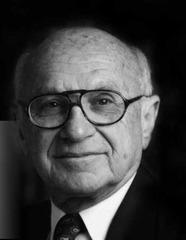
Milton Friedman

Milton Friedman Quotes

Economist

Filter quotes by topic

Famous Milton Friedman Quotes

“Central bankers always try to avoid their last big mistake. So every time there's the threat of a contraction in the economy, they'll over stimulate the economy, by printing too much money. The result will be a rising roller coaster of inflation, with each high and low being higher than the preceding one.”

“For one thing, there are many "inventions" that are not patentable. The "inventor" of the supermarket, for example, conferred great benefits on his fellowmen for which he could not charge them. Insofar as the same kind of ability is required for the one kind of invention as for the other, the existence of patents tends to divert activity to patentable inventions.”

“All of the progress that the US has made over the last couple of centuries has come from unemployment. It has come from figuring out how to produce more goods with fewer workers, thereby releasing labor to be more productive in other areas. It has never come about through permanent unemployment, but temporary unemployment, in the process of shifting people from one area to another.”

“The great virtue of a free market system is that it does not care what color people are; it does not care what their religion is; it only cares whether they can produce something you want to buy. It is the most effective system we have discovered to enable people who hate one another to deal with one another and help one another.”

“Keynes was a great economist. In every discipline, progress comes from people who make hypotheses, most of which turn out to be wrong, but all of which ultimately point to the right answer. Now Keynes, in 'The General Theory of Employment, Interest and Money,' set forth a hypothesis which was a beautiful one, and it really altered the shape of economics. But it turned out that it was a wrong hypothesis. That doesn't mean that he wasn't a great man!”

“Fundamentally, there are only two ways of coordinating the economic activities of millions. One is central direction involving the use of coercion - the technique of the army and of the modern totalitarian state. The other is voluntary cooperation of individuals - the technique of the marketplace.”

“The high rate of unemployment among teenagers, and especially black teenagers, is both a scandal and a serious source of social unrest. Yet it is largely a result of minimum wage laws. We regard the minimum wage law as one of the most, if not the most, anti-black laws on the statute books.”

“Consider Social Security. The young have always contributed to the support of the old. Earlier, the young helped their own parents out of a sense of love and duty. They now contribute to the support of someone else's parents out of compulsion and fear. The voluntary transfers strengthened the bonds of the family; the compulsory transfers weaken those bonds.”

“When everybody owns something, nobody owns it, and nobody has a direct interest in maintaining or improving its condition. That is why buildings in the Soviet Union - like public housing in the United States - look decrepit within a year or two of their construction.”

“Nobody spends somebody else's money as carefully as he spends his own. Nobody uses somebody else's resources as carefully as he uses his own. So if you want efficiency and effectiveness, if you want knowledge to be properly utilized, you have to do it through the means of private property.”

“The great danger to the consumer is the monopoly -whether private or governmental. His most effective protection is free competition at home and free trade throughout the world. The consumer is protected from being exploited by one seller by the existence of another seller from whom he can buy and who is eager to sell to him. Alternative sources of supply protect the consumer far more effectively than all the Ralph Naders of the world.”