Quotessence
Home / Authors / Milton Friedman
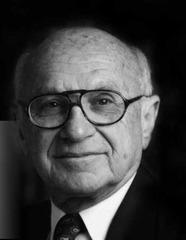
Milton Friedman

Milton Friedman Quotes

Economist

Filter quotes by topic

Famous Milton Friedman Quotes

“If we have system in which government is in a position to give large favor - it's human nature to try to get this favor - whether those people are large enterprises, or whether they're small businesses like farmers, or whether they're representatives of any other special group. The only way to prevent that is to force them to engage in competition one with the other.”

“If you spend your own money on yourself, you care how much you spend and how well you spend it. If you spend your own money on someone else, you care how much you spend, but you don't care how well it is spent. If you spend someone else's money on yourself, you don't care how much you spend, but you do care how well it is spent. And finally, if you spend someone else's money on someone else, you don't care how much you spend, and you don't care how well it is spent. That is government.”

“The lesson for Asia is; if you have a central bank, have a floating exchange rate; if you want to have a fixed exchange rate, abolish your central bank and adopt a currency board instead. Either extreme; a fixed exchange rate through a currency board, but no central bank, or a central bank plus truly floating exchange rates; either of those is a tenable arrangement. But a pegged exchange rate with a central bank is a recipe for trouble.”

“If the US government spends 40 percent of the nation's income, as it does through either borrowing or taxes, that income is not available for people to spend. The deficit is an indirect method of taxation. Of course, politicians prefer to borrow instead of tax because then someone down the road has to deal with the consequences.”

“The important issue is not how much inequality there is but how much opportunity there is for individuals to get out of the bottom classes and into the top. If there is enough movement upward, people will accept the efficiency of the markets. If you have opportunity, there is a great tolerance for inequality. That has been the saving grace of the American system.”

“If capitalism worked as the socialists think an economic system ought to work, and provided a constant equality of living conditions for all, regardless of whether a man was able or not, resourceful or not, diligent or not, thrifty or not, if capitalism put no premiums on resourcefulness and effort and not penalty on idleness or vice, it would produce only an equality of destitution.”

“If instead of looking at income, you look at levels of consumption, if anything that's become more equal. The fraction of families that have a dishwasher, that have a sewing machine, that have a television set. In respect to consumption, it's very hard to avoid the view that people have been getting more equal rather than more unequal.”

“Why have we had such a decline in moral climate? I submit to you that a major factor has been a change in the philosophy which has been dominant, a change from belief in individual responsibility to belief in social responsibility. If you adopt the view that a man is not responsible for his own behavior, that somehow society is responsible, why should he seek to make his behavior good?”

“For example, the supporters of tariffs treat it as self-evident that the creation of jobs is a desirable end, in and of itself, regardless of what the persons employed do. That is clearly wrong. If all we want are jobs, we can create any number--for example, have people dig holes and then fill them up again, or perform other useless tasks. Work is sometimes its own reward. Mostly, however, it is the price we pay to get the things we want. Our real objective is not just jobs but productive jobs--jobs that will mean more goods and services to consume.”

“Now here's somebody who wants to smoke a marijuana cigarette. If he's caught, he goes to jail. Now is that moral? Is that proper? I think it's absolutely disgraceful that our government, supposed to be our government, should be in the position of converting people who are not harming others into criminals, of destroying their lives, putting them in jail. That's the issue to me. The economic issue comes in only for explaining why it has those effects. But the economic reasons are not the reasons.”

“The key insight of Adam Smith's Wealth of Nations is misleadingly simple: if an exchange between two parties is voluntary, it will not take place unless both believe they will benefit from it. Most economic fallacies derive from the neglect of this simple insight, from the tendency to assume that there is a fixed pie, that one party can gain only at the expense of another.”

“I want people to take thought about their condition and to recognize that the maintainence of a free society is a very difficult and complicated thing and it requires a self-denying ordinance of the most extreme kind. It requires a willingness to put up with temporary evils on the basis of the subtle and sophisticated understanding that if you step in to do something about them you not only may make them worse, you will spread your tenticles and get bad results elsewhere.”

“The power to determine the quantity of money... is too important, too pervasive, to be exercised by a few people, however public-spirited, if there is any feasible alternative. There is no need for such arbitrary power... Any system which gives so much power and so much discretion to a few men, [so] that mistakes - excusable or not - can have such far reaching effects, is a bad system. It is a bad system to believers in freedom just because it gives a few men such power without any effective check by the body politic - this is the key political argument against an independent central bank.”

“The high rate of unemployment among teenagers, and especially black teenagers, is both a scandal and a serious source of social unrest. Yet it is largely a result of minimum wage laws. We regard the minimum wage law as one of the most, if not the most, anti-black laws on the statute books.”

“Nobody spends somebody else's money as carefully as he spends his own. Nobody uses somebody else's resources as carefully as he uses his own. So if you want efficiency and effectiveness, if you want knowledge to be properly utilized, you have to do it through the means of private property.”

“Because it is one thing to have free immigration to jobs. It is another thing to have free immigration to welfare. And you cannot have both. If you have a welfare state, if you have a state in which every resident is promises a certain minimal level of income, or a minimum level of subsistence, regardless of whether he works or not, produces it or not. Then it really is an impossible thing.”

“If you have free immigration, in the way we had it before 1914, everybody benefited. The people who were here benefited. The people who came benefited. Because nobody would come unless he, or his family, thought he would do better here than he would elsewhere. And, the new immigrants provided additional resources, provided additional possibilities for the people already here. So everybody can mutually benefit.”

“But on the other hand, if you come under circumstances where each person is entitled to a pro-rata share of the pot, to take an extreme example, or even to a low level of the pie, than the effect of that situation is that free immigration, would mean a reduction of everybody to the same, uniform level. Of course, I'm exaggerating, it wouldn't go quite that far, but it would go in that direction. And it is that perception, that leads people to adopt what at first seems like inconsistent values.”

“There is still a tendency to regard any existing government intervention as desirable, to attribute all evils to the market, and to evaluate new proposals for government control in their ideal form, as they might work if run by able, disinterested men free from the pressure of special interest groups.”