Quotessence
Home / Authors / Paul Saffo Books
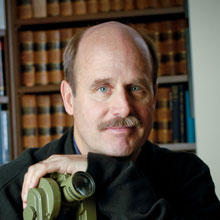
Paul Saffo

Paul Saffo Books

Professor

No books found for this author.

Related Quotes

“I think of futurists as people who have a particular attitude about the future. They're advocates for a certain kind of outcome. As a forecaster I am something very different. I am a professional bystander. I have opinions about the future, of course. But my whole posture is to be detached and to identify what I think will happen and not allow my judgments of what should happen to get involved.”

“I can't imagine how you can find the discipline to be emotionally detached reporting on a revolution, the winds of which are blowing right down the hallways of the publication you work for. That's like an orthopedic surgeon trying to perform arthroscopic surgery on their own knee. It's possible, but it's hard to see through all the pain.”

“The arrival of television established a mass-media order that dominated the last 50 years. This is a personal media revolution. The distinction between the old order and the new order is very important. Television delivered the world to our living room. In the old media, all we could do was press our noses against the glass and watch.”

“We've become more and more interrupt-driven. If you have six tasks to do in an hour, you can't just take 60 minutes and divide and have 10 minutes per task. You have 10 minutes per task minus the time required for context-shifting. That will be the next big challenge: figuring out how to fight the distraction-driven mode we're in and stay focused on one thing long enough to get it done.”

“Every new thing upsets people. We all know someone that has a teenage kid who sits in the room and the television is on, their iPod is on, they have the computer on and at least three other electronic devices going while they're doing their homework. It drives the dad nuts, but he can't complain because the kid's a 4.1 (GPA) student.”

“Think about reading: Today, parents would love it if their kids read books more because the parents understand the books. Just over 100 years ago, parents were upset because their kids were reading dime-store novels. Parents would say, "I don't want you inside reading anymore. Get outside and play." I guarantee you, in 50 years or so, parents are going to say, "You're not going outside to play until you finish that video game."”

“I think it was Samuel Johnson who said, "There are two kinds of information in this world: that what you know and that what you know where to get." The tools help the latter, and that's what keeps us from going nuts. The sense of overload comes from the gap between that sudden jump in volume (of information) and the tools we have to make sense of it.”

“As a global society we are performing a great experiment on ourselves. Half of the world population wants to race faster into the future. Go visit China and India. They're ready to go. And half of the world wants to drag us into the past. The problem is both sides have guns. I think there really is a reaction. A lot of people are saying enough is enough.”

“As recently as the '70s, people were forced to see information that they didn't agree with in newspapers and the like. Now there is so much information you really can build your own walled garden that just has the stuff that reinforces your view. I think it applies to all of us. People are really going into these separate camps, and that's the big social challenge in this age of too much information. How do we crack that and create a common dialogue?”

“People were touchingly naive at the dawn of the Internet revolution when they said the Internet will route around censorship the way it routes around damage. With any revolution, the establishment catches up and figures out how to screw it up. The answer is to keep technology advancing fast enough so that those who would try to control it can't. It's up to people to defend what they care about. We shouldn't be complacent that this stuff is going to be a force for good.”

“If you look at the last 150 years, about every 30 years or so, a new scientific discipline emerges that starts spinning out technologies and capturing people's imaginations. Go back to 1900: That industry was chemistry. People had chemistry sets. In the 1930s, it was the rise of physics and physicists. They build on each other. Chemists laid the experimental understanding for the physicists to build their theories. It was three physicists who invented the transistor in 1947. That started the information revolution. Today, kids get computers.”

“As Stewart Brand (co-founder of Emeryville's Global Business Network) likes to say, "Information lasts forever. Digital information lasts forever or for five years, whichever comes first." There are examples everywhere. The tapes from the original Viking landers that went to Mars are at (NASA's) Jet Propulsion Laboratory, but there is no machine that can read the tapes.”

“The difference between our collective generation and your generation (differentiating the reporters from the students) is that we poured our souls out on paper that got easily yellowed and lost. The danger is that many of your friends (nodding at the students) are putting intimate ideas in cyberspace journals. So when today's 15-year-old is 40, some friend is going to drag out all of that idiotic stuff at their class reunion.”

“I would say digital technology probably doesn't have much impact on us so far. We've seen photographs of people from when they are alive. We see home movies. We have videotapes now and e-mails. When it's going to get interesting is in massively multiplayer online games where you have avatars (online personas). You could actually create an avatar that's semi-autonomous. It could do things for you while you get off the game to run the rest of your life.”

“Take cyberspace as an example. We had this wonderful utopian vision of a new home for the mind. What we've reaped isn't cyberspace. It's cyberbia. It's this vast, bland wasteland of vulgar people and trivial ideas and pictures of half-naked starlets. But despite all the uncertainty, has there ever been a more fascinating moment to be alive?”

“The most important thing that a company can do in the midst of this economic turmoil is to not lose sight of the long-term perspective. Don't confuse the short-term crises with the long-term trends. Amidst all of these short-term change are some fundamental structural transformations happening in the economy, and the best way to stay in business is to not allow the short-term distractions to cause you to ignore what is happening in the long term.”

“When everybody else is in a down market is focusing on what they're doing wrong, instead focus on what you should be doing differently, it may be that what you did in the past was perfectly right. It is possible to do all the right things in business and still have a business crisis because of what's happening in the external environment. And if you start focusing on mistakes only, you're going to miss opportunities.”