Quotessence
Home / Authors / Rabindranath Tagore
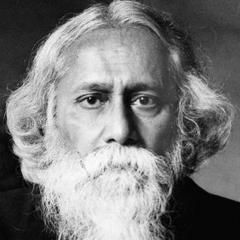
Rabindranath Tagore

Rabindranath Tagore Quotes

Author

Filter quotes by topic

Famous Rabindranath Tagore Quotes

“In learning a language, when from mere words we reach the laws of words, we have gained a great deal. But if we stop at that point and concern ourselves only with the marvels of the formation of a language, seeking the hidden reason of all its apparent caprices, we do not reach that end, for grammar is not literature… When we come to literature, we find that, though it conforms to the rules of grammar, it is yet a thing of joy; it is freedom itself. The beauty of a poem is bound by strict laws, yet it transcends them. The laws are its wings. They do not keep it weighed down. They carry it to freedom. Its form is in law, but its spirit is in beauty. Law is the first step toward freedom, and beauty is the complete liberation which stands on the pedestal of law. Beauty harmonizes in itself the limit and the beyond – the law and the liberty.”

“Let all the strains of joy mingle in my last song—the joy that makes the earth flow over in the riotous excess of the grass, the joy that sets the twin brothers, life and death, dancing over the wide world, the joy that sweeps in with the tempest, shaking and waking all life with laughter, the joy that sits still with its tears on the open red lotus of pain, and the joy that throws everything it has upon the dust, and knows not a word.”

“মম চিত্তে নিতি নৃত্যে কে যে নাচে তাতা থৈথৈ, তাতা থৈথৈ, তাতা থৈথৈ। তারি সঙ্গে কী মৃদঙ্গে সদা বাজে তাতা থৈথৈ তাতা থৈথৈ তাতা থৈথৈ॥ হাসিকান্না হীরাপান্না দোলে ভালে, কাঁপে ছন্দে ভালোমন্দ তালে তালে, নাচে জন্ম নাচে মৃত্যু পাছে পাছে, তাতা থৈথৈ, তাতা থৈথৈ, তাতা থৈথৈ। কী আনন্দ, কী আনন্দ, কী আনন্দ দিবারাত্রি নাচে মুক্তি নাচে বন্ধ-- সে তরঙ্গে ছুটি রঙ্গে পাছে পাছে তাতা থৈথৈ, তাতা থৈথৈ, তাতা থৈথৈ॥”

“According to the true Indian view, our consciousness of the world, merely as the sum total of things that exist, and as governed by laws, is imperfect. But it is perfect when our consciousness realizes all things as spiritually one with it, and therefore capable of giving us joy. For us the highest purpose of this world is not merely living in it, knowing it and making use of it, but realizing our own selves in it through expansion of sympathy; not alienating ourselves from it and dominating it, but comprehending and uniting it with ourselves in perfect union.”

“Joy is there everywhere; it is superfluous, unnecessary; nay, it very often contradicts the most peremptory behests of necessity. It exists to show that the bonds of law can only be explained by love; they are like body and soul. Joy is the realisation of the truth of oneness, the oneness of our soul with the world and of the world-soul with the supreme lover.”

“Where is heaven? you ask me, my child,-the sages tell us it is beyond the limits of birth and death, unswayed by the rhythm of day and night; it is not of the earth. But your poet knows that its eternal hunger is for time and space, and it strives evermore to be born in the fruitful dust. Heaven is fulfilled in your sweet body, my child, in your palpitating heart. The sea is beating its drums in joy, the flowers are a-tiptoe to kiss you. For heaven is born in you, in the arms of the mother- dust.”

“Give Me Strength This is my prayer to thee, my lord---strike, strike at the root of penury in my heart. Give me the strength lightly to bear my joys and sorrows. Give me the strength to make my love fruitful in service. Give me the strength never to disown the poor or bend my knees before insolent might. Give me the strength to raise my mind high above daily trifles. And give me the strength to surrender my strength to thy will with love.”

“If someone smells a flower and says he does not understand, the reply to him is: there is nothing to understand, it is only a scent. If he persists, saying: that I know, but what does it all mean? Then one has either to change the subject, or make it more abstruse by saying that the scent is the shape which the universal joy takes in the flower.”

“Who are you, reader, reading my poems an hundred years hence? I cannot send you one single flower from this wealth of the spring, one single streak of gold from yonder clouds. Open your doors and look abroad. From your blossoming garden gather fragrant memories of the vanished flowers of an hundred years before. In the joy of your heart may you feel the living joy that sang one spring morning, sending its glad voice across a hundred years.”

“Things in which we do not take joy are either a burden upon our minds to be got rid of at any cost; or they are useful, and therefore in temporary and partial relation to us, becoming burdensome when their utility is lost; or they are like wandering vagabonds, loitering for a moment on the outskirts of our recognition, and then passing on. A thing is only completely our own when it is a thing of joy to us.”

“Plant flowers in others' gardens and your life becomes a bouquet! Submitted by Lisa Letto, Coordinator, Nutrition Resource and Volunteer Centre, College of Pharmacy and Nutrition, University of Saskatchewan, Saskatchewan, Canada I slept and I dreamed that life is all joy, I woke and I saw that life is all service. I served and I saw that service is joy.”

“Joy is everywhere; it is in the earth's green covering of grass: in the blue serenity of the sky: in the reckless exuberance of spring: in the severe abstinence of grey winter: in the living flesh that animates our bodily frame: in the perfect poise of the human figure, noble and upright: in living, in the exercise of all our powers: in the acquisition of knowledge. . . Joy is there everywhere.”