Quotessence
Home / Authors / Sogyal Rinpoche
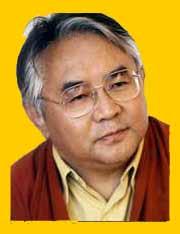
Sogyal Rinpoche

Sogyal Rinpoche Quotes

Lama

Filter quotes by topic

Famous Sogyal Rinpoche Quotes

“We often wonder: "How will I be when I die?" The answer to that is that whatever state of mind we are in now, whatever kind of person we are now, that's what we will be like at the moment of death, if we do not change. This is why it is so absolutely important to use this lifetime to purify our mindstream, and so our basic being and character, while we can.”

“Switch on the television or glance at the newspaper: You will see death everywhere. Yet, did the victims of those plane crashes and car accidents expect to die? They took life for granted, as we do. How often do we hear stories of people whom we know, or even friends, who died unexpectedly? We don't even have to be ill to die: Our bodies can suddenly break down and go out of order, just like our cars. We can be quite well one day, then fall sick and die the next.”

“At every moment in our lives we need compassion, but what more urgent moment could there be than when we are dying? What more wonderful and consoling gift could you give to dying people than the knowledge that they are being prayed for, and that you are taking on their suffering and purifying their negative karma through your practice for them?”

“I remember how people would often come to see my master Jamyang Khyentse simply to ask for his guidance for the moment of death. He was so loved and revered throughout Tibet, especially in the eastern province of Kham, that some would travel for months on end to meet him and get his blessing just once before they died. All my masters would give this as their advice, for this is the essence of what is needed as you come to die: "Be free of attachment and aversion. Keep your mind pure. And unite your mind with Buddha."”

“There would be no chance at all of getting to know death if it happened only once. But fortunately, life is nothing but a continuing dance of birth and death, a dance of change. Every time I hear the rush of a mountain stream, or the waves crashing on the shore, or my own heartbeat, I hear the sound of impermanence. These changes, these small deaths, are our living links with death. They are death's pulses, death's heartbeat, prompting us to let go of all the things we cling to.”

“If all we know of mind is the aspect of mind that dissolves when we die, we will be left with no idea of what continues, no knowledge of the new dimension of the deeper reality of the nature of mind. So it is vital for us all to familiarize ourselves with the nature of mind while we are still alive. Only then will we be prepared for the time when it reveals itself spontaneously and powerfully at the moment of death; be able to recognize it "as naturally," the teachings say, "as a child running into its mother's lap"; and by remaining in that state, finally be liberated.”

“For most of us, karma and negative emotions obscure the ability to see our own intrinsic nature, and the nature of reality. As a result we clutch on to happiness and suffering as real, and in our unskillful and ignorant actions go on sowing the seeds of our next birth. Our actions keep us bound to the continuous cycle of worldly existence, to the endless round of birth and death. So everything is at risk in how we live now at this very moment: How we live now can cost us our entire future.”

“This is the real and urgent reason why we must prepare now to meet death wisely, to transform our karmic future, and to avoid the tragedy of falling into delusion again and again and repeating the painful round of birth and death. This life is the only time and place we can prepare in, and we can only truly prepare through spiritual practice: This is the inescapable message of the natural bardo of this life.”

“At the moment of death, there are two things that count: whatever we have done in our lives, and what state of mind we are in at that very moment. Even if we have accumulated a lot of negative karma, if we are able to make a real change of heart at the moment of death, it can decisively influence our future, and transform our karma, for the moment of death is an exceptionally powerful opportunity to purify karma.”

“Ask yourself these two questions: Do I remember at every moment that I am dying, and that everyone and everything else is, and so treat all beings at all times with compassion? Has my understanding of death and impermanence become so keen and so urgent that I am devoting every second to the pursuit of enlightenment? If you can answer "yes" to both of these, then you really understand impermanence.”

“What is born will die, What has been gathered will be dispersed, What has been accumulated will be exhausted, What has been built up will collapse, And what has been high will be brought low.”

“Devotion {to the spiritual master} becomes the purest, quickest, and simplest way to realize the nature of our mind and all things. As we progress in it, the process reveals itself as wonderfully interdependent: We, from our side, try continually to generate devotion; the devotion we arouse itself generates glimpses of the nature of mind, and these glimpses only enhance and deepen our devotion to the master who is inspiring us. So in the end devotion springs out of wisdom: devotion and the living experience of the nature of mind becomes inseparable, and inspire one another.”

“Don't you notice that there are particular moments when you are naturally inspired to introspection? Work with them gently, for these are the moments when you can go through a powerful experience, and your whole worldview can change quickly.”

“Modern society seems to be a celebration of all the things that lead away from the Truth, make Truth hard to live for, and discourage people from even believing that it exists. And to think that all this springs from a civilization that claims to adore life, but actually starves it of any real meaning; that endlessly speaks of making people “happy”, but in fact blocks their way to the source of real joy.”

“Without our familiar props, we are faced with just ourselves, a person we do not know, an unnerving stranger with whom we have been living all the time but we never really wanted to meet. Isn't that why we have tried to fill every moment of time with noise and activity, however boring or trivial, to ensure that we are never left in silence with this stranger on our own?”

“. . . when the nature of mind is introduced by a master, it is just too simple for us to believe. Our ordinary mind tells us this cannot be, there must be something more to it than this. It must surely be more "glorious", with light blazing in space around us, angels with flowing golden hair swooping down to meet us, and a deep Wizard of Oz voice announcing, "Now you have been introduced to the nature of your mind." There is no such drama.”

“The point is not how long you meditate; the point is whether the practice actually brings you to a certain state of mindfulness and presence, where you are a little open and able to connect with your heart essence. And five minutes of wakeful sitting practice is of far greater value than twenty minutes of dozing!”

“So often we want happiness, but the very way we pursue it is so clumsy and unskillful that it brings only more sorrow. Usually we assume we must grasp in order to have that something that will ensure our happiness. [...] Learning to live is learning to let go.”

“Quoting Dudjom Rinpoche on the buddha-nature: No words can describe it No example can point to it Samsara does not make it worse Nirvana does not make it better It has never been born It has never ceased It has never been liberated It has never been deluded It has never existed It has never been nonexistent It has no limits at all It does not fall into any kind of category”

“{While meditating} I sit quietly and rest in the nature of mind; I don't question or doubt whether I am in the "correct" state or not. There is no effort, only rich understanding, wakefulness, and unshakable certainty. When I am in the nature of mind, the ordinary mind is no longer there. There is no need to sustain or confirm a sense of being: I simply am.”

“In the Buddhist approach, life and death are seen as one whole, where death is the beginning of another chapter of life. Death is the mirror in which the entire meaning of life is reflected.”

“To be a spiritual warrior means to develop a special kind of courage, one that is innately intelligent, gentle, and fearless. Spiritual warriors can still be frightened, but even so they are courageous enough to taste suffering, to relate clearly to their fundamental fear, and to draw out without evasion the lessons from difficulties.”