Quotessence
Home / Authors / Terry Tempest Williams Books
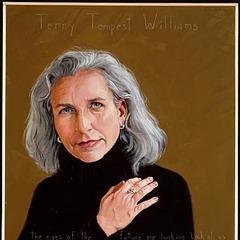
Terry Tempest Williams

Terry Tempest Williams Books

Author

Leap

A source page for quotes linked to Terry Tempest Williams.
0 quotes

Related Quotes

“What is it about the relationship of a mother that can heal or hurt us? Her womb is the first landscape we inhabit. It is here we learn to respond - to move, to listen, to be nourished and grow. In her body we grow to be human as our tails disappear and our gills turn to lungs. Our maternal environment is perfectly safe - dark, warm, and wet. It is a residency inside the Feminine. When we outgrow our mother's body, our cramps become her own. We move. She labors. Our body turns upside down in hers as we journey through the birth canal. She pushes in pain. We emerge, a head. She pushes one more time, and we slide out like a fish. Slapped on the back by the doctor, we breath. The umbilical cord is cut - not at our request. Separation is immediate. A mother reclaims her body, for her own life. Not ours. Minutes old, our first death is our own birth.”

“It's strange how deserts turn us into believers. I believe in walking in a landscape of mirages, because you learn humility. I believe in living in a land of little water because life is drawn together. And I believe in the gathering of bones as a testament to spirits that have moved on. If the desert is holy, it is because it is a forgotten place that allows us to remember the sacred. Perhaps that is why every pilgrimage to the desert is a pilgrimage to the self.”

“The creative process ignites our imagination, and I believe that that same imagination is what will propel us forward with issues of social change. I do think we have to acknowledge that we are a very capitalistic and consumptive nation, and that talk about conservation or issues of sustainability is never going to be popular with the dominant culture because it means checks and balances on an economy that is reserved for the dollar, rather than an economy that honors and respects spiritual resources and the right of all life to participate on the planet, not just our species.”

“There is something very sensual about a letter. The physical contact of pen to paper, the time set aside to focus thoughts, the folding of the paper into the envelope, licking it closed, addressing it, a chosen stamp, and then the release of the letter to the mailbox - are all acts of tenderness.”

“A mother and daughter are an edge. Edges are ecotones, transitional zones, places of danger or opportunity. House-dwelling tension. When I stand on the edge of the land and sea, I feel this tension, this fluid line of transition. High tide. Low tide. It is the sea's reach and retreat that reminds me we have been human for only a very short time.”

“The sin we commit against each other as women is lack of support. We hurt. We hurt each other. We hide. We project. We become mute or duplicitous, and we fester like boiling water until one day we erupt like a geyser. Do we forget we unravel in grief?”

“John Lilly suggests whales are a culture maintained by oral traditions. Stories. The experience of an individual whale is valuable to the survival of its community. I think of my family stories-Mother's in particular-how much I need them now, how much I will need them later. It has been said when an individual dies, whole worlds die with them. The same could be said of each passing whale.”

“I think an erotics of place may be one of the reasons why environmentalists are seen as subversive. There is a backlash now:... [ellipsis in source] take all the regulations away; weaken existing legislation; the endangered species act is too severe, too restrictive; let there be carte blanche for real-estate developers. Because if we really have to confront wildness, solitude, and serenity, both the fierceness and compassionate nature of the land, then we ultimately have to confront it in ourselves, and it's easier to be numb, to be distracted, to be disengaged.”

“I am obsessed by the idea of silence. I went through an entire library studying art, artists and their critics, philosophers, too, on the meaning and significance of the color white. I dreamed of white birds and white bears. I thought about the white pages of my mother's journals. I became enthralled with John Cage and his work, 4'33”, his masterpiece of ambient sound. Rauschenberg, too. And then at some point I let go. What sticks to the soul is what gets placed on the page. Maybe that's the unknown part, the mystery, the power of the empty page.”

“Well, we are Americans. I've always believed that you work with where you are - I am a Mormon woman who was raised on the edge of the Great Salt Lake in the American West in the United States of America. But, by the same token, much of my life has been spent resisting traditional forms of democracy, resisting traditional forms of orthodoxy, be it the United States government or the Mormon Church.”