Quotessence
Home / Authors / Terry Tempest Williams
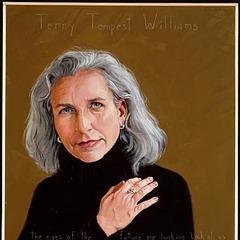
Terry Tempest Williams

Terry Tempest Williams Quotes

Author

Filter quotes by topic

Famous Terry Tempest Williams Quotes

“The creative process ignites our imagination, and I believe that that same imagination is what will propel us forward with issues of social change. I do think we have to acknowledge that we are a very capitalistic and consumptive nation, and that talk about conservation or issues of sustainability is never going to be popular with the dominant culture because it means checks and balances on an economy that is reserved for the dollar, rather than an economy that honors and respects spiritual resources and the right of all life to participate on the planet, not just our species.”

“John Lilly suggests whales are a culture maintained by oral traditions. Stories. The experience of an individual whale is valuable to the survival of its community. I think of my family stories-Mother's in particular-how much I need them now, how much I will need them later. It has been said when an individual dies, whole worlds die with them. The same could be said of each passing whale.”

“I think an erotics of place may be one of the reasons why environmentalists are seen as subversive. There is a backlash now:... [ellipsis in source] take all the regulations away; weaken existing legislation; the endangered species act is too severe, too restrictive; let there be carte blanche for real-estate developers. Because if we really have to confront wildness, solitude, and serenity, both the fierceness and compassionate nature of the land, then we ultimately have to confront it in ourselves, and it's easier to be numb, to be distracted, to be disengaged.”

“I think it could be argued that I am not heard, in the broadest sense. That is not my concern. My concern, a question really, is, do I have the courage to speak? If I speak I believe someone will respond. It then becomes my responsibility to listen to that person. And in listening, together we create a space where people can be heard. It's the conversation that I care most deeply about; this is the space I want to honor, respect, and protect. This is my faith in the open space of democracy.”

“I know the struggle from the inside out and I would never be so bold as to call myself a writer. I think that is what other people call you. But I consider myself a member of a community in Salt Lake City, in Utah, in the American West, in this country. And writing is what I do. That is the tool out of which I can express my love.”

“When I'm standing in the middle of the salt flats, where you swear that the pupils of your eyes have turned white because of the searing heat that is rising from the desert, I think of my childhood, I think of my mother, my father, my grandparents; I think of the history that we hold there and it is beautiful to me. But it is both a blessing and a burden to be rooted in place. It's recognizing the pattern of things, almost feeling a place before you even see it. In Southern Utah, on the Colorado plateau where canyon walls rise upward like praying hands, that is a holy place to me.”

“I think community is a shared history, it's a shared experience. It's not always agreement. In fact, I think that often it isn't. It's the commitment, again, to stay with something - to go the duration. You can't walk away. It's like a marriage, only I think it's more difficult to divorce yourself from community than it is to a human being because the strands are interconnected and so various.”

“When Pico [Iyer] talks about home being a place of isolation, I think he's right. But it's the paradox. I think that's why I so love Great Salt Lake. Every day when I look out at that lake, I think, "Ah, paradox" - a body of water than no one can drink. It's the liquid lie of the desert. But I think we have those paradoxes within us and certainly the whole idea of home is windswept with paradox.”

“I think that what I was talking about was that as a woman growing up in a Mormon tradition in Salt Lake City, Utah, we were taught - and we are still led to believe - that the most important value is obedience. But that obedience in the name of religion or patriotism ultimately takes our souls. So I think it's this larger issue of what is acceptable and what is not; where do we maintain obedience and law and where do we engage in civil disobedience - where we can cross the line physically and metaphorically and say, "No, this is no longer appropriate behavior."”

“I wonder, What is it to be human? Especially now that we are so urban. How do we remember our connection with place? What is the umbilical cord that roots us to that primal, instinctive, erotic place? Every time I walk to the edge of this continent and feel the sand beneath my feet, feel the seafoam move up my body, I think, "Ah, yes, evolution." It's there, we just forget.”

“I think we have powerful role-models among us in the American West. Certainly the Hopis, a timeless civilization that understands sustainability and what that means about living in harmony, in tandem with the natural world. We have much to learn from them, and they will survive us, I feel certain about that.”

“I think that it's too much to take on the world. It's too much to take on Los Angeles. All I can do is to go back home to the canyon where we live and ask the kinds of questions that can make a difference in our neighborhoods.”

“I feel we have to begin standing our ground in the places we love. I think that we have to demand that concern for the land, concern for the Earth, and this extension of community that we've been speaking of, is not marginal - in the same way that women's rights are not marginal, in the same way that rights for children are not marginal. There is no separation between the health of human beings and the health of the land. It is all part of a compassionate view of the world.”

“I think we have to stand up against what is unacceptable, and to push the boundaries and reclaim a more humane way of being in the world, so that we can extend our compassionate intelligence and begin to work with a strengthened will and imagination that can take us into the future.”

“I truly believe that to stay home, to learn the names of things, to realize who we live among . . . then I believe a politics of place emerges where we are deeply accountable to our communities, to our neighborhoods, to our home . . . If we are not rooted deeply in place, making that commitment to dig in and stay put . . . then I think we are living a life without specificity, and then our lives become abstractions. Then we enter a place of true desolation.”

“Hope is not attached to outcomes but is a state of mind, as Vaclav Havel says, "an orientation of the spirit." And I have faith; maybe more than hope, I have faith. I think of my great-grandmother, Vilate Lee Romney, who came from good pioneer Mormon stock. She always said to us that faith without works is dead, so I think if we have hope, we must work to further that hope. Maybe that is the most important thing of all, to have our faith rooted in action.”

“Even as a woman who has a voice in the world, I struggle to find it, to use it, to keep it, to stretch it, to take risks with my words. And I don't think I'm alone. I think the most powerful women among us struggle with how to use their voice. Because I think what every woman knows, is that when she speaks her truth she is at risk - whether it's Hillary Clinton or a rural woman in Rwanda.”

“I don't think there is anything as powerful as an active heart. They do not fear the wisdom of emotion, but embody it. They know how to listen. They are polite when they need to be and unyielding when necessary. They remain open, even as they push boundaries and inhabit the margins, understanding eventually, the margins will move toward the center. They are tenacious, informed, patient, and impatient, at once. They do not shy away from what is difficult. They refuse to accept the unacceptable. The most effective activists I know are in love with the world.”

“A friend of mine said to me not long ago, "Terry you are married to sorrow." I looked at him and said, "No, I am not married to sorrow, I just choose not to look away." To not avert our eyes to suffering is to trust the power of presence. Joy emerges through suffering. Suffering is a component of joy. Whether we are sitting with a loved one dying or witnessing dolphins side-by-side watching the oil burning in the Gulf of Mexico, to be present with the world is to be alive. I think of Rilke once again, "Beauty is the beginning of terror." We can breathe our way toward courage.”