Quotessence
Home / Authors / Terry Tempest Williams
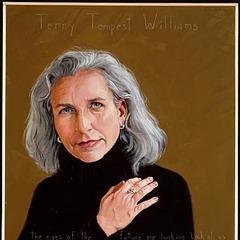
Terry Tempest Williams

Terry Tempest Williams Quotes

Author

Filter quotes by topic

Famous Terry Tempest Williams Quotes

“John Lilly suggests whales are a culture maintained by oral traditions. Stories. The experience of an individual whale is valuable to the survival of its community. I think of my family stories-Mother's in particular-how much I need them now, how much I will need them later. It has been said when an individual dies, whole worlds die with them. The same could be said of each passing whale.”

“Watching the spontaneous acts of kindness, compassion, and generosity, courage, and bravery in the aftermath of the Boston marathon bombings was so deeply moving. It is in our nature to want to help, to serve, to be part of something larger than ourselves. We have a desire to connect with others. We want to make a difference in the world. I would call this a spiritual longing to be whole, interrelated, interconnected.”

“My activism is a result of my love. So whether it's trying to preserve the wilderness in Southern Utah or writing about an erotics of place, it is that same impulse - to try to make sense of the world, to try to preserve something that is beautiful, to ask the tough questions, the push the boundaries of what is acceptable.”

“I think we have powerful role-models among us in the American West. Certainly the Hopis, a timeless civilization that understands sustainability and what that means about living in harmony, in tandem with the natural world. We have much to learn from them, and they will survive us, I feel certain about that.”

“I think that it's too much to take on the world. It's too much to take on Los Angeles. All I can do is to go back home to the canyon where we live and ask the kinds of questions that can make a difference in our neighborhoods.”

“I feel we have to begin standing our ground in the places we love. I think that we have to demand that concern for the land, concern for the Earth, and this extension of community that we've been speaking of, is not marginal - in the same way that women's rights are not marginal, in the same way that rights for children are not marginal. There is no separation between the health of human beings and the health of the land. It is all part of a compassionate view of the world.”

“I think we have to stand up against what is unacceptable, and to push the boundaries and reclaim a more humane way of being in the world, so that we can extend our compassionate intelligence and begin to work with a strengthened will and imagination that can take us into the future.”

“I see myself as a human being. You're right, I am an American, I do live in Utah, and I am deeply ashamed about the decisions our President is making around the world, in our name: the war in Iraq, his continued denial about global warming, the wholesale degradation of the environment on every level. Since September 11, 2001, I have come to believe that there are many forms of terrorism, and environmental degradation is one of them. We have to transcend our government and relate to each other as human beings first and Americans second and feel both our local and global responsibilities.”

“Even as a woman who has a voice in the world, I struggle to find it, to use it, to keep it, to stretch it, to take risks with my words. And I don't think I'm alone. I think the most powerful women among us struggle with how to use their voice. Because I think what every woman knows, is that when she speaks her truth she is at risk - whether it's Hillary Clinton or a rural woman in Rwanda.”

“There are different qualities of silence. There's the silence that sustains us, as women, that nourishes us, the silence where I believe our true voice, our authentic voice, dwells. But there's also the silence that censors us, that tells us what we have to say does not want to be heard, should not be heard, has no value. And that if we speak, it will be at our own peril. This kind of silence is deadly. This kind of silence is deadening to who we are as women. And when a woman is silenced, the world is silenced. When a woman speaks, there is an opening.”

“I don't think there is anything as powerful as an active heart. They do not fear the wisdom of emotion, but embody it. They know how to listen. They are polite when they need to be and unyielding when necessary. They remain open, even as they push boundaries and inhabit the margins, understanding eventually, the margins will move toward the center. They are tenacious, informed, patient, and impatient, at once. They do not shy away from what is difficult. They refuse to accept the unacceptable. The most effective activists I know are in love with the world.”

“A friend of mine said to me not long ago, "Terry you are married to sorrow." I looked at him and said, "No, I am not married to sorrow, I just choose not to look away." To not avert our eyes to suffering is to trust the power of presence. Joy emerges through suffering. Suffering is a component of joy. Whether we are sitting with a loved one dying or witnessing dolphins side-by-side watching the oil burning in the Gulf of Mexico, to be present with the world is to be alive. I think of Rilke once again, "Beauty is the beginning of terror." We can breathe our way toward courage.”

“The middle path makes me wary. . . . But in the middle of my life, I am coming to see the middle path as a walk with wisdom where conversations of complexity can be found, that the middle path is the path of movement. . . . In the right and left worlds, the stories are largely set. . . . We become missionaries for a position . . . practitioners of the missionary position. Variety is lost. Diversity is lost. Creativity is lost in our inability to make love with the world.”

“We are contemporary citizens living in a technological world. Swimming in crosscultural waters can be dangerous, and if you are honest you can't stay there very long. Sooner or later you have to look at your own reflection and decide what to do with yourself. We are urban people. We make periodic pilgrimages to the country. . . . If we align ourselves with the spirit of place we will find humility fused with joy. The land holds stories.”

“What I fear and desire most in this world is passion. I fear it because it promises to be spontaneous, out of my control, unnamed, beyond my reasonable self. I desire it because passion has color, like the landscape before me. It is not pale. It is not neutral. It reveals the backside of the heart.”

“I wonder how, among the Fremont, mothers and daughters shared their world. Did they walk side by side along the lake edge? What stories did they tell while weaving strips of bulrush into baskets? How did daughters bury their mothers and exercise their grief? What were the secret rituals of women? I feel certain they must have been tied to birds.”

“If we are at all sensitive to the life around us, to one another's pains and joys, to the beauty and fragility of the Earth, it is all about being broken open, allowing ourselves to step out from out hardened veneers and expose our core, allowing ourselves to be vulnerable in our emotional response to the world. And how can we not respond? This is what I mean by being 'broken open.' To engage. To love. Any one of these actions of the heart will lead to a personal transformation that bears collective gifts.”