Quotessence
Home / Authors / Terry Tempest Williams
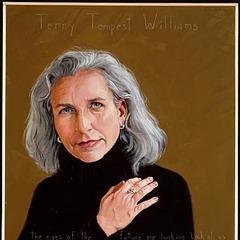
Terry Tempest Williams

Terry Tempest Williams Quotes

Author

Filter quotes by topic

Famous Terry Tempest Williams Quotes

“It's strange how deserts turn us into believers. I believe in walking in a landscape of mirages, because you learn humility. I believe in living in a land of little water because life is drawn together. And I believe in the gathering of bones as a testament to spirits that have moved on. If the desert is holy, it is because it is a forgotten place that allows us to remember the sacred. Perhaps that is why every pilgrimage to the desert is a pilgrimage to the self.”

“I think an erotics of place may be one of the reasons why environmentalists are seen as subversive. There is a backlash now:... [ellipsis in source] take all the regulations away; weaken existing legislation; the endangered species act is too severe, too restrictive; let there be carte blanche for real-estate developers. Because if we really have to confront wildness, solitude, and serenity, both the fierceness and compassionate nature of the land, then we ultimately have to confront it in ourselves, and it's easier to be numb, to be distracted, to be disengaged.”

“I think it could be argued that I am not heard, in the broadest sense. That is not my concern. My concern, a question really, is, do I have the courage to speak? If I speak I believe someone will respond. It then becomes my responsibility to listen to that person. And in listening, together we create a space where people can be heard. It's the conversation that I care most deeply about; this is the space I want to honor, respect, and protect. This is my faith in the open space of democracy.”

“...if we allow ourselves contemplative time in nature-whether it's gardening, going for a walk with the dog, or being in the heart of the southern Utah wilderness-then we can hear the voice of our conscience. If we listen to that voice, it asks us to be conscious. And if we become conscious we choose to live lives of consequence.”

“I truly believe that to stay home, to learn the names of things, to realize who we live among . . . then I believe a politics of place emerges where we are deeply accountable to our communities, to our neighborhoods, to our home . . . If we are not rooted deeply in place, making that commitment to dig in and stay put . . . then I think we are living a life without specificity, and then our lives become abstractions. Then we enter a place of true desolation.”

“We are contemporary citizens living in a technological world. Swimming in crosscultural waters can be dangerous, and if you are honest you can't stay there very long. Sooner or later you have to look at your own reflection and decide what to do with yourself. We are urban people. We make periodic pilgrimages to the country. . . . If we align ourselves with the spirit of place we will find humility fused with joy. The land holds stories.”

“I am slowly, painfully discovering that my refuge is not found in my mother, my grandmother, of even the birds of Bear River. My refuge exists in my capacity to love. If I can learn to love death then I can begin to find refuge in change.”

“For far too long we have been seduced into walking a path that did not lead us to ourselves. For far too long we have said yes when we wanted to say no. And for far too long we have said no when we desperately wanted to say yes. . . . When we don't listen to our intuition, we abandon our souls. And we abandon our souls because we are afraid if we don't, others will abandon us.”

“We usually recognize a beginning. Endings are more difficult to detect. Most often, they are realized only after reflection. Silence. We are seldom conscious when silence begins—it is only afterward that we realize what we have been a part of. In the night journeys of Canada geese, it is the silence that propels them. Thomas Merton writes, “Silence is the strength of our interior life.… If we fill our lives with silence, then we will live in hope.”

“I have felt the pain that arises from a recognition of beauty, pain we hold when we remember what we are connected to and the delicacy of our relations. It is this tenderness born out of a connection to place that fuels my writing. Writing becomes an act of compassion toward life, the life we so often refuse to see because if we look too closely or feel too deeply, there may be no end to our suffering. But words empower us, move us beyond our suffering, and set us free. This is the sorcery of literature. We are healed by our stories.”

“If we are at all sensitive to the life around us, to one another's pains and joys, to the beauty and fragility of the Earth, it is all about being broken open, allowing ourselves to step out from out hardened veneers and expose our core, allowing ourselves to be vulnerable in our emotional response to the world. And how can we not respond? This is what I mean by being 'broken open.' To engage. To love. Any one of these actions of the heart will lead to a personal transformation that bears collective gifts.”