Quotessence
Home / Authors / Terry Tempest Williams
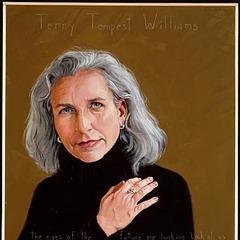
Terry Tempest Williams

Terry Tempest Williams Quotes

Author

Filter quotes by topic

Famous Terry Tempest Williams Quotes

“A mother and daughter are an edge. Edges are ecotones, transitional zones, places of danger or opportunity. House-dwelling tension. When I stand on the edge of the land and sea, I feel this tension, this fluid line of transition. High tide. Low tide. It is the sea's reach and retreat that reminds me we have been human for only a very short time.”

“I live just outside of Salt Lake City in a place called Emigration Canyon. It's on the Mormon trail. So I feel deeply connected, not only because of my Mormon roots, which are five or six generations, but because of where we live. There isn't a day that goes by that I'm not mindful of the spiritual sovereignty that was sought by my people in coming to Utah.”

“I wonder, What is it to be human? Especially now that we are so urban. How do we remember our connection with place? What is the umbilical cord that roots us to that primal, instinctive, erotic place? Every time I walk to the edge of this continent and feel the sand beneath my feet, feel the seafoam move up my body, I think, "Ah, yes, evolution." It's there, we just forget.”

“I think we have powerful role-models among us in the American West. Certainly the Hopis, a timeless civilization that understands sustainability and what that means about living in harmony, in tandem with the natural world. We have much to learn from them, and they will survive us, I feel certain about that.”

“I feel we have to begin standing our ground in the places we love. I think that we have to demand that concern for the land, concern for the Earth, and this extension of community that we've been speaking of, is not marginal - in the same way that women's rights are not marginal, in the same way that rights for children are not marginal. There is no separation between the health of human beings and the health of the land. It is all part of a compassionate view of the world.”

“What is real to me is the power of our awareness when we are focused on something beyond ourselves. It is a shaft of light shining in a dark corner. Our ability to shift our perceptions and seek creative alternatives to the conondrums of modernity is in direct proportion to our empathy. Can we imagine, witness, and ultimately feel the suffering of another?”

“Today, I feel stronger, learning to live within the natural cycles of a day and to not expect too much of myself. As women, we hold the moon in our bellies. It is too much to ask to operate on full-moon energy three hundred and sixty-five days a year. I am in a crescent phase.”

“I have felt the pain that arises from a recognition of beauty, pain we hold when we remember what we are connected to and the delicacy of our relations. It is this tenderness born out of a connection to place that fuels my writing. Writing becomes an act of compassion toward life, the life we so often refuse to see because if we look too closely or feel too deeply, there may be no end to our suffering. But words empower us, move us beyond our suffering, and set us free. This is the sorcery of literature. We are healed by our stories.”

“I wonder how, among the Fremont, mothers and daughters shared their world. Did they walk side by side along the lake edge? What stories did they tell while weaving strips of bulrush into baskets? How did daughters bury their mothers and exercise their grief? What were the secret rituals of women? I feel certain they must have been tied to birds.”