Quotessence
Home / Authors / Warren Buffett
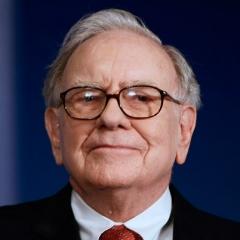
Warren Buffett

Warren Buffett Quotes

Investor

Filter quotes by topic

Famous Warren Buffett Quotes

“Someone is sitting in the shade today because someone planted a tree a long time ago.”

“To invest successfully, you need not understand beta, efficient markets, modern portfolio theory, option pricing or emerging markets. You may, in fact, be better off knowing nothing of these. That, of course, is not the prevailing view at most business schools, whose finance curriculum tends to be dominated by such subjects. In our view, though, investment students need only two well-taught courses - How to Value a Business, and How to Think About Market Prices.”

“I have pledged - to you, the rating agencies and myself - to always run Berkshire with more than ample cash. We never want to count on the kindness of strangers in order to meet tomorrow's obligations. When forced to choose, I will not trade even a night's sleep for the chance of extra profits.”

“Long ago, Sir Isaac Newton gave us three laws of motion, which were the work of genius. But Sir Isaac's talents didn't extend to investing: He lost a bundle in the South Sea Bubble, explaining later, 'I can calculate the movement of the stars, but not the madness of men.' If he had not been traumatized by this loss, Sir Isaac might well have gone on to discover the Fourth Law of Motion: For investors as a whole, returns decrease as motion increases.”

“Would your reply possibly be this? Well, it all depends on what my tax rate will be on the gain you're saying we're going to make. If the taxes are too high, I would rather leave the money in my savings account, earning a quarter of 1 percent. Only in Grover Norquist's imagination does such a response exist.”

“Charlie and I decided long ago that in an investment lifetime, it's too hard to make hundreds of smart decisions. That judgment became ever more compelling as Berkshire's capital mushroomed and the universe of investments that could significantly affect our results shrank dramatically. Therefore, we adopted a strategy that required our being smart and not too smart at that, only a very few times. Indeed, we now settle for one good idea a year.”

“In our view, though, investment students need only two well-taught courses-How to Value a Business, and How to Think about Market Prices. Your goal as an investor should simply be to purchase, at a rational price, a part interest in an easily-understandable business who's earnings are virtually certain to be materially higher five, ten and twenty years from now.”

“Investors should remember that their scorecard is not computed using Olympic-diving methods: Degree-of-difficulty doesn't count. If you are right about a business whose value is largely dependent on a single key factor that is both easy to understand and enduring, the payoff is the same as if you had correctly analyzed an investment alternative characterized by many constantly shifting and complex variables.”

“The line separating investment and speculation, which is never bright and clear, becomes blurred still further when most market participants have recently enjoyed triumphs. Nothing sedates rationality like large doses of effortless money. After a heady experience of that kind, normally sensible people drift into behavior akin to that of Cinderella at the ball.”

“You ought to be able to explain why you’re taking the job you’re taking, why you’re making the investment you’re making, or whatever it may be. And if it can’t stand applying pencil to paper, you’d better think it through some more. And if you can’t write an intelligent answer to those questions, don’t do it.”

“What motivates most gold purchasers is their belief that the ranks of the fearful will grow. During the past decade that belief has proved correct. Beyond that, the rising price has on its own generated additional buying enthusiasm, attracting purchasers who see the rise as validating an investment thesis. As 'bandwagon' investors join any party, they create their own truth - for a while.”

“We will continue to ignore political and economic forecasts, which are an expensive distraction for many investors and businessmen. Thirty years ago, no one could have foreseen the huge expansion of the Vietnam War, wage and price controls, two oil shocks, the resignation of a president, the dissolution of the Soviet Union, a one-day drop in the Dow of 508 points, or treasury bill yields fluctuating between 2.8% and 17.4%.”

“But, surprise - none of these blockbuster events made the slightest dent in Ben Graham's investment principles. Nor did they render unsound the negotiated purchases of fine businesses at sensible prices. Imagine the cost to us, then, if we had let a fear of unknowns cause us to defer or alter the deployment of capital. Indeed, we have usually made our best purchases when apprehensions about some macro event were at a peak. Fear is the foe of the faddist, but the friend of the fundamentalist.”

“Our investments continue to be few in number and simple in concept: The truly big investment idea can usually be explained in a short paragraph. We like a business with enduring competitive advantages that is run by able and owner-oriented people. When these attributes exist, and when we can make purchases at sensible prices, it is hard to go wrong (a challenge we periodically manage to overcome).”