Quotessence
Home / Quotes / Quote by Miguel de Unamuno

Quote by Miguel de Unamuno

Work

Tragic Sense of Life

This work delves into the philosophical underpinnings of tragedy, examining its role in shaping human understanding of life and the universe. The author explores the nature of suffering, the human condition, and the search for meaning amidst life's inherent struggles. more
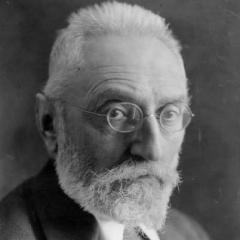
Author

Miguel de Unamuno
Miguel de Unamuno

Miguel de Unamuno was a Spanish novelist, philosopher, and academic. His works profoundly reflected the ideas of individualism and existentialism, and had a profound impact on 20th-century literature and philosophy. more

You May Also Like

“Scientists constantly get clobbered with the idea that we spent 27 billion dollars on the Apollo programs, and are asked "What more do you want?" We didn't spend it; it was done for political reasons. ... Apollo was a response to the Bay of Pigs fiasco and to the successful orbital flight of Yuri Gagarin. President Kennedy's objective was not to find out the origin of the moon by the end of the decade; rather it was to put a man on the moon and bring him back, and we did that.”

“The fundamental idea of these pylons, or great archways, is based on a method of construction peculiar to me, of which the principle consists in giving to the edges of the pyramid a curve of such a nature that this pyramid shall be capable of resisting the force of the wind without necessitating the junction of the edges by diagonals as is usually done.”

“The history of science, like the history of all human ideas, is a history of irresponsible dreams, of obstinacy, and of error. But science is one of the very few human activities-perhaps the only one-in which errors are systematically criticized and fairly often, in time, corrected. This is why we can say that, in science, we often learn from our mistakes, and why we can speak clearly and sensibly about making progress there. In most other fields of human endeavour there is change, but rarely progress ... And in most fields we do not even know how to evaluate change.”

“The members of the department became like the Athenians who, according to the Apostle Paul, "spent their time in nothing else, but either to tell or to hear some new thing." Anyone who thought he had a bright idea rushed out to try it out on a colleague. Groups of two or more could be seen every day in offices, before blackboards or even in corridors, arguing vehemently about these 'brain storms.' It is doubtful whether any paper ever emerged for publication that had not run the gauntlet of such criticism. The whole department thus became far greater than the sum of its individual members.”