Quotessence
Home / Authors / E. O. Wilson
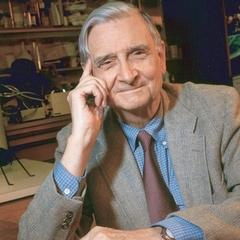
E. O. Wilson

E. O. Wilson Quotes

Biologist

Filter quotes by topic

Famous E. O. Wilson Quotes

“We should not knowingly allow any species or race to go extinct. And let us go beyond mere salvage to begin the restoration of natural environments, in order to enlarge wild populations and stanch the hemorrhaging of biological wealth. There can be no purpose more enspiriting than to begin the age of restoration, reweaving the wondrous diversity of life that still surrounds us.”

“Yes, the natural sciences are telling us a great deal about human origins, the origins of our species the origins of our minds; we're on our way to explaining a large part of it. I'll accept an answer provided only by such means as obtaining and exploring, analyzing and arguing over the evidence - not because of a scribe's myopic view of the subject written 500 years before the birth of Christ!”

“Somewhere close I knew spear-nosed bats flew through the tree crowns in search of fruit, palm vipers coiled in ambush in the roots of orchids, jaguars walked the river's edge; around them eight hundred species of trees stood, more than are native to all of North America; and a thousand species of butterflies, 6 percent of the entire world fauna, waited for the dawn.”

“While ants exist in just the right numbers for the rest of the living world, humans have become too numerous. If we were to vanish today, the land environment would return to the fertile balance that existed before the human population explosion. Only a dozen or so species, among which are the crab louse and a mite that lives in the oil glands of our foreheads, depend on us entirely. But if ants were to disappear, tens of thousands of other plants and animal species would perish also, simplifying and weakening land ecosystems almost everywhere.”

“On the lawn next to the sidewalk a fire ant colony is swarming. The ants are pouring out of a mound nest, here no more than an irregular pile of dirt partly flattened by the last pass of a lawnmower. Winged queens and males are taking off on their nuptial flight, protected by angry-looking workers that run up and down the grass blades and out onto the blistering-hot concrete of the sidewalk. The species is unmistakably Solenopsis geminata, the native fire ant.”

“We don't even know what species are out there, for the most part, particularly when you get down to the microbes and very small invertebrates. They make up the mass of the organisms around us, including the soil we depend on, the soil of cornfields as well as hardwood forests. We haven't taken ecology to the point where we can even make a crude prediction of what's going to happen when we've reduced the living world down to a certain level.”

“That's the way to get young people. Once they see there are wonderful things to hunt for, to rediscover a species that was thought to be extinct or is extremely rare, to be the first to see a nest, to discover a new species unsuspected close to your home - these are things, I think, with a little education and excitement and the right kind of natural history would actually start a movement that makes going back to nature a profitable adventure.”

“Humanity is a biological species, living in a biological environment, because like all species, we are exquisitely adapted in everything: from our behavior, to our genetics, to our physiology, to that particular environment in which we live. The earth is our home. Unless we preserve the rest of life, as a sacred duty, we will be endangering ourselves by destroying the home in which we evolved, and on which we completely depend.”

“Biology is a science of three dimensions. The first is the study of each species across all levels of biological organization, molecule to cell to organism to population to ecosystem. The second dimension is the diversity of all species in the biosphere. The third dimension is the history of each species in turn, comprising both its genetic evolution and the environmental change that drove the evolution. Biology, by growing in all three dimensions, is progressing toward unification and will continue to do so.”

“The worst thing that will probably happen-in fact is already well underway-is not energy depletion, economic collapse, conventional war, or the expansion of totalitarian governments. As terrible as these catastrophes would be for us, they can be repaired in a few generations. The one process now going on that will take millions of years to correct is loss of genetic and species diversity by the destruction of natural habitats. This is the folly our descendants are least likely to forgive us.”

“Science is not marginal. Like art, it is a universal possession of humanity, and scientific knowledge has become a vital part of our species' repertory. It comprises what we know of the material world with reasonable certainty. . . . Thanks to science and technology, access to factual information of all kinds is rising exponentially.”

“Now when you cut a forest, an ancient forest in particular, you are not just removing a lot of big trees and a few birds fluttering around in the canopy. You are drastically imperiling a vast array of species within a few square miles of you. The number of these species may go to tens of thousands. Many of them are still unknown to science, and science has not yet discovered the key role undoubtedly played in the maintenance of that ecosystem, as in the case of fungi, microorganisms, and many of the insects.”

“Women are extraordinary in lacking the estrus, or period of heat. The females of most other primate species become sexually active, to the point of aggression, only at the time of ovulation. Why has sexual responsiveness become nearly continuous? Unusually frequent sexual activity between males and females served as the principle device for cementing the pair bond.”

“If insemination were the sole biological function of sex, it could be achieved far more economically in a few seconds of mounting and insertion. Indeed, the least social of mammals mate with scarcely more ceremony. The species that have evolved long-term bonds are also, by and large, the ones that rely on elaborate courtship rituals. . . . Love and sex do indeed go together.”

“Human existence may be simpler than we thought. There is no predestination, no unfathomed mystery of life. Demons and gods do not vie for our allegiance. Instead, we are self-made, independent, alone, and fragile, a biological species adapted to live in a biological world. What counts for long-term survival is intelligent self-understanding, based upon a greater independence of thought than that tolerated today even in our most advanced democratic societies.”

“The green prehuman earth is the mystery we were chosen to solve, a guide to the birthplace of our spirit, but it is slipping away. The way back seems harder every year. If there is danger in the human trajectory, it is not so much in the survival of our own species as in the fulfillment of the ultimate irony of organic evolution: that in the instant of achieving self-understanding, through the mind of man, life has doomed its most beautiful creations. And thus humanity closes the door on its past.”