Quotessence
Home / Authors / Friedrich Nietzsche
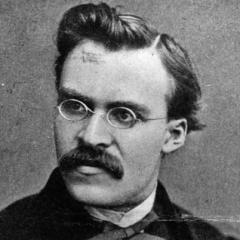
Friedrich Nietzsche

Friedrich Nietzsche Quotes

Philologist

Filter quotes by topic

Famous Friedrich Nietzsche Quotes

“Socrates.- If all goes well, the time will come when one will take up the memorabilia of Socrates rather than the Bible as a guide to morals and reason... The pathways of the most various philosophical modes of life lead back to him... Socrates excels the founder of Christianity in being able to be serious cheerfully and in possessing that wisdom full of roguishness that constitutes the finest state of the human soul. And he also possessed the finer intellect.”

“Preparatory human beings. - I welcome all signs that a more virile, warlike age is about to begin, which will restore honour to courage above all! For this age shall prepare the way for one yet higher, and it shall gather the strength that this higher age will require some day - the age that will carry heroism into the search for knowledge and that will wage wars for the sake of ideas and their consequences.”

“Man is at his furthest remove from the animal as a child, his intellect most human. With his fifteenth year and puberty he comes astep closer to the animal; with the sense of possessions of his thirties (the median line between laziness and greediness), still another step. In his sixtieth year of life he frequently loses his modesty as well, then the septuagenarian steps up to us as a completely unmasked beast: one need only look at the eyes and the teeth.”

“That the world is not the embodiment of an eternal rationality can be conclusively proved by the fact that the piece of the worldthat we know--I mean our human reason--is not so very rational. And if it is not eternally and completely wise and rational, then the rest of the world will not be either; here the conclusion a minori ad majus, a parte ad totum applies, and does so with decisive force.”

“We, however, want to become those we are--human beings who are new, unique, incomparable, who give themselves laws, who create themselves. To that end we must become the best learners and discoverers of everything that is lawful and necessary in the world: we must become physicists in order to be able to be creators in this sense--while hitherto all valuations and ideals have been based on ignorance of physics or were constructed so as to contradict it. Therefore: long live physics! And even more so that which compels us to turn to physics--our honesty!”

“There is a great ladder of religious cruelty, and, of its many rungs, three are the most important. People used to make human sacrifices to their god, perhaps even sacrificing those they loved the best ... Then, during the moral epoch of humanity, people sacrificed the strongest instincts they had, their 'nature,' to their god... Finally: what was left to be sacrificed? ... Didn't people have to sacrifice God himself and worship rocks, stupidity, gravity, fate, or nothingness out of sheer cruelty to themselves?”

“The strong individual loves the earth so much he lusts for recurrence. He can smile in the face of the most terrible thought: meaningless, aimless existence recurring eternally. The second characteristic of such a man is that he has the strength to recognize - and to live with the recognition - that the world is valueless in itself and that all values are human ones. He creates himself by fashioning his own values; he has the pride to live by the values he wills.”

“Because we have for millenia made moral, aesthetic, religious demands on the world, looked upon it with blind desire, passion or fear, and abandoned ourselves to the bad habits of illogical thinking, this world has gradually become so marvelously variegated, frightful, meaningful, soulful, it has acquired color - but we have been the colorists: it is the human intellect that has made appearances appear and transported its erroneous basic conceptions into things.”

“Consider the cattle, grazing as they pass you by. They do not know what is meant by yesterday or today, they leap about, eat, rest, digest, leap about again, and so from morn till night and from day to day, fettered to the moment and its pleasure or displeasure, and thus neither melancholy nor bored. [...] A human being may well ask an animal: 'Why do you not speak to me of your happiness but only stand and gaze at me?' The animal would like to answer, and say, 'The reason is I always forget what I was going to say' - but then he forgot this answer too, and stayed silent.”

“Remain faithful to the earth, my brothers, with the power of your virtue. Let your gift-giving love and your knowledge serve the meaning of the earth. Thus I beg and beseech you. Do not let them fly away from earthly things and beat with their wings against eternal walls. Alas, there has always been so much virtue that has flown away. Lead back to the earth the virtue that flew away, as I do—back to the body, back to life, that it may give the earth a meaning, a human meaning.”

“Morality is neither rational nor absolute nor natural. World has known many moral systems, each of which advances claims universality; all moral systems are therefore particular, serving a specific purpose for their propagators or creators, and enforcing a certain regime that disciplines human beings for social life by narrowing our perspectives and limiting our horizons.”

“Truth is a mobile army of metaphors, metonyms, anthropomorphisms, in short a sum of human relations which have been subjected to poetic and rhetorical intensification, translation and decoration […]; truths are illusions of which we have forgotten that they are illusions, metaphors which have become worn by frequent use and have lost all sensuous vigour […]. Yet we still do not know where the drive to truth comes from, for so far we have only heard about the obligation to be truthful which society imposes in order to exist" from, "On Truth and Lying in a Non-Moral Sense".”

“What then is truth? A movable host of metaphors, metonymies, and anthropomorphisms: in short, a sum of human relations which have been poetically and rhetorically intensified, transferred, and embellished, and which, after long usage, seem to a people to be fixed, canonical, and binding. Truths are illusions which we have forgotten are illusions — they are metaphors that have become worn out and have been drained of sensuous force.”