Quotessence
Home / Authors / Fyodor Dostoevsky Books
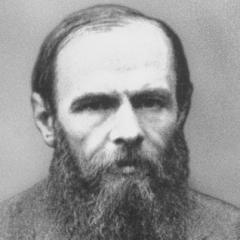
Fyodor Dostoevsky

Fyodor Dostoevsky Books

Novelist

Related Quotes

“Though these young men unhappily fail to understand that the sacrifice of life is, in many cases, the easiest of all sacrifices, and that to sacrifice, for instance, five or six years of their seething youth to hard and tedious study, if only to multiply tenfold their powers of serving the truth and the cause they have set before them as their goal--such a sacrifice is utterly beyond the strength of many of them.”

“I am a sick man... I am a spiteful man. I am an unpleasant man. I think my liver is diseased. However, I don't know beans about my disease, and I am not sure what is bothering me. I don't treat it and never have, though I respect medicine and doctors. Besides, I am extremely superstitious, let's say sufficiently so to respect medicine. (I am educated enough not to be superstitious, but I am.) No, I refuse to treat it out of spite. You probably will not understand that. Well, but I understand it. Of course I can't explain to you just whom I am annoying in this case by my spite. I am perfectly well aware that I cannot "get even" with the doctors by not consulting them. I know better than anyone that I thereby injure only myself and no one else. But still, if I don't treat it, its is out of spite. My liver is bad, well then-- let it get even worse!”

“There are seconds - they come only five or six at a time- when you suddenly feel the presence of an eternal harmony that has been fully attained. This is not something earthly. I'm not saying that it's heavenly, but that man in his earthly form cannot endure it. He must change physically or else die. It is a clear and unambiguous feeling. It's as if you suddenly have a sense of nature as a whole, and you suddenly say: yes, this is true. God, when he was creating the world, said at the end of each day of creation: "Yes, this is true, this is good." This... this is not deep emotion, but is simply joy. You don't forgive anything, because there's no longer anything to forgive. You don't really love - oh, this is higher than love! If it lasts longer than five seconds, your soul can't endure it and must disappear. In these five seconds I live an entire lifetime, and for them I will give my entire life, because it's worth it. In order to endure ten seconds, one must change physically. I think that man should stop giving birth. Why have children, why have evolution if the goal has been attained? In the Gospels it is said that in the resurrection there will be no childbirth, but all will be like God's angels. It's a hint. Is your wife giving birth?”

“And so these refined parents rejected their five-year-old girl to all kinds of torture. They beat her, kicked her, flogged her, for no reason that they themselves knew of. The child’s whole body was covered in bruises. Eventually they devised a new refinement. Under the pretext that the child dirtied her bed (as though a five-year-old deep in her angelic sleep could be punished for that), they forced her to eat excrement, smearing it all over her face. And it was the mother that did it! And that woman would lock her daughter up in the outhouse until morning and she did so even on the coldest nights, when it was freezing. Just imagine the woman being able to sleep with the child’s cries coming from that outhouse! Imagine that little creature, unable to even understand what is happening to her, beating her sore little chest with her tiny fist, weeping hot, unresentful, meek tears, and begging ‘gentle Jesus’ to help her… ...let’s assume that you were called upon to build the edifice of human destiny so that men would finally be happy and would find peace and tranquility. If you knew that, only to attain this, you would have to torture just one single creature, let’s say the little girl who beat her chest so desperately in the outhouse, and that on her unavenged tears you could build that edifice, would you agree to do it?”

“Here there is no doubt that timidity and a total lack of personal initiative have always been regarded among us as the chiefest and best sign of the practical man—and are so regarded even now. But why blame only ourselves—if this opinion can be considered an accusation? Lack of originality, everywhere, all over the world, from time immemorial, has always been considered the foremost quality and the best recommendation of the active, efficient and practical man.”

“Jeżeli ludzkość bez wyjątku raz wyrzeknie się Boga (...), to sam przez się, bez ludożerstwa, upadnie cały stary światopogląd, przede wszystkim zaś, cała stara moralność, i nastąpi wszystko nowe. Ludzie zjednoczą się, by wziąć od życia wszystko, co ono dać może dla szczęścia i radości na jednym tylko świecie, na tym świecie. Człowiek wzniesie się do boskiej, tytanicznej dumy i zjawi się człowiek-bóg. Nieustannie pokonując przyrodę, już bez granic, wolą swą i nauką człowiek będzie odczuwał w tym rozkosz tak wzniosłą, że mu zastąpi ona całkowicie dawną nadzieję na niebieskie radości. Każdy pozna, że jest śmiertelny i nie licząc już na zmartwychwstanie, powita śmierć dumnie i spokojnie jak Bóg. Pojmie w dumie swojej, że nie ma co szemrać na to, że życie jest chwilką tylko i pokocha brata swego już bez żadnego wyrachowania na zapłatę. Miłość będzie wypełniała tylko krótki moment życia, lecz samo poczucie jej chwilowości wzmocni jej ogień nieskończenie silniej, niż dziś, gdy rozpływa się w nadziejach na miłość pozagrobową i nieskończoną...”

“Do you want to live your entire life with me, but very far from here? It's in the mountains, in Switzerland, there's a certain place there... Don't worry, I'll never abandon you and I won't put you into a madhouse. I'll have enough money to live without begging. You will have a servant, you won't have to do any work. Everything you can possibly want will be provided for you. You will pray, go where you like and do what you like. I won't touch you. I won't leave the place and go anywhere my whole life either. If you want, I won't speak to you my whole life; if you want, you can tell me your stories every evening, as you used to in the corners of those rooms in Petersburg. I'll read books to you, if you wish. But in exchange for all this, it will be an entire life spent in one place, and a gloomy place at that. Do you want to? Can you make up your mind to do it? You won't regret it, and torment me with tears and curses?”

“You ape, you're teasing me so as to get the better of me. Shut up, you can't understand anything. If there is no God, then l am God. You know, I never was able to understand this particular point of yours: why should you be God?' If God exists, then all will is his, and I can't escape his will. If he does not exist, then all will is mine, and I am obliged to proclaim self-will. 'Self-will? And why are you obliged?' 'Because all will has become mine. Can it really be that no one on this entire planet, once having put an end to God and having developed a belief in self-will, will dare to proclaim self-will, in the fullest possible sense? It's like a poor man who's received an inheritance and is frightened by it and doesn't dare come near the bag full of money, regarding himself as too feeble to possess it. I want to proclaim self-will. Even if I'm the only one, I'll do it.' 'So go ahead and do it.' I am obliged to shoot myself because my self-will in the fullest possible sense for me is to kill myself. "But look, you're not the only one to kill yourself; there are many suicides." "With good reason. But to do it without any reason, solely for self-will, I'm the only one.' 'You know what,' he observed irritably, "if I were in your place, to show self-will I would kill someone else, and not myself. You could become useful. I'll show you who, if you're not afraid. Then perhaps you won't have to shoot yourself today. We could reach an understanding." "To kill someone else would be the lowest point of my self-will, and that's where you reveal who you are completely. I'm not you: I want the highest point, and I'll kill myself." 'He's worked this out all by himself,' Pyotr Stepanovich muttered angrily. I am obliged to proclaim disbelief,' Kirillov was walking about the room. 'For me there is no higher idea than the non- existence of God. Human history is behind me. Man has done nothing but invent God in order to live without killing himself; that's the essence of world history to this point. I am the only one in world history who hasn't felt like inventing God for the allow first time. Let people find that out once and for all.”

“Kirillov remained silent. 'You know what, in my opinion, your belief is even stronger than a priest's.' In whom? In Him? Listen.' Kirillov stopped pacing, and stared straight before him with a fixed and ecstatic look. 'Listen to a great idea. There was a certain day on earth, and in the centre of the earth stood three crosses. One man on a cross believed to such an extent that he said to another: "Today you will be with me in paradise." The day ended, both died, they went and they found nothing - neither paradise nor resurrection. What had been said proved unjustified. Listen: this man was the highest on the entire earth, he comprised that which allowed it to live. The entire planet, with everything on it, is nothing but madness without that man. There has never been one like Him, either before or after, even by virtue of a miracle. The miracle is that there never has been nor will there be another such man, ever. And if that's so, if the laws of nature didn't spare even This One, didn't even spare his miracle, but compelled even Him to live amidst a lie and to die for a lie, then it follows that the entire planet is a lie and rests on a lie and on a stupid joke. It follows that the very laws of the planet are a lie and a farce put on by the Devil. What's there to live for, answer me, if you are a man?”

“Now I did not say to you that I don't believe at all!' he finally shouted. 'I'm letting you know, purely and simply, that I'm an unhappy, boring book and nothing more, for the time being, for the time being. But let my name perish! You're what ... we're discussing, not me... I am a man without talent, and all I can do is spill my blood and nothing more, like any man without talent. Let my blood perish as well!”

“The moments of contemplating that animal fear, when the criminal sees that all is lost, but still struggles, still means to struggle, the moments when every instinct of self-preservation rises up in him at once and he looks at you with questioning and suffering eyes, studies you, your face, your thoughts, uncertain on which side you will strike, and his distracted mind frames thousands of plans in an instant, but he is still afraid to speak, afraid of giving himself away! This purgatory of the spirit, this animal thirst for self-preservation, these humiliating moments of the human soul, are awful, and sometimes arouse horror and compassion for the criminal even in the lawyer.”

“and—and is it really impossible to be unhappy? Oh, what are my grief and my trouble, if I am able to be happy? You know, I don’t understand how it’s possible to pass by a tree and not be happy to see it. To talk with a man and not be happy that you love him! Oh, I only don’t know how to say it... but there are so many things at every step that are so beautiful, that even the most confused person finds beautiful. Look at a child, look at God’s sunrise, look at the grass growing, look into the eyes that are looking at you and love you...”

“And so will I here state just plainly and briefly that I accept God. But I must point out one thing: if God does exist and really created the world, as we well know, he created it according to the principles of Euclidean geometry and made the human brain capable of grasping only three dimensions of space. Yet there have been and still are mathematicians and philosophers-among them some of the most outstanding-who doubt that the whole universe or, to put it more generally, all existence was created to fit Euclidean geometry; they even dare to conceive that two parallel lines that, according to Euclid, never do meet on earth do, in fact, meet somewhere in infinity. And so my dear boy, I’ve decided that I am incapable of understanding of even that much, I cannot possibly understand about God.”

“Christ knew that by bread alone you cannot reanimate man. If there were no spiritual life, no ideal of Beauty, man would pine away, die, go mad, kill himself or give himself to pagan fantasies. And as Christ, the ideal of Beauty in Himself and his Word, he decided it was better to implant the ideal of Beauty in the soul. If it exists in the soul, each would be the brother of everyone else and then, of course, working for each other, all would also be rich. Whereas if you give them bread, they might become enemies to each other out of boredom.”

“There are seconds, they come only five or six at a time, and you suddenly feel the presence of eternal harmony, fully achieved. It is nothing earthly; not that it’s heavenly, but man cannot endure it in his earthly state. One must change physically or die. The feeling is clear and indisputable. As if you suddenly sense the whole of nature and suddenly say: yes, this is true. God, when he was creating the world, said at the end of each day of creation: ‘Yes, this is true, this is good.’ This … this is not tenderheartedness, but simply joy. You don’t forgive anything, because there’s no longer anything to forgive. You don’t really love—oh, what is here is higher than love! What’s most frightening is that it’s so terribly clear, and there’s such joy. If it were longer than five seconds—the soul couldn’t endure it and would vanish. In those five seconds I live my life through, and for them I would give my whole life, because it’s worth it.”

“There are seconds, they only come five or six at a time, and you suddenly feel the presence of eternal harmony, fully achieved. It is nothing earthly; not that it’s heavenly, but man cannot endure it in his earthly state. One must physically change or die. The feeling is clear and indisputable. As if you suddenly sense the whole of nature and suddenly say: yes this is true. God, when he was creating the world, said at the end of each day of creation: ‘Yes this is true, this is good.’ This. . . this is not tenderheartedness, but simply joy. You don’t forgive anything, because there’s no longer anything to forgive. You don’t really love—oh, what is here is higher than love! What’s most frightening is that it’s so terribly clear and there’s such joy. If it were longer than five seconds—the soul couldn’t endure it and would vanish. In those five seconds I live my life through, and for them I would give my whole life, because it’s worth it.”

“[...]it is necessary for a man to know and believe every moment that there is somewhere a perfect and peaceful happiness, for everyone and for everything … The whole law of human existence consists in nothing other than a man’s always being able to bow before the immeasurably great. If people are deprived of the immeasurably great, they will not live and will die in despair. The immeasurable and infinite is as necessary for man as the small planet he inhabits.”

“I heard exactly the same thing, a long time ago to be sure, from a doctor,' the elder remarked. 'He was then an old man, and unquestionably intelligent. He spoke just as frankly as you, humorously, but with a sorrowful humor. "I love mankind," he said, "but I am amazed at myself: the more I love mankind in general, the less I love people in particular, that is, individually, as separate persons. In my dreams," he said, "I often went so far as to think passionately of serving mankind, and, it may be, would really have gone to the cross for people if it were somehow suddenly necessary, and yet I am incapable of living in the same room with anyone even for two days; this I know from experience. As soon as someone is there, close to me, his personality oppresses my self-esteem and restricts my freedom. In twenty-four hours I can begin to hate even the best of men: one because he takes too long eating his dinner, another because he has a cold and keeps blowing his nose. I become the enemy of people the moment they touch me," he said. "On the other hand, it has always happened that the more I hate people individually, the more ardent becomes my love for humanity as a whole."''But what is to be done, then?”

“There's nothing more devious than one's own self, because no one will believe it. And, I admit I had wanted to play the fool, because a fool is easier than one's own self; but since a fool is an extreme, after all, and an extreme sparks curiosity, then I finally settled on my very own self. Well then, what is my very own self? A golden mean: neither stupid, nor intelligent, without any particular gifts, and "dropped from the moon", as the sensible people here say, isn't that so?”

“Let us examine first the psychological and legal position of the criminal. We see that in spite of the difficulty of finding other food, the accused, or, as we may say, my client, has often during his peculiar life exhibited signs of repentance, and of wishing to give up this clerical diet. Incontrovertible facts prove this assertion. He has eaten five or six children, a relatively insignificant number, no doubt, but remarkable enough from another point of view. It is manifest that, pricked by remorse—for my client is religious, in his way, and has a conscience, as I shall prove later—and desiring to extenuate his sin as far as possible, he has tried six times at least to substitute lay nourishment for clerical. That this was merely an experiment we can hardly doubt: for if it had been only a question of gastronomic variety, six would have been too few; why only six? Why not thirty? But if we regard it as an experiment, inspired by the fear of committing new sacrilege, then this number six becomes intelligible. Six attempts to calm his remorse, and the pricking of his conscience, would amply suffice, for these attempts could scarcely have been happy ones. In my humble opinion, a child is too small; I should say, not sufficient; which would result in four or five times more lay children than monks being required in a given time. The sin, lessened on the one hand, would therefore be increased on the other, in quantity, not in quality. Please understand, gentlemen, that in reasoning thus, I am taking the point of view which might have been taken by a criminal of the middle ages. As for myself, a man of the late nineteenth century, I, of course, should reason differently; I say so plainly, and therefore you need not jeer at me nor mock me, gentlemen. As for you, general, it is still more unbecoming on your part. In the second place, and giving my own personal opinion, a child’s flesh is not a satisfying diet; it is too insipid, too sweet; and the criminal, in making these experiments, could have satisfied neither his conscience nor his appetite. I am about to conclude, gentlemen; and my conclusion contains a reply to one of the most important questions of that day and of our own! This criminal ended at last by denouncing himself to the clergy, and giving himself up to justice. We cannot but ask, remembering the penal system of that day, and the tortures that awaited him—the wheel, the stake, the fire!—we cannot but ask, I repeat, what induced him to accuse himself of this crime? Why did he not simply stop short at the number sixty, and keep his secret until his last breath? Why could he not simply leave the monks alone, and go into the desert to repent? Or why not become a monk himself? That is where the puzzle comes in! There must have been something stronger than the stake or the fire, or even than the habits of twenty years! There must have been an idea more powerful than all the calamities and sorrows of this world, famine or torture, leprosy or plague—an idea which entered into the heart, directed and enlarged the springs of life, and made even that hell supportable to humanity! Show me a force, a power like that, in this our century of vices and railways!”

“Pytałem przed chwilą co to jest ojciec i zawołałem, że to słowo wielkie, miano drogocenne. Ale słowa trzeba, panowie, używać uczciwie (...) „ojcowie, nie rozgoryczajcie dzieci waszych”! Albowiem wypełnijmy najpierw sami wolę Chrystusową, a wtedy dopiero stawiajmy wymagania dzieciom naszym. Inaczej nie ojcami, ale wrogami dzieci naszych jesteśmy, one zaś nie dziećmi naszymi, ale wrogami, których samiśmy sobie uczynili! „Jaką miarką mierzycie, taką będzie wam odmierzone” – już nie ja to mówię, lecz Ewangelia – jakże więc obwiniać dzieci, że nam naszą miarką odmierzają? (...) ten, co zrodził, nie jest jeszcze ojcem – ojcem bowiem jest ten, co i zrodził, i zasłużył sobie na miano ojca.”

“Above all, do not lie to yourself. A man who lies to himself and listens to his own lie comes to a point where he does not discern any truth either in himself or anywhere around him, and thus falls into disrespect towards himself and others. Not respecting anyone, he ceases to love, and having no love, he gives himself up to passions and coarse pleasures in order to occupy and amuse himself, and in his vices reaches complete beastiality, and it all comes from lying continually to others and himself. A man who lies to himself is often the first to take offense. it sometimes feels very good to take offense, doesn't it? And surely he knows that no one has offended him, and that he himself has invented the offense and told lies just for the beauty of it, that he has exaggerated for the sake of effect, that he has picked up on a word and made a mountain out of a pea--he knows all of that, and still he is the first to take offense, he likes feeling offended, it gives him great pleasure, and thus he reaches the point of real hostility...”

“I will add that in any ingenious or new human thought, or even simply in any serious human thought born in someone's head, there always remains something which it is quite impossible to convey to other people, though you may fill whole volumes with writing and spend thirty-five years trying to explain your thought; there always remains something that absolutely refuses to leave your skull and will stay with you forever; you will die with it, not having conveyed to anyone what is perhaps most important in your idea.”

“Your life, Katerina, will be spent in painful brooding over your own feelings, your own heroism, and your own suffering. But in the end that suffering will be softened and will pass into contemplation of the fulfillment of a bold and proud design. Yea, proud it certainly is, and desperate in any case, but a triumph for you. And the consciousness of it all will at last be a source of complete satisfaction and will make you resigned to something else.”

“And why are you so firmly and triumphantly certain that only what is normal and positive - in short, only well-being - is good for man? Is reason mistaken about what is good? After all, perhaps prosperity isn't the only thing that pleases mankind, perhaps he is just as attracted to suffering. Perhaps suffering is just as good for him as prosperity. Sometimes a man is intensely, even passionately, attached to suffering - that is a fact. About this there is no need to consult universal history: ask yourself, if you are a man and have ever lived even in some degree. As for my own personal opinion, I find it somehow unseemly to love only well-being. Whether it's a good thing or a bad thing, smashing things is also sometimes very pleasant.”

“Car peu d'entre nous savent ce qu'il peut y avoir d'infiniment patient, de commisération et d'indulgence sans bornes dans certains coeurs féminins. D'immenses trésors de sympathie, de consolation, d'espérance reposent dans ces coeurs purs, si souvent blessés eux aussi, car un coeur qui aime beaucoup souffre beaucoup, mais qui dissimulent soigneusement leur blessure aux regards indiscrets, car le chagrin profond le plus souvent se tait et se cache.”

“Tell me, how is it that we can’t all be like brothers together? Why is it that even the best of men always seem to hide something from other people and to keep something back? Why not say straight out what is in one’s heart, when one knows that one is not speaking idly? As it is every one seems harsher than he really is, as though all were afraid of doing injustice to their feelings, by being too quick to express them.”