Quotessence
Home / Authors / Georg Wilhelm Friedrich Hegel Books
Georg Wilhelm Friedrich Hegel

Georg Wilhelm Friedrich Hegel Books

Philosopher

Philosophy of right

A source page for quotes linked to Georg Wilhelm Friedrich Hegel.
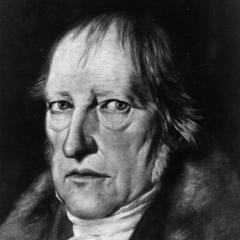
0 quotes

The Logic of Hegel

A source page for quotes linked to Georg Wilhelm Friedrich Hegel.

0 quotes

Wer denkt abstrakt?

A source page for quotes linked to Georg Wilhelm Friedrich Hegel.

0 quotes

Science of Logic

A source page for quotes linked to Georg Wilhelm Friedrich Hegel.

0 quotes

Related Quotes

“customs must be introduced that require, if one is to be aware of their necessity and utility, either trusting belief or habituation from childhood on. Thus it is evident that a Volksreligion, if as the concept of religion implies its teaching is to be efficacious in active life, cannot possibly be constructed out of sheer reason. Positive religion necessarily rests on faith in the tradition by which it is handed down to us.”

“If we are in a general way permitted to regard human activity in the realm of the beautiful as a liberation of the soul, as a release from constraint and restriction, in short to consider that art does actually alleviate the most overpowering and tragic catastrophes by means of the creations it offers to our contemplation and enjoyment, it is the art of music which conducts us to the final summit of that ascent to freedom.”

“In a state which is really articulated rationally all the laws and organizations are nothing but a realization of freedom in its essential characteristics. When this is the case, the individual’s reason finds in these institutions, only the actuality of his own essence, and if he obeys these laws, he coincides, not with something alien to himself, but simply with what is his own. Freedom of choice, of course, is often equally called ‘freedom’; but freedom of choice is only non-rational freedom, choice and self-determination issuing not from the rationality of the will but from fortuitous impulses and their dependence on sense and the external world.”

“When we say of things that they are finite, we understand thereby that they not only have a determinateness, that their quality is not only a reality and an intrinsic determination, that finite things are not merely limited . . . but that on the contrary, non-being constitutes their nature and being. Finite things are, but their relation to themselves is that they are negatively self-related and this very relation drives them beyond their being. They are, but the truth of this being is their destruction. The finite not only alters, as anything does, but it ceases to be, and it is not merely a possibility that it ceases to be, as though it could be that it might not cease. No, the nature of the being of finite things is that they have within them the seeds of their own destruction; the hour of their birth is the hour of their death.”

“Wenn aber der Widerstreit des Glaubens und der Vernunft verschwunden und in eine Aussöhnung übergegangen ist, so würde es wesentlich von der Natur dieser Aussöhnung selbst abhängen, inwiefern zu ihr Glück zu wünschen wäre. Denn es gibt auch einen Frieden der Gleichgültigkeit gegen die Tiefen des Geistes, einen Frieden des Leichtsinns, der Kahlheit; in einem solchen Frieden kann das Widerwärtige beseitigt scheinen, indem es nur auf die Seite gestellt ist. (Vorrede zu Hinrichs' Religionsphilosophie, 1822)”

“No matter how deeply it [a faith based on mere authority] entrenches itself behind authority, no matter how artfully it seeks to ward off all counter-hypotheses and alternative possibilities by assembling a system that covers every conceivable circumstance . . . , reason will still venture to subject it to critical scrutiny. And it will do so spontaneously [aus sich selbst], generating from within itself principles of possibility and plausibility irrespective of any such artificial historical structure predisposed to neglect reason and to claim primacy on historical grounds over the persuasiveness of rational truths.”

“The two first parts of the doctrine of Mind embrace the finite mind. Mind is the infinite Idea, and finitude here means the disproportion between the concept and the reality – but with the qualification that it is a shadow cast by the mind’s own light – a show or illusion which the mind implicitly imposes as a barrier to itself, in order, by its removal, actually to realize and become conscious of freedom as its very being, i.e. to be fully manifested. The several steps of this activity, on each of which, with their semblance of being, it is the function of the finite mind to linger, and through which it has to pass, are steps in its liberation. In the full truth of that liberation is given the identification of the three stages – finding a world presupposed before us, generating a world as our own creation, and gaining freedom from it and in it. To the infinite form of this truth the show purifies itself till it becomes a consciousness of it.”

“When, therefore, a man is told, “You (your inner being) are so and so, because your skull-bone is so constituted,” this means nothing else than that we regard a bone as the man's reality. To retort upon such a statement with a box on the ear — in the way mentioned above when dealing with psysiognomy — removes primarily the “soft” parts of his head from their apparent dignity and position, and proves merely that these are no true inherent nature, are not the reality of mind; the retort here would, properly speaking, have to go the length of breaking the skull of the person who makes a statement like that, in order to demonstrate to him in a manner as palpable as his own wisdom that a bone is nothing of an inherent nature at all for a man, still less his true reality.”

“Kant ist über dieses äußerliche Verhältnis des Verstandes als des Vermögens der Begriffe und des Begriffes selbst zum Ich hinausgegangen. Es gehört zu den tiefsten und richtigsten Einsichten, die sich in der Kritik der Vernunft finden, daß die Einheit, die das Wesen des Begriffs ausmacht, als die ursprünglich-synthetische Einheit der Apperzeption, als Einheit des »Ich denke« oder des Selbstbewußtseins erkannt wird”

“I hold the view that the World Spirit has given the times the order to advance; such an order is obeyed; this being strides forward like an armored, firmly closed phalanx, irresistibly and as imperceptibly as the sun moves, through thick and thin; it is flanked by innumerable light troops for and against it; most of them have no idea of what is at stake, and only get knocked on over the head, as if by an invisible hand. All the hesitant fibbing and sophisticated shadow boxing in the world is of no help against it; it can only reach about as high as the shoelaces of this colossus and smear a bit of mud or shoe polish on them, but it cannot loosen them, much less remove the divine shoes with the elastic soles or the seven-league boots, if the colossus puts them on. The safest game (both inwardly and outwardly) is, I dare say, to keep one's eye on the advancing giant.”

“... το να αποδίδεις ισχύ σε αφαιρέσεις μέσα στην πραγματικότητα σημαίνει να καταστρέφεις την πραγματικότητα.”

“The life of God - the life which the mind apprehends and enjoys as it rises to the absolute unity of all things - may be described as a play of love with itself; but this idea sinks to an edifying truism, or even to a platitude, when it does not embrace in it the earnestness, the pain, the patience, and labor, involved in the negative aspect of things.”

“The soul is presupposed as a ready-made agent, which displays such features as its acts and utterances, from which we can learn what it is, what sort of faculties and powers it possesses -- all without being aware that the act and utterance of what the soul is really invests it with that character in our conception and makes it reach a higher stage of being than it explicitly had before.”

“Because of its concrete content, sense-certainty immediately appears as the richest kind of knowledge, indeed a knowledge of infinite wealth for which no bounds can be found, either when we reach out into space and time in which it is dispersed, or when we take a bit of this wealth, and by division enter into it. Moreover, sense-certainty appears to be the truest knowledge ... but, in the event, this very certainty proves itself to be the most abstract and poorest truth. All that it says about what it knows is just that it is; and its truth contains nothing but the sheer being of the thing.”

“Each of the parts of philosophy is a philosophical whole, a circle rounded and complete in itself. In each of these parts, however, the philosophical Idea is found in a particular specificality or medium. The single circle, because it is a real totality, bursts through the limits imposed by its special medium, and gives rise to a wider circle. The whole of philosophy in this way resembles a circle of circles. The Idea appears in each single circle, but, at the same time, the whole Idea is constituted by the system of these peculiar phases, and each is a necessary member of the organisation.”

“Every philosophy is complete in itself and, like a genuine work of art, contains the totality. Just as the works of Apelles and Sophocles, if Raphael and Shakespeare had known them, should not have appeared to them as mere preliminary exercises for their own work, but rather as a kindred force of the spirit, so, too reason cannot find in its own earlier forms mere useful preliminary exercises for itself.”

“To be independent of public opinion is the first formal condition of achieving anything great or rational whether in life or in science. Great achievement is assured, however, of subsequent recognition and grateful acceptance by public opinion, which in due course will make it one of its own prejudices”