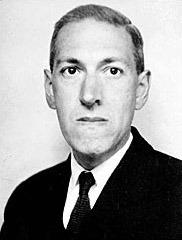
“Contrary to what you may assume, I am not a pessimist but an indifferentist- that is, I don't make the mistake of thinking that the... cosmos... gives a damn one way or the the other about the especial wants and ultimate welfare of mosquitoes, rats, lice, dogs, men, horses, pterodactyls, trees, fungi, dodos, or other forms of biological energy.”
“In London there is a man who screams when the church bells ring.”
Source: Complete Collection Of H. P. Lovecraft - 150 eBooks With 100+ Audiobooks (Complete Collection Of Lovecraft's Fiction, Juvenilia, Poems, Essays And Collaborations)
“Men of broader intellect know that there is no sharp distinction betwixt the real and the unreal”
Source: The Tomb
“Truly, there are terrible primal arcana of earth which had better be left unknown and unevoked; dread secrets which have nothing to do with man, and which man may learn only in exchange for peace and sanity; cryptic truths which make the knower evermore an alien among his kind, and cause him to walk alone on earth.”
Source: H.P. Lovecraft: The Ultimate Collection (160 Works Including Early Writings, Fiction, Collaborations, Poetry, Essays & Bonus Audiobook Links)
“Rome was so mighty that it could not fall. It had to vanish in a cloud, like so many of the mythical heros of antiquity, and to receive its apotheosis among the stars before men became fully aware that it had vanished from the earth!”
“Wise men have interpreted dreams, and the gods have laughed.”
Source: THE DREAMLANDS SERIES: 20+ Gruesome Tales of Terror in One Premium Edition: The Dream Cycle: Beyond the Wall of Sleep, At the Mountains of Madness, The Dreams in the Witch House, From Beyond, The Nameless City, Ex Oblivione, The Case of Charles Dexter Ward, Polaris, Hypnosäó_
“After man there would be the mighty beetle civilisation, the bodies of whose members the cream of the Great Race would seize when the monstrous doom overtook the elder world. Later, as the earth's span closed, the transferred minds would again migrate through time and space -- to another stopping place in the bodies of the bulbous vegetable entities of Mercury. But there would be races after them, clinging pathetically to the cold planet and burrowing to its horror-filled core, before the utter end.”
Source: Delphi Complete Works of H. P. Lovecraft (Illustrated)
“May the merciful god, if indeed there be such, guard those hours when no power of the will, or drug that the cunning of man devises, can keep me from the chasm of sleep. Death is merciful, for there is no return therefrom, but with him who has come back out of the nethermost chambers of night, haggard and knowing, peace rests nevermore.”
Source: H. P. Lovecraft Fiction Collection
“Good art means the ability of any one man to pin down in some permanent and intelligible medium a sort of idea of what he sees in Nature that nobody else sees. In other words, to make the other fellow grasp, through skilled selective care in interpretative reproduction or symbolism, some inkling of what only the artist himself could possibly see in the actual objective scene itself.”
“Though not a participant in the Business of life; I am, like the character of Addison and Steele, an impartial (or more or less impartial) Spectator, who finds not a little recreation in watching the antics of those strange and puny puppets called men.”
“There are not many persons who know what wonders are opened to them in the stories and visions of their youth; for when as children we listen and dream, we think but half-formed thoughts, and when as men we try to remember, we are dulled and prosaic with the poison of life.”
Source: H. P. LOVECRAFT äóñ Ultimate Collection: 120+ Works ALL in One Volume: Complete Novellas & Short Stories, Juvenilia, Poetry, Essays & Collaborations: The Call of Cthulhu, The Shadow Out of Time, At the Mountains of Madness, The Dunwich Horror, Dagon, The Case of Charles Dexter Ward, The Outsider, The Whisperer in Darkness, The Cats of Ultharäó_
“You see them? You see the things that float and flop about you and through you ever moment of your life? You see the creatures that form what men call the pure air and the blue sky? Have I not succeeded in breaking down the barrier; have I not shown you worlds that no other living men have seen?”
Source: Waking Up Screaming: Haunting Tales of Terror
“More wonderful than the lore of old men and the lore of books is the secret lore of the ocean. Blue, green, grey, white, or black; smooth, ruffled, or mountainous; that ocean is not silent. All my days I have watched it and listened to it, and I know it well. At first it told to me only the plain little tales of calm beaches and near ports, but with the years it grew more friendly and spoke of other things; of things more strange and more distant in space and time.”
Source: Complete Collection Of H. P. Lovecraft - 150 eBooks With 100+ Audiobooks (Complete Collection Of Lovecraft's Fiction, Juvenilia, Poems, Essays And Collaborations)
“Man's relations to man do not captivate my fancy. It is man's relation to the cosmos--to the unknown--which alone arouses in me the spark of creative imagination.”
Source: The Annotated Supernatural Horror in Literature
“We must recognise the essential underlaying savagery in the animal called man, and return to older and sounder principles of national life and defense. We must realise that man's nature will remain the same so long as he remains man; that civilisation is but a slight coverlet beneath which the dominant beast sleeps lightly and ever ready to awake.”
Source: Delphi Complete Works of H. P. Lovecraft (Illustrated)
“It is better to laugh at man from outside the universe, than to weep for him within.”
“Pessimists are just as illogical as optimists; insomuch as both envisage the aims of mankind as unified, and as having a direct relationship (either of frustration or of fulfilment) to the inevitable flow of terrestrial motivation and events. That is - both schools retain in a vestigial way the primitive concept of a conscious teleology - of a cosmos which gives a damn one way or the other about the especial wants and ultimate welfare of mosquitos, rats, lice, dogs, men, horses, pterodactyls, trees, fungi, dodos, or other forms of biological energy.”
“Man's respect for the imponderables varies according to his mental constitution and environment. Through certain modes of thought and training it can be elevated tremendously, yet there is always a limit.”
Source: H. P. Lovecraft: The Complete Fiction
“Every limited mind demands a certain freedom of expression, and the man who cannot express himself satisfactorily without the stimulation derived from the spirited mode of two centuries ago should certainly be permitted to follow without undue restraint a practice so harmless, so free from essential error, and so sanctioned by precedent, as that of employing in his poetical compositions the smooth and inoffensive allowable rhyme.”
“Of what use is it to please the herd? They are simply coarse animals - for all that is admirable in man is the artificial product of special breeding.”
“Children will always be afraid of the dark, and men with minds sensitive to hereditary impulse will always tremble at the thought of the hidden and fathomless worlds of strange life which may pulsate in the gulfs beyond the stars, or press hideously upon our own globe in unholy dimensions which only the dead and the moonstruck can glimpse.”
Source: At the Mountains of Madness: The Definitive Edition
“The phenomenon of dreaming ... helped to build up the notion of an unreal or spiritual world; and in general, all the conditions of savage dawn-life so strongly conduced toward a feeling of the supernatural, that we need not wonder at the thoroughness with which man's very hereditary essence has become saturated with religion and superstition.”
Source: Delphi Complete Works of H. P. Lovecraft (Illustrated)
“The moon is dark, and the gods dance in the night; there is terror in the sky, for upon the moon hath sunk an eclipse foretold in no books of men or of earth's gods.”
Source: THE DREAMLANDS SERIES: 20+ Gruesome Tales of Terror in One Premium Edition: The Dream Cycle: Beyond the Wall of Sleep, At the Mountains of Madness, The Dreams in the Witch House, From Beyond, The Nameless City, Ex Oblivione, The Case of Charles Dexter Ward, Polaris, Hypnosäó_
“I expect nothing of man, and disown the race. The only folly is expecting what is never attained; man is most contemptible when compared with his own pretensions. It is better to laugh at man from outside the universe, than to weep for him within.”
“The cat is cryptic, and close to strange things which men cannot see.”
Source: THE WEIRD TALES of H. P. Lovecraft: At the Mountains of Madness, The Call of Cthulhu, The Whisperer in Darkness, The Shunned House, The Outsider, Pickmanäó»s Model, The Picture in the House, The Templeäó_: The Greatest Tales of Horror & Macabre: The Cats of Ulthar, The Shadow over Innsmouth, The Colour Out of Space, The Horror at Red Hook, The Strange High House in the Mist, From Beyond, Dagonäó_
“Man is an essentially superstitious and fearful animal. Take away the herd's Christian gods and saints and they will without failing come to worship...something else.”
“With hidden powers of unknown extent apparently at his disposal, Curwen was not a man who could safely be warned to leave town.”
“It is an unfortunate fact that every man who seeks to disseminate knowledge must contend not only against ignorance itself, but against false instruction as well. No sooner do we deem ourselves free from a particularly gross superstition, than we are confronted by some enemy to learning who would set aside all the intellectual progress of years, and plunge us back into the darkness of mediaeval disbelief.”
“I am disillusioned enough to know that no man's opinion on any subject is worth a damn unless backed up with enough genuine information to make him really know what he's talking about.”
“What a man does for pay is of little significance. What he is, as a sensitive instrument responsive to the world's beauty, is everything!”
“I never ask a man what his business is, for it never interests me. What I ask him about are his thoughts and dreams.”
“But more wonderful than the lore of old men and the lore of books is the secret lore of ocean.”
Source: H. P. LOVECRAFT äóñ The Complete Fiction in One Volume: The Call of Cthulhu, The Case of Charles Dexter Ward, At the Mountains of Madness, The Shadow over Innsmouth, The Dunwich Horror and Many More: The Whisperer in Darkness, Beyond the Wall of Sleep, The Rats in the Walls, The Shunned House, The Shadow Out of Time, The Alchemist, The Dreams in the Witch House, The Silver Key, The Templeäó_
“An isolated person requires correspondence as a means of seeing his ideas as others see them, and thus guarding against the dogmatisms and extravagances of solitary and uncorrected speculation. No man can learn to reason and appraise from a mere perusal of the writing of others. If he live not in the world, where he can observe the public at first hand and be directed toward solid reality by the force of conversation and spoken debate, then he must sharpen his discrimination and regulate his perceptive balance by an equivalent exchange of ideas in epistolary form.”
“There was really nothing for serious men to do in cases of wild gossip, for superstitious rustics will say and believe anything.”
Source: The Classic Horror Stories
“If I am mad, it is mercy! May the gods pity the man who in his callousness can remain sane to the hideous end!”
Source: The Complete Fiction of H.P. Lovecraft
“For although nepenthe has calmed me, I know always that I am an outsider; a stranger in this century and among those who are still men. This I have known ever since I stretched out my fingers to the abomination within that great gilded frame; stretched out my fingers and touched a cold and unyielding surface of polished glass.”
Source: The Outsider, Pickman’s Model, The Rats in the Walls, The Silver Key
“I know always that I am an outsider; a stranger in this century and among those who are still men.”
Source: The Outsider
“There are black zones of shadow close to our daily paths, and now and then some evil soul breaks a passage through. When that happens, the man who knows must strike before reckoning the consequences.”
Source: THE CTHULHU MYTHOS TALES äóñ The Call of Cthulhu, The Haunter of the Dark, The Shadow out of Time, The Dunwich Horror, The Whisperer in Darkness, The Colour out of Space, The Thing on the Doorstepäó_: The Gateway into the Ancient Dimension of Terror Inhabited with Unspeakable Creatures, a Pantheon of Alien Extra-Dimensional Deities and Mythical Horrors Which Predate Humanity
“There are horrors beyond life's edge that we do not suspect, and once in a while man's evil prying calls them just within our range.”
Source: H. P. LOVECRAFT äóñ The Complete Fiction in One Volume: The Call of Cthulhu, The Case of Charles Dexter Ward, At the Mountains of Madness, The Shadow over Innsmouth, The Dunwich Horror and Many More: The Whisperer in Darkness, Beyond the Wall of Sleep, The Rats in the Walls, The Shunned House, The Shadow Out of Time, The Alchemist, The Dreams in the Witch House, The Silver Key, The Templeäó_
“Who knows the end? What has risen may sink, and what has sunk may rise. Loathsomeness waits and dreams in the deep, and decay spreads over the tottering cities of men.”
Source: H. P. LOVECRAFT äóñ The Complete Fiction in One Volume: The Call of Cthulhu, The Case of Charles Dexter Ward, At the Mountains of Madness, The Shadow over Innsmouth, The Dunwich Horror and Many More: The Whisperer in Darkness, Beyond the Wall of Sleep, The Rats in the Walls, The Shunned House, The Shadow Out of Time, The Alchemist, The Dreams in the Witch House, The Silver Key, The Templeäó_