Quotessence
Home / Authors / Herodotus
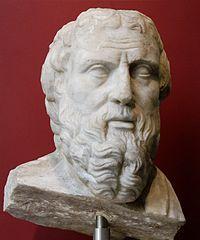
Herodotus

Herodotus Quotes

Historian

Filter quotes by topic

Famous Herodotus Quotes

“(Story on an Egyptian pharaoh) (Close Friends and family disturbed by him not keeping regular hours at court.) _________________________________________ “Sire you are not conducting yourself properly by pursuing worthless past times you ought to be seated solemnly on your stately throne transacting affairs of state throughout the day that way the Egyptians would know that they’re being governed by a competent man and your reputation would improve but as it is, you are not acting at all like a king.” The king retorts: “When archers need to use their bows, they string them tightly but when they are finished using them, they relax them for if a bow where to remain tightly strung all the time it would snap and be of no use when someone needed it. The same principle applies to the daily routine of a human being. If someone wants to work seriously all the time and not let himself ease off for a share of play, he will go insane without even knowing it or at least suffer a stroke. And it is because I recognize this maximum that I allot a share of my time to each aspect of life.”

“He asked, 'Croesus, who told you to attack my land and meet me as an enemy instead of a friend?' The King replied, 'It was caused by your good fate and my bad fate. It was the fault of the Greek gods, who with their arrogance, encouraged me to march onto your lands. Nobody is mad enough to choose war whilst there is peace. During times of peace, the sons bury their fathers, but in war it is the fathers who send their sons to the grave.”

“Those who are skilled in archery bend their bow only when they are preparing to use it; when they do not require it, they allow it to remain unbent, for otherwise it would remain unserviceable when the time for using it arrived. So it is with man. If he were to devote himself unceasingly to a dull round of business, without breaking the monotony by cheerful amusements, he would fall imperceptibly into idiocy, or be struck by paralysis”

“the Egyptians were the first to discover the solar year, and to portion out its course into twelve parts both the space of time and the seasons which they delimit. It was observation of the course of the stars which led them to adopt this divisionIt is also the Egyptians who first bought into use the names of the twelve gods, which the Greeks adopted from them”

“The Persians are very fond of wine ... It is also their general practice to deliberate upon affairs of weight when they are drunk; and then in the morning, when they are sober, the decision to which they came the night before is put before them by the master of the house in which it was made; and if it is then approved they act on it; if not, they set it aside. Sometimes, however, they are sober at their first deliberations, but in this case they always reconsider the matter under the influence of wine.”

“Calumny is a monstrous vice: for, where parties indulge in it, there are always two that are actively engaged in doing wrong, and one who is subject to injury. The calumniator inflicts wrong by slandering the absent; he who gives credit to the calumny before he has investigated the truth is equally implicated. The person traduced is doubly injured--first by him who propagates, and secondly by him who credits the calumny.”

“The Andrians were the first of the islanders to refuse Themistocles' demand for money. He had put it to them that they would be unable to avoid paying, because the Athenians had the support of two powerful deities, one called Persuasion and the other Compulsion.The Andrians had replied that Athens was lucky to have two such useful gods, who were obviously responsible for her wealth and greatness; unfortunately, they themselves, in their small & inadequate land, had two utterly useless deities, who refused to leave the island and insisted on staying; and their names were Poverty and Inability.”

“One man envies the success in life of another, and hates him in secret; nor is he willing to give him good advice when he is consulted, except it be by some wonderful effort of good feeling, and there are, alas, few such men in the world. A real friend, on the other hand, exults in his friend?s happiness, rejoices in all his joys, and is ready to afford him the best advice.”