Quotessence
Home / Authors / Howard Zinn
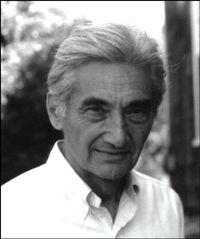
Howard Zinn

Howard Zinn Quotes

Historian

Filter quotes by topic

Famous Howard Zinn Quotes

“And our topic is topsy-turvy: civil disobedience. As soon as you say the topic is civil disobedience, you are saying our problem is civil disobedience. That is not our problem.... Our problem is civil obedience. Our problem is the numbers of people all over the world who have obeyed the dictates of the leaders of their government and have gone to war, and millions have been killed because of this obedience. And our problem is that scene in All Quiet on the Western Front where the schoolboys march off dutifully in a line to war. Our problem is that people are obedient all over the world, in the face of poverty and starvation and stupidity, and war and cruelty. Our problem is that people are obedient while the jails are full of petty thieves, and all the while the grand thieves are running the country. That's our problem.”

“I was astonished, bewildered. This was America, a country where, whatever its faults, people could speak, write, assemble, demonstrate without fear. It was in the Constitution, the Bill of Rights. We were a democracy... But I knew it wasn't a dream; there was a painful lump on the side of my head... The state and its police were not neutral referees in a society of contending interests. They were on the side of the rich and powerful. Free speech? Try it and the police will be there with their horses, their clubs, their guns, to stop you. From that moment on, I was no longer a liberal, a believer in the self-correcting character of American democracy. I was a radical, believing that something fundamental was wrong in this country--not just the existence of poverty amidst great wealth, not just the horrible treatment of black people, but something rotten at the root. The situation required not just a new president or new laws, but an uprooting of the old order, the introduction of a new kind of society--cooperative, peaceful, egalitarian.”

“Indeed, it is impossible to be neutral. In a world already moving in certain directions, where wealth and power are already distributed in certain ways, neutrality means accepting the way things are now. It is a world of clashing interests – war against peace, nationalism against internationalism, equality against greed, and democracy against elitism – and it seems to me both impossible and undesirable to be neutral in those conflicts.”

“Behind the deceptive words designed to entice people into supporting violence -- words like democracy, freedom, self-defense, national security -- there is the reality of enormous wealth in the hands of a few, while billions of people in the world are hungry, sick, homeless.”

“Protest beyond the law is not a departure from democracy; it is absolutely essential to it. It is a corrective to the sluggishness of "the proper channels," a way of breaking through passages blocked by tradition and prejudice. It is disruptive and troublesome, but it is a necessary disruption, a healthy troublesome.”

“We are not hated because we practice democracy, value freedom, or uphold human rights. We are hated because our government denies these things to people in Third World countries whose resources are coveted by multinational corporations. That hatred we have sown has come back to haunt us in the form of terrorism....”

“Majorities can be wrong, majorities can overrule rights of minorities. If majorities ruled, we could still have slavery. 80% of the population once enslaved 20% of the population. While run by majority rule that is ok. That is very flawed notion of what democracy is. Democracy has to take into account several things - proportionate requirements of people, not just needs of the majority, but also needs of the minority. Majority, especially in societies where the media manipulates public opinion, can be totally wrong and evil. People have to act according to conscience and not by majority vote.”

“The democratic principle, enunciated in the words of the Declaration of Independence, declared that government was secondary, that the people who established it were primary. Thus, the future of democracy depended on the people, and their growing consciousness of what was the decent way to relate to their fellow human beings all over the world.”

“If patriotism were defined, not as blind obedience to government, not as submissive worship to flags and anthems, but rather as love of one's country, one's fellow citizens (all over the world), as loyalty to the principles of justice and democracy, then patriotism would require us to disobey our government, when it violated those principles.”

“If democracy were to be given any meaning, if it were to go beyond the limits of capitalism and nationalism, this would not come, if history were any guide, from the top. It would come through citizen's movements, educating, organizing, agitating, striking, boycotting, demonstrating, threatening those in power with disruption of the stability they needed.”