Quotessence
Home / Authors / Jesse Owens
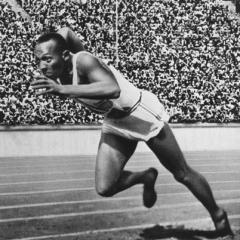
Jesse Owens

Jesse Owens Quotes

Olympic athlete

Filter quotes by topic

Famous Jesse Owens Quotes

“"She (Minnie Ruth Solomon) was unusual because even though I knew her family was as poor as ours, nothing she said or did seemed touched by that. Or by prejudice. Or by anything the world said or did. It was as if she had something inside her that somehow made all that not count. I fell in love with her some the first time we ever talked, and a little bit more every time after that until I thought I couldn't love her more than I did. And when I felt that way, I asked her to marry me . . . and she said she would."”

“To a sprinter, the hundred-yard dash is over in three seconds, not nine or ten. The first 'second' is when you come out of the blocks. The next is when you look up and take your first few strides to attain gain position. By that time the race is actually about half over. The final 'second' - the longest slice of time in the world for an athlete - is that last half of the race, when you really bear down and see what you're made of. It seems to take an eternity, yet is all over before you can think what's happening.”

“Well, I couldn't play an instrument. I'd just stand up front and announce the numbers. They had me sing a little, but that was a horrible mistake. I can't carry a tune in a bucket. We played black theaters and nightclubs all over hell. One-nighters. Apollo Theater in Harlem and the Earle Theater in Philly - That was big time for blacks.”

“People who worked with me or knew me still called me the 'world's fastest human' because I almost never stopped. I'd found that I could get more done with no regular job or regular hours at all, but by being on my own, flying to speak here, help with a public relations campaign for some client there, tape my regular jazz radio show one morning at 5:00 a.m. before leaving on a plane for another city or another continent three hours later to preside over a major sporting event.”

“In the space of less than seven days, I attended a track meet in Boston, flew from there to Bowling Green for the National Jaycees, then to Rochester for the blind, Buffalo for another track meet, New York to shoot a film called The Black Athlete, Miami for Ford Motor Company, back up to New York for 45 minutes to deliver a speech, then into L. A. for another the same night.”

“People say that it was degrading for an Olympic champion to run against a horse, but what was I supposed to do? I had four gold medals, but you can't eat four gold medals. There was no television, no big advertising, no endorsements then. Not for a black man, anyway.”

“There is something that can happen to every athlete and every human being; the instinct to slack off, to give in to pain, to give less than your best; the instinct to hope you can win through luck or through your opponent not doing his best, instead of going to the limit and past your limit where victory is always found. Defeating those negative instincts that are out to defeat us, is the difference between winning and losing - and we all face that battle every day.”

“We all have dreams. But in order to make dreams come into reality, it takes an awful lot of determination, dedication, self-discipline, and effort.”

“The battles that count aren't the ones for gold medals. The struggles within yourself - the invisible, inevitable battles inside all of us - that's where it's at.”

“I always loved running... it was something you could do by yourself, and under your own power. You could go in any direction, fast or slow as you wanted, fighting the wind if you felt like it, seeking out new sights just on the strength of your feet and the courage of your lungs.”

“In the end, it's extra effort that separates a winner from second place. But winning takes a lot more that that, too. It starts with complete command of the fundamentals. Then it takes desire, determination, discipline, and self-sacrifice. And finally, it takes a great deal of love, fairness and respect for your fellow man. Put all these together, and even if you don't win, how can you lose?”

“One day or another every athlete feels like taking it easy. He stops trying to exceed his limits, and thinks he can keep winning because of his lucky star, or the bad luck of his opponents. You must overcome this negative instinct, which affects all of us, and which is the only difference between the person who wins a race, and those who lose. This is the battle you have to fight every day of your life.”

“I wanted no part of politics. And I wasn't in Berlin to compete against any one athlete. The purpose of the Olympics, anyway, was to do your best. As I'd learned long ago from Charles Riley, the only victory that counts is the one over yourself.”