Quotessence
Home / Authors / Pico Iyer Books
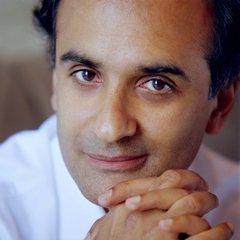
Pico Iyer

Pico Iyer Books

Essayist

The Gate

A source page for quotes linked to Pico Iyer.
0 quotes

Related Quotes

“As I read deeper in the Zen poets, I soon stumbled upon Ikkyū, the fifteenth-century sword-wielding monk of Daitokuji, who had entered a temple at the age of six and gone on to express his contempt for the corrupt monasteries of his time in famously controversial poems. Like the Sixth Dalai Lama, in his way, Ikkyū had been a patron - and a laureate - of the local taverns, and of the pretty girls he had found therein; and like his Tibetan counterpart, or John Donne in our own tradition, he had deliberately conflated the terms of earthly love with those of devotion to the Absolute. The very name he gave himself, "Crazy Cloud", had played subversively on the fact that "cloud water" was a traditional term for monks, who wandered without trace, yet "cloud rain" was a conventional idiom for the act of love. His image of the "red thread" ran through the austere surroundings of his poems as shockingly as the scarlet peonies of Akiko. And in his refusal to kowtow to convention, the maverick monk had turned every certainty on its head: whores, he said, could be like ideal monks - since they inhabited the ideal Zen state of "no min" - while monks, in selling themselves for gold brocade, were scarcely different from whores. Many of his verses trembled with this ambiguity. One couplet, taken one way, was translated as "Making distinctions between good and evil, the monk's skill lies in knowing the essential condition of the Buddha and the Devil"; taken another way, it meant: "That girl is no good, this one will do; the monk's skill is in having the appetite of a devilish Buddha.”

“For some reason I have become terribly serious since arriving here,” Sōseki wrote, in his “Letter from London,” a year after his arrival in England. “Looking and listening to everything around me, I think incessantly of the problem of ‘Japan’s future.’” Its future, then as now, involves trying to make a peace, or form a synthesis, between the ancient Chinese ideal of sitting still and watching the seasons pass, tending to social harmonies, and the new American way of pushing forward individually , convinced that tomorrow will be better than today.”

“Not many years ago, it was access to information and movement that seemed our greatest luxury; nowadays it’s often freedom from information, the chance to sit still, that feels like the ultimate prize. Stillness is not just an indulgence for those with enough resources – it’s a necessity for anyone who wishes to gather less visible resources.”

“In the end, we need two things to lead a balanced life - a sense of the world and a sense of ourselves; it's like breathing in and breathing out. And if you can only get to know the world by stepping out, and losing yourself in experience, you can only get to know the self by stepping back, and finding yourself in contemplation. One without the other leads to a kind of madness.”

“Visiting a new town is like having a conversation. Places ask questions of you just as searchingly as you question them. And, as in any conversation, it helps to listen with an open mind, so you can be led somewhere unexpected. The more you leave assumptions at home, I've found, the better you can hear whatever it is that a destination is trying to say to you.”

“Anybody who travels knows that you're not really doing so in order to move around - you're traveling in order to be moved. And really what you're seeing is not just the Grand Canyon or the Great Wall but some moods or intimations or places inside yourself that you never ordinarily see when you're sleepwalking through your daily life.”

“I love the fact that we can't explain coincidences. I think it's like sometimes you walk into a crowded room and you'll see a stranger and you feel as if you know her better than the friends that you came with. And the very fact that you can't explain it is what gives it its power, that it lies in some deeper or mysterious realm, I think.”

“I began thinking about why am I constructing almost a shadow father or ghost father in my head into Graham Greene in response to the father who created me? What's going on here? I think a part of my sense is it's every boy's story. When we are kids, we imagine that to define ourselves or to find ourselves means charting your own individuality, making your own destiny and actually running away from your parents and your home and what you grew up with.”

“I wanted to bring the book out right now because I think anyone who cares about Tibet knew there would be disturbances in the run up to the Olympics [2008]. Many Tibetans feel it's their last chance to broadcast their suffering and frustration and pain to the world before the Olympics take place and China is accepted as a modern nation and the world forgets about Tibet.”

“I'd spent thirty years visiting the Dalai Lama, and twenty years as a journalist going to difficult places, war zones and revolutions from North Korea to Haiti and Beirut to Sri Lanka, and the question came up: What does this man have to offer to this world which seems so torn up and so attached to conflict?”