Quotessence
Home / Authors / Richard P. Feynman
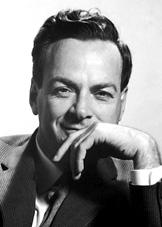
Richard P. Feynman

Richard P. Feynman Quotes

Physicist

Filter quotes by topic

Famous Richard P. Feynman Quotes

“First you guess. Don't laugh, this is the most important step. Then you compute the consequences. Compare the consequences to experience. If it disagrees with experience, the guess is wrong. In that simple statement is the key to science. It doesn't matter how beautiful your guess is or how smart you are or what your name is. If it disagrees with experience, it's wrong. That's all there is to it.”

“What is necessary for 'the very existence of science,' and what the characteristics of nature are, are not to be determined by pompous preconditions, they are determined always by the material with which we work, by nature herself. We look, and we see what we find, and we cannot say ahead of time successfully what it is going to look like. ... It is necessary for the very existence of science that minds exist which do not allow that nature must satisfy some preconceived conditions.”

“The principle of science, the definition, almost, is the following: The test of all knowledge is experiment. Experiment is the sole judge of scientific "truth." But what is the source of knowledge? Where do the laws that are to be tested come from? Experiment, itself, helps to produce these laws, in the sense that it gives us hints. But also needed is imagination to create from these hints the great generalizations--to guess at the wonderful, simple, but very strange patterns beneath them all, and then to experiment to check again whether we have made the right guess.”

“Our freedom to doubt was born out of a struggle against authority in the early days of science. It was a very deep and strong struggle: permit us to question - to doubt - to not be sure. I think that it is important that we do not forget this struggle and thus perhaps lose what we have gained.”

“For a successful technology, reality must take precedence over public relations, for Nature cannot be fooled.”

“We are at the very beginning of time for the human race. It is not unreasonable that we grapple with problems. But there are tens of thousands of years in the future. Our responsibility is to do what we can, learn what we can, improve the solutions, and pass them on.”

“The difficulty really is psychological and exists in the perpetual torment that results from your saying to yourself, "But how can it be like that?" which is a reflection of uncontrolled but utterly vain desire to see it in terms of something familiar. ... If you will simply admit that maybe Nature does behave like this, you will find her a delightful, entrancing thing. Do not keep saying to yourself, if you can possible avoid it, "But how can it be like that?" because you will get 'down the drain', into a blind alley from which nobody has escaped. Nobody knows how it can be like that.”