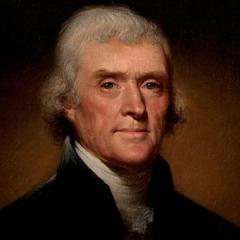
“The right of self-government does not comprehend the government of others.”
Source: The Writings of Thomas Jefferson: Correspondence, cont
“To constrain the brute force of the people, the European governments deem it necessary to keep them down by hard labor, poverty and ignorance, and to take from them, as from bees, so much of their earnings, as that unremitting labor shall be necessary to obtain a sufficient surplus to sustain a scanty and miserable life.”
Source: Memoir, Correspondence, and Miscellanies: From the Papers of Thomas Jefferson
“Government as well as religion has furnished its schisms, its persecutions and its devices for fattening idleness on the earnings of the people.”
Source: The Papers of Thomas Jefferson: 1 October 1814 to 31 August 1815
“We are now vibrating between too much and too little government, and the pendulum will rest finally in the middle.”
Source: The Works of Thomas Jefferson: Correspondence 1786-1787
“We exist, and are quoted, as standing proofs that a government, so modeled as to rest continually on the will of the whole society, is a practicable government.”
Source: Light and Liberty: Reflections on the Pursuit of Happiness
“A noiseless course, not meddling with the affairs of others, unattractive of notice, is a mark that society is going on in happiness. If we can prevent the government from wasting the labors of the people under the pretense of taking care of them, they must become happy.”
Source: The writings of Thomas Jefferson: being his autobiography, correspondence, reports, messages, addresses, and other writings, official and private
“I have so much confidence in the good sense of man, and his qualifications for self-government, that I am never afraid of the issue where reason is left free to exert her force.”
Source: Thomas Jefferson: A Chronology of His Thoughts
“Ignorance and bigotry, like other insanities, are incapable of self-government.”
Source: Memoir, correspondence, and miscellanies from the papers of T. Jefferson
“If virtuous, the government need not fear the fair operation of attack and defense. Nature has given to man no other means of sifting the truth, either in religion, law, or politics.”
Source: Thomas Jefferson: A Chronology of His Thoughts
“The opinions of men are not the object of civil government, nor under its jurisdiction.”
Source: The Essential Jefferson
“A government held together by the bands of reason only, requires much compromise of opinion.”
Source: Correspondence. Reports and opinions while secretarry of state
“The Gothic idea that we were to look backwards instead of forwards for the improvement of the human mind, and to recur to the annals of our ancestors for what is most perfect in government, in religion and in learning, is worthy of those bigots in religion and government by whom it has been recommended, and whose purposes it would answer. But it is not an idea which this country will endure.”
Source: The writings of Thomas Jefferson
“The division into whig and tory is founded in the nature of men; the weakly and nerveless, the rich and the corrupt, seeing more safety and accessibility in a strong executive; the healthy, firm, and virtuous, feeling confidence in their physical and moral resources, and willing to part with only so much power as is necessary for their good government; and, therefore, to retain the rest in the hands of the many, the division will substantially be into Whig and Tory.”
Source: Jefferson: Political Writings
“To me... it appears that there have been differences of opinion and party differences, from the first establishment of government to the present day, and on the same question which now divides our own country; that these will continue through all future time; that every one takes his side in favor of the many, or of the few, according to his constitution, and the circumstances in which he is placed.”
Source: Memoirs, 4: Correspondence and Private Papers
“I am opposed to any form of tyranny over the mind of man.”
“The concentrating of powers in the same hands is precisely the definition of despotic government. It will be no alleviation that these powers will be exercised by a plurality of hands, and not by a single one.”
Source: The Works of Thomas Jefferson: Notes on Virginia II, Correspondence 1782-1786
“Responsibility is a tremendous engine in a free government.”
Source: The Essential Jefferson
“Very many and very meritorious were the worthy patriots who assisted in bringing back our government to its republican tack. To preserve it in that, will require unremitting vigilance.”
Source: Memoir, Correspondence, and Miscellanies: From the Papers of Thomas Jefferson
“I join cordially in admiring and revering the Constitution of the United States, the result of the collected wisdom of our country. That wisdom has committed to us the important task of proving by example that a government, if organized in all its parts on the Representative principle unadulterated by the infusion of spurious elements, if founded, not in the fears & follies of man, but on his reason, on his sense of right, on the predominance of the social over his dissocial passions, may be so free as to restrain him in no moral right, and so firm as to protect him from every moral wrong.”
“[T]he States can best govern our home concerns and the general government our foreign ones. I wish, therefore . . . never to see all offices transferred to Washington, where, further withdrawn from the eyes of the people, they may more secretly be bought and sold at market.”
“We established however some, although not all its [self-government] important principles . The constitutions of most of our States assert, that all power is inherent in the people; that they may exercise it by themselves, in all cases to which they think themselves competent, (as in electing their functionaries executive and legislative, and deciding by a jury of themselves, in all judiciary cases in which any fact is involved,) or they may act by representatives, freely and equally chosen; that it is their right and duty to be at all times armed.”
Source: Jefferson: Political Writings
“A rigid economy of the public contributions and absolute interdiction of all useless expenses will go far towards keeping the government honest and unoppressive.”
Source: Thomas Jefferson: Thoughts on War and Revolution : Annotated Correspondence
“It is a wise rule and should be fundamental in a government disposed to cherish its credit, and at the same time to restrain the use of it within the limits of its faculties, "never to borrow a dollar without laying a tax in the same instant for paying the interest annually, and the principal within a given term; and to consider that tax as pledged to the creditors on the public faith."”
Source: Memoirs, Correspondence and Private Papers of Thomas Jefferson, Late President of the United States
“But with respect to future debt; would it not be wise and just for that nation to declare in the constitution they are forming that neither the legislature, nor the nation itself can validly contract more debt, than they may pay within their own age, or within the term of 19 years.”
Source: Thomas Jefferson: Thoughts on War and Revolution : Annotated Correspondence
“The natural aristocracy I consider as the most precious gift of nature for the instruction, the trusts, and government of society. And indeed it would have been inconsistent in creation to have formed man for the social state, and not to have provided virtue and wisdom enough to manage the concerns of the society. May we not even say that that form of government is the best which provides the most - for a pure selection of these natural aristoi into the offices of government?”
Source: The Essential Jefferson
“The germ of dissolution of our federal government is in the constitution of the federal judiciary; an irresponsible body, (for impeachment is scarcely a scare-crow) working like gravity by night and by day, gaining a little today and a little tomorrow, and advancing its noiseless step like a thief, over the field of jurisdiction, until all shall be usurped from the States, and the government of all be consolidated into one.”
“It has also been a great solace to me, to believe that you are engaged in vindicating to posterity the course we have pursued for preserving to them, in all their purity, the blessings of self-government, which we had assisted too in acquiring for them. If ever the earth has beheld a system of administration conducted with a single and steadfast eye to the general interest and happiness of those committed to it, one which, protected by truth, can never know reproach, it is that to which our lives have been devoted.”
Source: The Essential Jefferson
“Taxes should be continued by annual or biennial reeactments, because a constant hold, by the nation, of the strings of the public purse is a salutary restraint from which an honest government ought not wish, nor a corrupt one to be permitted, to be free.”
Source: The writings of Thomas Jefferson
“[The people] are in truth the only legitimate proprietors of the soil and government.”
“A judiciary independent of a king or executive alone, is a good thing; but independence of the will of the nation is a solecism, at least in a republican government.”
Source: Memoirs, Correspondence and Private Papers of Thomas Jefferson, Late President of the United States
“The judiciary of the United States is the subtle corps of sappers and miners constantly working under ground to undermine the foundations of our confederated fabric. They are construing our constitution from a co-ordination of a general and special government to a general and supreme one alone.”
Source: Correspondence. Reports and opinions while secretarry of state
“[T]he opinion which gives to the judges the right to decide what laws are constitutional and what not, not only for themselves, in their, own sphere of action, but for the Legislature and Executive also in their spheres, would make the Judiciary a despotic branch.”
Source: Memoir, correspondence, and miscellanies from the papers of T. Jefferson
“The great object of my fear is the federal judiciary. That body, like gravity, ever acting, with noiseless foot, and unalarming advance, gaining ground step by step, and holding what it gains, is ingulfing insidiously the special governments into the jaws of that which feeds them.”
Source: The Real Thomas Jefferson
“Legislators invent too many devices for subdividing property, only taking care to let their subdivisions go hand in hand with the natural affections of the human mind.”
Source: The Essential Jefferson
“[A]lthough a republican government is slow to move, yet when once in motion, its momentum becomes irresistible.”
Source: The writings of Thomas Jefferson: being his autobiography, correspondence, reports, messages, addresses, and other writings, official and private : published by the order of the Joint Committee of Congress on the Library, from the original manuscripts, deposited in the Department of State
“If, then, the control of the people over the organs of their government be the measure of its republicanism, and I confess I know no other measure, it must be agreed that our governments have much less of republicanism than ought to have been expected; in other words, that the people have less regular control over their agents, than their rights and their interests require.”
Source: Memoir, correspondence, and miscellanies from the papers of T. Jefferson
“I considered 4 of these bills [of the revised code of Virginia] as forming a system by which every fibre would be eradicated of antient or future aristocracy; and a foundation laid for a government truly republican.”
“The principle of the Constitution is that of a separation of legislative, Executive and Judiciary functions, except in cases specified. If this principle be not expressed in direct terms, it is clearly the spirit of the Constitution, and it ought to be so commented and acted on by every friend of free government.”
Source: The Papers of Thomas Jefferson, Volume 29: 1 March 1796 to 31 December 1797
“I hold it that a little rebellion, now and then, is a good thing, and as necessary in the political world as storms are in the physical. Unsuccessful rebellions, indeed, generally establish the encroachments on the rights of the people, which have produced them. An observation of this truth should render honest republican governors so mild in their punishment of rebellions, as not to discourage them too much. It is medicine necessary for the sound health of government.”
“But when a long train of abuses and usurpations, pursuing invariably the same Object evinces a design to reduce them under absolute Despotism, it is their right, it is their duty, to throw off such Government, and to provide new Guards for their future security.”
Source: The Works of Thomas Jefferson: Correspondence 1771 - 1779, the Summary View, and the Declaration of Independence
“We hold these truths to be self-evident, that all men are created equal, that they are endowed by their Creator with certain inalienable rights, among these are life, liberty, and the pursuit of happiness, that to secure these rights governments are instituted among men. We...solemnly publish and declare, that these colonies are and of a right ought to be free and independent states...and for the support of this declaration, with a firm reliance on the protection of divine providence, we mutually pledge our lives, our fortunes, and our sacred honour.”
Source: Thomas Jefferson, His Words and Vision
“The most sacred of the duties of a government [is] to do equal and impartial justice to all its citizens.”
Source: Correspondence
“It is to secure our rights that we resort to government at all.”
Source: The writings of Thomas Jefferson
“If we are made in some degree for others, yet in a greater are we made for ourselves. It were contrary to feeling and indeed ridiculous to suppose that a man had less rights in himself than one of his neighbors, or indeed all of them put together. This would be slavery, and not that liberty which the bill of rights has made inviolable, and for the preservation of which our government has been charged.”
Source: The writings of Thomas Jefferson: being his autobiography, correspondence, reports, messages, addresses, and other writings, official and private : published by the order of the Joint Committee of Congress on the Library, from the original manuscripts, deposited in the Department of State
“The equal rights of man and the happiness of every individual are now acknowledged to be the only legitimate objects of government.”
Source: Light and Liberty: Reflections on the Pursuit of Happiness
“When we come to the moral principles on which the government is to be administered, we come to what is proper for all conditions of society. Liberty, truth, probity, honor, are declared to be the four cardinal principles of society. I believe that morality, compassion, generosity, are innate elements of the human constitution; that there exists a right independent of force.”
Source: The Essential Jefferson
“I consider ethics, as well as religion, as supplements to law in the government of man.”
Source: The Writings of Thomas Jefferson: Correspondence. Reports and opinions while secretary of state
“In every government on earth is some trace of human weakness, some germ of corruption and degeneracy, which cunning will discover, and wickedness insensibly open, cultivate and improve.”
Source: Notes on the State of Virginia
“Those characters wherein fear predominates over hope may apprehend too much from...instances of irregularity. They may conclude too hastily that nature has formed man insusceptible of any other government than that of force, a conclusion not founded in truth nor experience.”
“No government can continue good, but under the control of the people.”
Source: Memoirs, correspondence and private papers of Thomas Jefferson, ed. by T.J. Randolph