Quotessence
Home / Authors / Thomas Jefferson
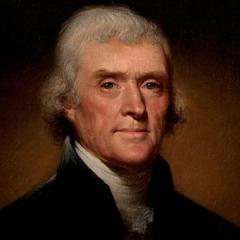
Thomas Jefferson

Thomas Jefferson Quotes

3rd U.S. President

Filter quotes by topic

Famous Thomas Jefferson Quotes

“The clergy, by getting themselves established by law and in-grafted into the machine of government, have been a very formidable engine against the civil and religious rights of man.”

“Believing with you that religion is a matter which lies solely between man and his God, that he owes account to none other for his faith or his worship, that the legislative powers of government reach actions only, and not opinions, I contemplate with sovereign reverence that act of the whole American people which declared that their legislature should 'make no law respecting an establishment of religion, or prohibiting the free exercise thereof,' thus building a wall of separation between church and State.”

“We have solved, by fair experiment, the great and interesting question whether freedom of religion is compatible with order in government and obedience to the laws. And we have experienced the quiet as well as the comfort which results from leaving every one to profess freely and openly those principles of religion which are the inductions of his own reason and the serious convictions of his own inquiries.”

“I consider the government of the United States as interdicted by the Constitution from intermeddling with religious institutions, their doctrines, discipline, or exercises. This results not only from the provision that no law shall be made respecting the establishment or free exercise of religion, but from that also which reserves to the States the powers not delegated to the United States. Certainly, no power to prescribe any religious exercise or to assume authority in any religious discipline has been delegated to the General Government. It must then rest with the States.”

“The opinions of men are not the object of civil government, nor under its jurisdiction; that to suffer the civil magistrate to intrude his powers into the field of opinion and to restrain the profession or propagation of principles on supposition of their ill tendency is a dangerous falacy, which at once destroys all religious liberty...”

“I consider the government of the U.S. as interdicted by the Constitution from intermeddling with religious institutions, their doctrines, discipline, or exercises.”

“Take not from the mouth of labor the bread it has earned.”

“Single acts of tyranny may be ascribed to the accidental opinion of the day; but a series of oppressions, begun at a distinguished period, and pursued unalterably through every change of ministers (adminstrators) too plainly proves a deliberate, systematic plan of reducing us to slavery.”

“The way to have good and safe government is not to trust it all to one, but to divide it among the many, distributing to everyone exactly the functions in which he is competent ... It is by dividing and subdividing these Republics from the great national one down through all its subordinations until it ends in the administration of everyman's farm by himself, by placing under everyone what his own eye may superintend, that all will be done for the best.”

“Why suspend the habeas corpus in insurrections and rebellions? Examine the history of England. See how few of the cases of the suspension of the habeas corpus law have been worthy of that suspension. They have been either real treasons, wherein the parties might as well have been charged at once, or sham plots, where it was shameful they should ever have been suspected. Yet for the few cases wherein the suspension of the habeas corpus has done real good, that operation is now become habitual and the minds of the nation almost prepared to live under its constant suspension.”

“An elective despotism was not the government we fought for, but one which should not only be founded on true free principles, but in which the powers of government should be so divided and balanced among general bodies of magistracy, as that no one could transcend their legal limits without being effectually checked and restrained by the others.”

“The mobs of the great cities add just so much to the support of pure government as sores do to the strength of the human body. It is the manners and spirit of a people which preserve a republic in vigor. A degeneracy in these is a canker which soon eats to the heart of its laws and constitution.”

“I believe that banking institutions are more dangerous to our liberties than standing armies. Already they have raised up a moneyed aristocracy that has set the Government at defiance. The issuing power should be taken from the banks and restored to the people to whom it properly belongs.”

“No government can continue good but under the control of the people; and . . . . their minds are to be informed by education what is right and what wrong; to be encouraged in habits of virtue and to be deterred from those of vice . . . . These are the inculcations necessary to render the people a sure basis for the structure and order of government.”

“I have ever deemed it fundamental for the United States never to take active part in the quarrels of Europe. Their political interests are entirely distinct from ours. Their mutual jealousies, their balance of power, their complicated alliances, their forms and principles of government, are all foreign to us. They are nations of eternal war.”

“The basis of our governments being the opinion of the people, the very first object should be to keep that right; and were it left to me to decide whether we should have a government without newspapers or newspapers without a government, I should not hesitate a moment to prefer the latter. But I should mean that every man should receive those papers and be capable of reading them.”

“There are two subjects, indeed, which I shall claim a right to further as long as I breathe: the public education, and the sub-division of counties into wards. I consider the continuance of republican government as absolutely hanging on these two hooks.”

“It is (our) duty . . . to pay especial attention to the principles of government which shall be inculcated therein (at the University), and to provide that none shall be inculcated which are incompatible with those on which the Constitutions of this State, and of the United States were genuinely based, in the common opinion; and for this purpose it may be necessary to point out specially where these principles are to be found legitimately developed.”

“The legitimate powers of government extend to such acts only as are injurious to others.”

“Certainly, no power to prescribe any religious exercise, or to assume authority in religious discipline, has been delegated to the General Government.”

“The legislative powers of government reach actions only and not opinions.”

“By nature's law, every man has a right to seize and retake by force his own property taken from him by another, by force of fraud. Nor is this natural right among the first which is taken into the hands of regular government after it is instituted. It was long retained by our ancestors. It was a part of their common law, laid down in their books, recognized by all the authorities, and regulated as to circumstances of practice.”

“No government can be maintained without the principle of fear as well as duty. Good men will obey the last, but bad ones the former only. If our government ever fails, it will be from this weakness.”

“It behooves our citizens to be on their guard, to be firm in their principles, and full of confidence in themselves. We are able to preserve our self-government if we will but think so.”

“Most codes extend their definitions of treason to acts not really against one's country. They do not distinguish between acts against the government, and acts against the oppressions of the government. The latter are virtues, yet have furnished more victims to the executioner than the former. Real treasons are rare; oppressions frequent. The unsuccessful strugglers against tyranny have been the chief martyrs of treason laws in all countries.”

“A single good government becomes... a blessing to the whole earth, its welcome to the oppressed restraining within certain limits the measure of their oppressions. But should even this be counteracted by violence on the right of expatriation, the other branch of our example then presents itself for imitation: to rise on their rulers and do as we have done.”

“A first attempt to recover the right of self government may fail, so may a second, a third, etc. But as a younger and more instructed race comes on, the sentiment becomes more and more intuitive, and a fourth, a fifth, or some subsequent one of the ever renewed attempts will ultimately succeed... To attain all this, however, rivers of blood must yet flow, and years of desolation pass over; yet the object is worth rivers of blood and years of desolation. For what inheritance so valuable can man leave to his posterity?”

“A government regulating itself by what is wise and just for the many, uninfluenced by the local and selfish views of the few who direct their affairs, has not been seen, perhaps, on earth. Or if it existed for a moment at the birth of ours, it would not be easy to fix the term of its continuance. Still, I believe it does exist here in a greater degree than anywhere else; and for its growth and continuance... I offer sincere prayers.”

“May [our Declaration of Independence] be to the world, what I believe it will be (to some parts sooner, to others later, but finally to all), the signal of arousing men to burst the chains under which monkish ignorance and superstition had persuaded them to bind themselves, and to assume the blessings and security of self-government... All eyes are opened, or opening, to the rights of man.”

“The excellence of every government is its adaptation to the state of those to be governed by it.”