Quotessence
Home / Authors / Aldo Leopold
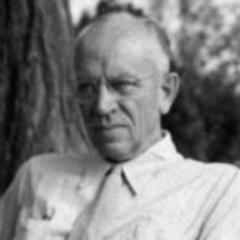
Aldo Leopold

Aldo Leopold Quotes

Author

Filter quotes by topic

Famous Aldo Leopold Quotes

“There is, as yet, no sense of pride in the husbandry of wild plants and animals, no sense of shame in the proprietorship of a sick landscape. We tilt windmills in behalf of conservation in convention halls and editorial offices, but on the back forty we disclaim even owning a lance.”

“The real jewel of my disease-ridden woodlot is the prothonotary warbler. ... The flash of his gold-and-blue plumage amid the dank decay of the June woods is in itself proof that dead trees are transmuted into living animals, and vice versa.”

“There are men charged with the duty of examining the construction of the plants, animals, and soils which are the instruments of the great orchestra. These men are called professors. Each selects one instrument and spends his life taking it apart and describing its strings and sounding boards. This process of dismemberment is called research. The place for dismemberment is called a university.”

“The last word in ignorance is the man who says of an animal or plant, "What good is it?" If the land mechanism as a whole is good, then every part is good, whether we understand it or not. If the biota, in the course of aeons, has built something we like but do not understand, then who but a fool would discard seemingly useless parts? To keep every cog and wheel is the first precaution of intelligent tinkering.”

“All ethics so far evolved rest upon a single premise: that the individual is a member of a community of interdependent parts. . . The land ethic simply enlarges the boundaries of the community to include soils, waters, plants, and animals, or collectively: the land.”

“This song of the waters is audible to every ear, but there is other music in these hills, by no means audible to all. On a still night, when the campfire is low and the Pleiades have climbed over rimrocks, sit quietly and listen, and think hard of everything you have seen and tried to understand. Then you may hear it - a vast pulsing harmony - its score inscribed on a thousand hills, its notes the lives and deaths of plants and animals, its rhythms spanning the seconds and the centuries.”

“My favorite quote: The land ethic simply enlarges the boundaries of the community to include soils, waters, plants, and animals, or collectively: the land. In short, a land ethic changes the role of Homo sapiens from conqueror of the land-community to plain member and citizen of it. It implies respect for his fellow-members, and also respect for the community as such.”

“We realize the indivisibility of the earth - its soil, mountains, rivers, forests, climate, plants, and animals - and respect it collectively not only as a useful servant but as a living being, vastly less alive than ourselves in degree, but vastly greater than ourselves in time and space - a being that was old when the morning stars sang together, and when the last of us has been gathered unto his fathers, will still be young.”

“One of the anomalies of modern ecology is the creation of two groups, each of which seems barely aware of the existence of the other. The one studies the human community, almost as if it were a separate entity, and calls its findings sociology, economics and history. The other studies the plant and animal community and comfortably relegates the hodge-podge of politics to the liberal arts. The inevitable fusion of these two lines of thought will, perhaps, constitute the outstanding advance of this century.”

“There is yet no ethic dealing with man's relation to land and to the animals and plants which grow upon it. Land, like Odysseus' slave-girls, is still property. The land-relation is still strictly economic, entailing privileges but not obligations.”