Quotessence
Home / Authors / Anton Chekhov Books
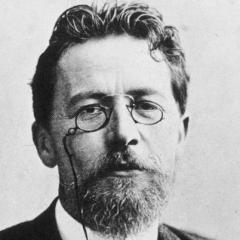
Anton Chekhov

Anton Chekhov Books

Physician

Чайка

A source page for quotes linked to Anton Chekhov.
0 quotes

Related Quotes

“If only you would go to the university," he said. "Only enlightened and holy people are interesting, it's only they who are wanted. The more of such people there are, the sooner the Kingdom of God will come on earth. Of your town then not one stone will be left, everything will he blown up from the foundations, everything will be changed as though by magic. And then there will be immense, magnificent houses here, wonderful gardens, marvellous fountains, remarkable people.... But that's not what matters most. What matters most is that the crowd, in our sense of the word, in the sense in which it exists now -- that evil will not exist then, because every man will believe and every man will know what he is living for and no one will seek moral support in the crowd. Dear Nadya, darling girl, go away! Show them all that you are sick of this stagnant, grey, sinful life. Prove it to yourself at least!”

“What they sang had occurred to him before, but this thought had somehow sat behind other thoughts in his head and flashed timidly, like a distant lantern in misty weather. And he felt that this suicide and the peasant’s grievances lay in his conscience too; to be reconciled with the fact that these people, submissive to their lot, heaped on themselves what was heaviest and darkest in life — how terrible it was! To be reconciled with that, and to wish for oneself a bright, boisterous life among happy, contented people, and to dream constantly of such a life, meant to dream of new suicides by overworked, careworn people, or by weak neglected people, whom one sometimes talked about with vexation or mockery over dinner, but whom one did not go to help.”

“Little girls ought to be taught and brought up with boys, so that they might be always together. A woman ought to be trained so that she may be able, like a man, to recognise when she's wrong, or she always thinks she's in the right. Instil into a little girl from her cradle that a man is not first of all a cavalier or a possible lover, but her neighbour, her equal in everything. Train her to think logically, to generalise, and do not assure her that her brain weighs less than a man's and that therefore she can be indifferent to the sciences, to the arts, to the tasks of culture in general. The apprentice to the shoemaker or the house painter has a brain of smaller size than the grown-up man too, yet he works, suffers, takes his part in the general struggle for existence. We must give up our attitude to the physiological aspect, too -- to pregnancy and childbirth, seeing that in the first place women don't have babies every month; secondly, not all women have babies; and, thirdly, a normal countrywoman works in the fields up to the day of her confinement and it does her no harm. Then there ought to be absolute equality in everyday life. If a man gives a lady his chair or picks up the handkerchief she has dropped, let her repay him in the same way. I have no objection if a girl of good family helps me to put on my coat or hands me a glass of water --”

“Ivanov: I am a bad, pathetic and worthless individual. One needs to be pathetic, too, worn out and drained by drink, like Pasha, to be still fond of me and to respect me. My God, how I despise myself! I so deeply loathe my voice, my walk, my hands, these clothes, my thoughts. Well, isn't that funny, isn't that shocking? Less than a year ago I was healthy and strong, I was cheerful, tireless, passionate, I worked with these very hands, I could speak to move even Philistines to tears, I could cry when I saw grief, I became indignant when I encountered evil. I knew inspiration, I knew the charm and poetry of quiet nights when from dusk to dawn you sit at your desk or indulge you mind with dreams. I believed, I looked into the future as into the eyes of my own mother... And now, my God, I am exhausted, I do not believe, I spend my days and nights in idleness.”

“Anna Petrovna: Kolya, my dearest, stay at home. Ivanov: My love, my unhappy darling, I beg you, don't stop me going out in the evenings. It's cruel and unjust on my part, but let me commit that injustice. It's an agony for me at home. As soon as the sun disappears, my spirit begins to be weighed down by depression. What depression! Don't ask why. I myself don't know. I swear by God's truth I don't know. Here I'm in anguish, I go to the Lebedevs and there it's still worse; I return from there and here it's depression again, and so all night... Simply despair!”

“They were tough and sour, but as Pushkin said, 'Dearer to us than a host of truths is an exalting illusion.' I saw a happy man, whose cherished dream had so obviously come true, who had attained his goal in life, had gotten what he wanted, who was content with his fate and with himself. For some reason there had always been something sad mixed with my thoughts about human happiness, but now, at the sight of a happy man, I was overcome by an oppressive feeling close to despair. - Gooseberries”

“Ivanov: With a heavy head, with a slothful spirit, exhausted, overstretched, broken, without faith, without love, without a goal, I roam like a shadow among men and I don't know who I am, why I'm alive, what I want. And I now think that love is nonsense, that embraces are cloying, that there's no sense in work, that song and passionate speeches are vulgar and outmoded. And everywhere I take with me depression, chill boredom, dissatisfaction, revulsion from life... I am destroyed, irretrievably!”

“A man who under the influence of mental pain or unbearably oppressive suffering sends a bullet through his own head is called a suicide; but for those who give freedom to their pitiful, soul-debasing passions in the holy days of spring and youth there is no name in man's vocabulary. After the bullet follows the peace of the grave: ruined youth is followed by years of grief and painful recollections. He who has profaned his spring will understand the present condition of my soul. I am not yet old, or grey, but I no longer live. Psychiaters tell us that a solider, who was wounded at Waterloo, went mad, and afterwards assured everybody - and believed it himself - that he had died at Waterloo, and that what was now considered to be him was only his shadow, a reflection of the past. I am now experiencing something resembling this semi-death..”

“He [Ivan Alexeyevich Ognev] walked along, and he thought how often it happens in life that one meets wonderful people and what a pity it was that nothing remains of these meetings but memories. Sometimes a flight of cranes will pass like a flash across the horizon and a light wind carries back their wailing, rapturous cry, but a minute later, no matter how greedily you may peer into the blue distance, you will not see a sign of them nor hear a sound--in just the same way people, with their faces and words, will flash into our lives and melt into our past, leaving nothing behind but insignificant traces in the memory. (Verochka, 1887)”

“People say that a person needs six feet of earth. But in fact it's a corpse that needs six feet of earth, not a person. People don’t need six feet of earth, or even a house in the country, but the whole globe, the whole of nature in its entirety, so they can have the space to express all the capacities and particularities of their free spirit.”

“لماذا نمنع الناس من أن يموتوا إذا كان الموت هو النهاية الطبيعية للإنسان؟ وما الفائدة من مد حياة تاجر أو موظف خمس أو عشر سنوات؟ وإذا اعتبرنا أن هدف الدواء هو تخفيفي الألم يقفز إلى الذهن السؤال التالى: ولم نخففها؟ أولا: يقال إن الآلام تساعد الإنسان على بلوغ الكمال، وثانيا: إذا تعلمت الإنسانية فعلا أن تخفف آلامها بالحبوب والنقط فإنها ستهمل الدين والفلسفة تماما، لأنها للآن تجد فيهما بلسما لكل المصائب.”

“Anna Petrovna: Do you know what, Kolya? Try and sing, laugh, get angry, as you once did... You stay in, we'll laugh and drink fruit liqueur and we'll drive away your depression in a flash. I'll sing if you like. Or else let's go and sit in the dark in your study as we used to, and you'll tell me about your depression... You have such suffering eyes. I'll look into them and cry, and we'll both feel better.”

“Ivanov: No, my clever young thing, it's not a question of romance. I say as before God that I will endure everything - depression and mental illness and ruin and the loss of my wife and premature old age and loneliness - but I cannot tolerate, cannot endure being ridiculous in my own eyes. I'm dying of shame at the thought that I, a healthy, strong man, have turned into some sort of Hamlet or Manfred, some sort of 'superfluous man'... devil knows precisely what! There are pitiful people who are flattered by being called Hamlet or superfluous men, but for me it's a disgrace! It stirs up my pride, I'm overcome by shame and I suffer...”

“Dear, highly esteemed bookcase, I salute you. For over a hundred years you have devoted yourself to the glorious ideals of goodness and justice. Throughout the hundred years your silent appeal to fruitful work has never faltered. It sustained [through tears] in several generations of our family, their courage and faith in a better future and fostered in us the ideals of goodness and social consciousness.”

“...there’s a great deal which I don’t understand in people. In a human being everything should be beautiful: the face, the clothes, the soul, the thoughts. . . .Often I see a beautiful face and clothes, so beautiful that my head gets giddy with rapture; but as for the soul and thoughts, my God! In a beautiful outside there’s sometimes hidden such a black soul that no whitening can rub it off...”

“Lebedev: France has a clear and defined policy... The French know what they want. They just want to wipe out the Krauts, finish, but Germany, my friend, is playing a very different tune. Germany has many more birds in her sights than just France... Shabelsky: Nonsense! ...In my view the German are cowards and the French are cowards... They're just thumbing their noses at each other. Believe me, things will stop there. They won't fight. Borkin: And as I see it, why fight? What's the point of these armaments, congresses, expenditures? You know what I'd do? I'd gather together dogs from all over the country, give them a good dose of rabies and let them loose in enemy country. In a month all my enemies would be running rabid.”

“In short, the man displayed a constant and insurmountable impulse to wrap himself in a covering, to make himself, so to speak, a case which would isolate him and protect him from external influences. Reality irritated him, frightened him, kept him in continual agitation, and, perhaps to justify his timidity, his aversion for the actual, he always praised the past and what had never existed; and even the classical languages which he taught were in reality for him goloshes and umbrellas in which he sheltered himself from real life.”