Quotessence
Home / Authors / Carl Sagan
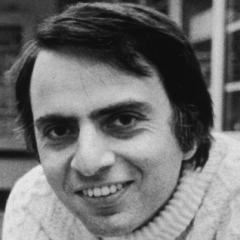
Carl Sagan

Carl Sagan Quotes

Astronomer

Filter quotes by topic

Famous Carl Sagan Quotes

“There are many other (besides testosterone) behaviour-eliciting hormones fundamental for humen well-being, including estrogen and progesterone in females. The fact that complex behavioural patterns can be triggered by a tiny concentration of moleculas coursing through the bloodstream, and that different animals of the same species generate different amounts of these hormones, is something worth thinking about when it's time to judge such matters as free will, individual responsibility, and law and order.”

“At a few hundred kilometers altitude, the Earth fills half your sky, and the band of blue that stretches from Mindanao to Bombay, which your eye encompasses in a single glance, can break your heart with its beauty. Home you think. Home. This is my world. This is where I come from. Everyone I know, everyone I ever heard of, grew up down there, under that relentless and exquisite blue.”

“He sought a way to preserve the past. John Hershel was one of the founders of a new form of time travel.... a means to capture light and memories. He actually coined a word for it... photography. When you think about it, photography is a form of time travel. This man is staring at us from across the centuries, a ghost preserved by light.”

“The impediment to scientific thinking is not, I think, the difficulty of the subject. Complex intellectual feats have been mainstays even of oppressed cultures. Shamans, magicians and theologians are highly skilled in their intricate and arcane arts. No, the impediment is political and hierarchical.”

“Science is much more than a body of knowledge. It is a way of thinking. This is central to its success. Science invites us to let the facts in, even when they don't conform to our preconceptions. It counsels us to carry alternative hypotheses in our heads and see which ones best match the facts. It urges on us a fine balance between no-holds-barred openness to new ideas, however heretical, and the most rigorous skeptical scrutiny of everything - new ideas and established wisdom.”

“That kind of skeptical, questioning, "don't accept what authority tells you" attitude of science - is also nearly identical to the attitude of mind necessary for a functioning democracy. Science and democracy have very consonant values and approaches, and I don't think you can have one without the other.”

“I would love to believe that when I die I will live again, that some thinking, feeling, remembering part of me will continue. But as much as I want to believe that, and despite the ancient and worldwide cultural traditions that assert an afterlife, I know of nothing to suggest that it is more than wishful thinking.”

“The near side of a galaxy is tens of thousands of light-years closer to us than the far side; thus we see the front as it was tens of thousands of years before the back. But typical events in galactic dynamics occupy tens of millions of years, so the error in thinking of an image of a galaxy as frozen in one moment of time is small.”

“If we can't think for ourselves, if we're unwilling to question authority, then we're just putty in the hands of those in power. But if the citizens are educated and form their own opinions, then those in power work for us. In every country, we should be teaching our children the scientific method and the reasons for a Bill of Rights. With it comes a certain decency, humility and community spirit. In the demon-haunted world that we inhabit by virtue of being human, this may be all that stands between us and the enveloping darkness.”

“Think of how many religions attempt to validate themselves with prophecy. Think of how many people rely on these prophecies, however vague, however unfulfilled, to support or prop up their beliefs. Yet has there ever been a religion with the prophetic accuracy and reliability of science? ... No other human institution comes close.”

“The Earth is a very small stage in a vast cosmic arena. Think of the rivers of blood spilled by all those generals and emperors so that, in glory and triumph, they could become the momentary masters of a fraction of a dot. Think of the endless cruelties visited by the inhabitants of one corner of this pixel on the scarcely distinguishable inhabitants of some other corner, how frequent their misunderstandings, how eager they are to kill one another, how fervent their hatreds.”

“We are an intelligent species and the use of our intelligence quite properly gives us pleasure. In this respect the brain is like a muscle. When we think well, we feel good. Understanding is a kind of ecstasy.”

“For myself, I like a universe that, includes much that is unknown and, at the same time, much that is knowable. A universe in which everything is known would be static and dull, as boring as the heaven of some weak-minded theologians. A universe that is unknowable is no fit place for a thinking being. The ideal universe for us is one very much like the universe we inhabit. And I would guess that this is not really much of a coincidence.”

“As agonizing a disease as cancer is, I do not think it can be said that our civilization is threatened by it. ... But a very plausible case can be made that our civilization is fundamentally threatened by the lack of adequate fertility control. Exponential increases of population will dominate any arithmetic increases, even those brought about by heroic technological initiatives, in the availability of food and resources, as Malthus long ago realized.”

“You mean am I for it or against it? You think this is a key question I'm going to be asked on Vega, and you want to make sure I give the right answer? Okay. Overpopulation is why I'm in favor of homosexuality and a celibate clergy. A celibate clergy is an especially good idea, because it tends to suppress any hereditary propensity toward fanaticism.”

“These are all cases of proved or presumptive baloney. A deception arises, sometimes innocently but collaboratively, sometimes with cynical premeditation. Usually the victim is caught up in a powerful emotion -- wonder, fear, greed, grief. Credulous acceptance of baloney can cost you money; that's what P. T. Barnum meant when he said, 'There's a sucker born every minute.' But it can be much more dangerous than that, and when governments and societies lose the capacity for critical thinking, the results can be catastrophic -- however sympathetic we may be to those who have bought the baloney.”

“We are the product of 4.5 billion years of fortuitous, slow biological evolution. There is no reason to think that the evolutionary process has stopped. Man is a transitional animal. He is not the climax of creation.”

“If we offer too much silent assent about mysticism and superstition - even when it seems to be doing a little good - we abet a general climate in which scepticism is considered impolite, science tiresome, and rigorous thinking somehow stuffy and inappropriate.”

“We are rare and precious because we are alive, because we can think as well as we can. We are privileged to influence and perhaps control our future. I believe we have an obligation to fight for life on Earth - not just for ourselves, but for all those, humans and others, who came before us, and to whom we are beholden, and for all those who, if we are wise enough, will come after.”

“What distinguishes our species is thought. The cerebral cortex is in a way a liberation. We need no longer be trapped in the genetically inherited behavior patterns of lizards and baboons: territoriality and aggression and dominance hierarchies. We are each of us largely responsible for what gets put in to our brains. For what as adults we wind up caring for and knowing about. No longer at the mercy of the reptile brain we can change ourselves. Think of the possibilities.”

“In college, in the early 1950s, I began to learn a little about how science works, the secrets of its great success, how rigorous the standards of evidence must be if we are really to know something is true, how many false starts and dead ends have plagued human thinking, how our biases can colour our interpretation of evidence, and how often belief systems widely held and supported by the political, religious and academic hierarchies turn out to be not just slightly in error, but grotesquely wrong.”

“Science is a way of thinking much more than it is a body of knowledge. Its goal is to find out how the world works, to seek what regularities there may be, to penetrate to the connections of things-from subatomic particles, which may be the constituents of all matter, to living organisms, the human social community, and thence to the cosmos as a whole.”