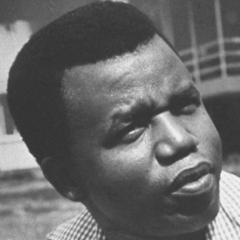
Quotessence
Home / Authors / Chinua Achebe
Chinua Achebe

Chinua Achebe Quotes

Novelist

Filter quotes by topic

Famous Chinua Achebe Quotes

“I do not think that there need be the conflict between books and videos, that one would drive out the other. It certainly is possible to watch the screen for some things and for others to sit down and read, because the screen is easier to do, to watch is easier than to read because you don't have to contemplate anything. Someone else has done the work of putting it on the video.”

“Naming is like putting a stamp on something and fixing it. A kind of formaldehyde sort of fixation, but it becomes dead, sitting there forever, frozen. So, I'm not a great one for these modernist, post modernist, post colonial labels. I think they serve certain purpose. You do need some kind of sign post here and there, but it can also become an end in itself.”

“I think that is one of the first things that I got clear in my mind when I began to play around with fiction, that I had to find a language and it was not in existance at the time. You have put it very well - it wasn't to be taken for granted. You had to go on and search until you found a way through the conversation of English and Igbo. The two languages stuck into each other and tried to find a way to express through one, the medium of the thoughts. That's a very exciting thing to do, a very difficult thing to do.”

“The white man is very clever. He came quietly and peaceably with his religion. We were amused at his foolishness and allowed him to stay. Now he has won our brothers, and our clan can no longer act like one. He has put a knife on the things that held us together and we have fallen apart.”

“Unoka went into an inner room and soon returned with a small wooden disc containing a kola nut, some alligator pepper and a lump of white chalk. "I have kola," he announced when he sat down, and passed the disc over to his guest. "Thank you. He who brings kola brings life. But I think you ought to break it," replied Okoye passing back the disc. "No, it is for you, I think," and they argued like this for a few moments before Unoka accepted the honor of breaking the kola. Okoye, meanwhile, took the lump of chalk, drew some lines on the floor, and then painted his big toe.”

“Ogbuef Ezedudu,who was the oldest man in the village, was telling two other men when they came to visit him that the punishment for breaking the Peace of Ani had become very mild in their clan. "It has not always been so," he said. "My father told me that he had been told that in the past a man who broke the peace was dragged on the ground through the village until he died. but after a while this custom was stopped because it spoiled the peace which it was meant to preserve.”

“Mr. Brown had thought of nothing but numbers. He should have known that the kingdom of God did not depend on large crowds. Our Lord Himself stressed the importance of fewness. Narrow is the way and few the number. To fill the Lord's holy temple with an idolatrous crowd clamoring for signs was a folly of everlasting consequence. Our Lord used the whip only once in His life - to drive the crowd away from His church.”

“Perhaps down in his heart Okonkwo was not a cruel man. But his whole life was dominated by fear, the fear of failure and of weakness. It was deeper and more intimate that the fear of evil and capricious gods and of magic, the fear of the forest, and of the forces of nature, malevolent, red in tooth and claw. Okonkwo’s fear was greater than these. It was not external but lay deep within himself.”

“The world is large,” said Okonkwo. “I have even heard that in some tribes a man’s children belong to his wife and her family.” “That cannot be,” said Machi. “You might as well say that the woman lies on top of the man when they are making the babies.”

“What I can say is that it was clear to many of us that an indigenous African literary renaissance was overdue. A major objective was to challenge stereotypes, myths, and the image of ourselves and our continent, and to recast them through stories- prose, poetry, essays, and books for our children. That was my overall goal.”

“Writing has always been a serious business for me. I felt it was a moral obligation. A major concern of the time was the absence of the African voice. Being part of that dialogue meant not only sitting at the table but effectively telling the African story from an African perspective - in full earshot of the world.”

“The triumph of the written word is often attained when the writer achieves union and trust with the reader, who then becomes ready to be drawn into unfamiliar territory, walking in borrowed literary shoes so to speak, toward a deeper understanding of self or society, or of foreign peoples, cultures, and situations.”

“Some people flinch when you talk about art in the context of the needs of society thinking you are introducing something far too common for a discussion of art. Why should art have a purpose and a use? Art shouldn't be concerned with purpose and reason and need, they say. These are improper. But from the very beginning, it seems to me, stories have indeed been meant to be enjoyed, to appeal to that part of us which enjoys good form and good shape and good sound.”