Quotessence
Home / Authors / Clement of Alexandria Books
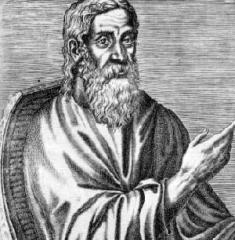
Clement of Alexandria

Clement of Alexandria Books

Theologian

Miscellanies

A source page for quotes linked to Clement of Alexandria.
0 quotes

Collected Works

A source page for quotes linked to Clement of Alexandria.

0 quotes

The Instructor

A source page for quotes linked to Clement of Alexandria.

0 quotes

Related Quotes

“Since the fact that pleasure is not a good thing is admitted from the fact that certain pleasures are evil, by this reason good appears evil, and evil good. And then, if we choose some pleasures and shun others, it is not every pleasure that is a good thing. Similarly, also, the same rule holds with pains, some of which we endure, and others we shun. But choice and avoidance are exercised according to knowledge; so that it is not pleasure that is the good thing, but knowledge by which we shall choose a pleasure at a certain time, and of a certain kind. Now the martyr chooses the pleasure that exists in prospect through the present pain. If pain is conceived as existing in thirst, and pleasure in drinking, the pain that has preceded becomes the efficient cause of pleasure. But evil cannot be the efficient cause of good. Neither, then, is the one thing nor the other evil.”

“For self-control is common to all human beings who have made choice of it. And we admit that the same nature exists in every race, and the same virtue. As far as respects human nature, the woman does not possess one nature, and the man exhibit another, but the same: so also with virtue. If, consequently, a self-restraint and righteousness, and whatever qualities are regarded as following them, is the virtue of the male, it belongs to the male alone to be virtuous, and to the woman to be licentious and unjust. But it is offensive even to say this. Accordingly woman is to practise self-restraint and righteousness, and every other virtue, as well as man, both bond and free; since it is a fit consequence that the same nature possesses one and the same virtue. We do not say that woman's nature is the same as man's, as she is woman. For undoubtedly it stands to reason that some difference should exist between each of them, in \ virtue of which one is male and the other female. Preg-\ nancy and parturition, accordingly, we say belong to woman, |as she is woman, and not as she is a human being. But if there were no difference between man and woman, both would do and suffer the same things. As then there is sameness, as far as respects the soul, she will attain to the same virtue ; but as there is difference as respects the peculiar construction of the body, she is destined for child-bearing and housekeeping.”

“For self-control is common to all human beings who have made choice of it. And we admit that the same nature exists in every race, and the same virtue. As far as respects human nature, the woman does not possess one nature, and the man exhibit another, but the same: so also with virtue. If, consequently, a self-restraint and righteousness, and whatever qualities are regarded as following them, is the virtue of the male, it belongs to the male alone to be virtuous, and to the woman to be licentious and unjust. But it is offensive even to say this. Accordingly woman is to practise self-restraint and righteousness, and every other virtue, as well as man, both bond and free; since it is a fit consequence that the same nature possesses one and the same virtue. We do not say that woman's nature is the same as man's, as she is woman. For undoubtedly it stands to reason that some difference should exist between each of them, in virtue of which one is male and the other female. Pregnancy and parturition, accordingly, we say belong to woman, as she is woman, and not as she is a human being. But if there were no difference between man and woman, both would do and suffer the same things. As then there is sameness, as far as respects the soul, she will attain to the same virtue; but as there is difference as respects the peculiar construction of the body, she is destined for child-bearing and housekeeping.”

“For pre-eminently a divine image, resembling God, is the soul of a righteous man; in which, through obedience to the commands, as in a consecrated spot, is enclosed and enshrined the Leader of mortals and of immortals, King and Parent of what is good, who is truly law, and right, and eternal Word, being the one Saviour individually to each, and in common to all.”

“So I think it is demonstrated that the God being good, and the Lord powerful, they save with a righteousness and equality which extend to all that turn to Him, whether here or elsewhere. For it is not here alone that the active power of God is beforehand, but it is everywhere and is always at work.”

“Our superintendence in instruction and discipline is the office of the Word, from whom we learn frugality and humility, and all that pertains to love of truth, love of humanity, and love of excellence. And so, in a word, being assimilated to God by participation in moral excellence, we must not retrograde into carelessness and sloth. But labor, and faint not.”

“« Les soixante-et-dix semaines sont abrégées sur ton peuple et sur la sainte cité, afin que la prévarication soit consommée et que le péché prenne fin, et que l'iniquité soit effacée et expiée, et que la justice éternelle paraisse, et que la vision et la prophétie soient accomplies, et que le saint des saints recoive l'onction. Sache donc et comprends : Depuis cette prophétie et la réédification de Jérusalem jusqu'au Christ roi, il y aura sept semaines et soixante-deux semaines; et de nouveau seront édifiées la place publique et les murailles, et les temps seront renouvelés, et après soixante-deux semaines le Christ sera mis à mort, et il n'y aura pas de jugement pour lui ; et de concert avec le roi qui doit venir, il dissipera la cité et le sanctuaire ; et un nouveau cataclysme en exterminera les habitants, et jusqu'à la fin de la guerre la destruction les décimera; et il confirmera l'alliance à plusieurs dans une semaine, et au milieu d'une semaine l'oblation et le sacrifice cesseront, et l'abomination de la désolation sera dans le temple, et persévérera jusqu'à la consommation des temps. Et au milieu d'une semaine, il ne s'élèvera plus de parfums de l'autel des sacrifices, et la destruction étendra 82 ses ravages jusqu'à la consommation, et en quelque sorte, jusqu'à l'anéantissement de l'oblation. » Il est donc évident que le temple a été reconstruit dans les sept premières semaines ; car le fait se trouve dans Esdras. Ainsi, le Christ est devenu roi des Juifs, après l'accomplissement des sept semaines ; et durant les soixante-deux semaines la Judée entière s'est reposée dans une paix profonde qu'aucune guerre n'a troublée; et notre Seigneur Jésus-Christ, le Saint des Saints, étant alors venu et ayant accompli la vision et la prophétie, a été oint par l'esprit du Père dans la chair qu'il avait revêtue. La royauté du Christ appartient donc à ces soixante-deux semaines et à la semaine unique, comme a dit le prophète. La moitié de la semaine suivante occupe la fin du règne de Néron, et part de l'époque où cet empereur mit l'abomination dans la ville sainte de Jérusalem ; et la seconde moitié de cette semaine le vit périr lui-même, ainsi que Galba, Othon et Vitellius; elle vit également l'élection de Vespasien à l'empire, la destruction de Jérusalem et la désolation du temple. Pour celui qui peut comprendre, il est évident que les choses se sont réalisées comme le prophète les avait annoncées.”

“D'après la distinction de quelques-uns, la foi nous révélerait le Fils; la connaissance, le Saint-Esprit. Ils n'ont pas pris garde que s'il faut croire véritablement au Fils, à sa qualité de fils, à son avènement, à son incarnation, à la raison de son incarnation et à ses souffrances, il n'est pas moins nécessaire de connaitre quel est le fils de Dieu. Dès lors, pas de connaissance indépendamment de la foi, pas de foi indépendamment de la connaissance. Mais le Père ne va pas non plus sans le Fils; la paternité renferme l'idée du Fils. Or, le Fils est le seul maitre qui puisse nous révéler le Père. Pour croire au Fils, il faut connaitre le Père, auquel appartient le Fils; et pour connaitre d'avance le Père, il faut croire au Fils, parce que c'est le Fils de Dieu qui nous donne la connaissance de Dieu. En effet, c'est le Père qui, par l'intermédiaire du Fils, nous conduit de la foi à la connaissance.”

“En effet, ils n'ont ni connu ni fait la volonté de la loi ; ce qu'ils ont pensé, ils ont cru que la loi le voulait. Ainsi ils n'ont pas cru à la loi en tant que parole prophétique, ils n'ont vu en elle qu'une parole stérile. C'est par crainte, non par affection ni par foi qu'ils lui ont été fidèles; car Jésus-Christ, dont l'avènement a été prédit par la loi, est la fin de la loi pour justifier tous ceux qui croiront.”

“Und der nämliche ist gerecht und gut, der wahrhafte Gott, der selbst alles ist, wie alles er selbst ist, weil er selbst Gott, der alleinige Gott ist. Denn wie der Spiegel dem Häßlichen nicht übelgesinnt ist, weil er ihn so zeigt, wie er ist, und wie der Arzt dem Kranken nicht übelgesinnt ist, wenn er ihm sagt, daß er Fieber hat (denn der Arzt ist nicht schuld an dem Fieber, sondern er stellt das Fieber nur fest), so ist auch der Tadelnde gegen den nicht übelgesinnt, der an seiner Seele krank ist; denn er bringt die Verfehlungen nicht erst in sie hinein, sondern weist auf die vorhandenen Sünden hin, um von ähnlicher Handlungsweise abzuhalten.”

“Mais la chair et le sang qui est en elle sont arrosés de lait, en retour de ce qu'ils le produisent, et lui doivent une nouvelle reproduction. Car la formation de l'enfant, dans le sein de sa mère, a lieu par suite du mélange de la semence de l'homme avec le sang de la femme, après la purification mensuelle. Cette semence a la faculté de réunir le sang en globules autour d'elle, comme la presure fait coaguler le lait, et forme enfin une substance, qui devient le corps de l'enfant, ni trop froide, ni trop ardente ; une nature bien tempérée est généralement productive ; les tempéraments dont les qualités sont extrêmes, sont une cause de stérilité. C'est ainsi que le grain pourrit dans une terre trop délayée par les eaux, et qu'il se flétrit dans une terre excessivement sèche. Au contraire, une terre où les sucs abondent, ni trop humide, ni trop ferme, conserve le grain et le fait pousser. Quelques naturalistes établissent que la semence des animaux est l'écume de leur sang. Aussi Diogène Apolloniate a appelé ces opérations aphrodisia, mot qui veut dire provenant de l'écume.”

“Our whole life can go on in observation of the laws of nature, if we gain dominion over our desires from the beginning and if we do not kill, by various means of a perverse art, the human offspring, born according to the designs of divine providence; for these women who, in order to hide their immorality, use abortive drugs which expel the child completely dead, abort at the same time their own human feelings.”

“We must not cast away riches which can benefit our neighbor. Possessions were made to be possessed; goods are called goods because they do good, and they have been provided by God for the good of men: they are at hand and serve as the material, the instruments for a good use in the hand of him who knows how to use them.”

“We say that knowledge is not mere talk, but a certain divine knowledge, that light which is kindled in the soul as a result of obedience to the commandments, and which reveals all that is in a state of becoming, enables man to know himself and teaches him to become possessed of God.”

“He who prohibited the making of a graven image would never himself have made an image in the likeness of holy things [i.e., by creating an image of them here on earth]. Nor is there at all any composite thing or creature endowed with sensation [made by God here on earth] like those in heaven. But the face is a symbol of the rational soul, the wings are the lofty ministers and energies of powers right and left, and the voice is delightful glory in endless contemplation.”