Quotessence
Home / Authors / Cornell Woolrich
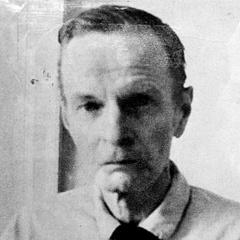
Cornell Woolrich

Cornell Woolrich Quotes

Novelist

Filter quotes by topic

Famous Cornell Woolrich Quotes

“One of the two owners, the man who had been sitting in the front room, was stretched out in there asleep, stockinged-toes pointed at the ceiling, one hand backed defensively against his eyes to ward off the light. He'd taken off his vest and shoes, and that strap that wasn't straight enough to be a suspender-strap was dangling now around one of the knobs at the foot of the bed. It ended in a holster, with a black, cross-grained slab of metal protruding from it. Turner couldn't take his eyes off it, while the long seconds that to him were minutes toiled by. That meant out, that black slab, more surely than any door. He had to have it. More than that, it meant a continuance of out, for so long as he had it. And he wanted out with all the desperate longing of all trapped things, blindly scratching, clawing their way through a maze to the open. To the open where the equal chance is.”

“There was nothing the matter out there. It was in here, with me. I decided I'd better go to work, maybe that would exorcise me. I fled from the room almost as though it were haunted. It was too late to stop off at a breakfast counter now. I didn't want any, anyway. My stomach kept giving little quivers. In the end I didn't go to work, either. I couldn't, I wouldn't have been any good. I telephoned in that I was too ill to come, and it was no idle excuse, even though I was upright on my two legs. I roamed around the rest of the day in the sunshine. Wherever the sunshine was the brightest, I sought and stayed in that place, and when it moved on I moved with it. I couldn't get it bright enough or strong enough. I avoided the shade, I edged away from it, even the slight shade of an awning or of a tree. And yet the sunshine didn't warm me. Where others mopped their brows and moved out of it, I stayed - and remained cold inside. And the shade was winning the battle as the hours lengthened. It outlasted the sun. The sun weakened and died; the shade deepened and spread. Night was coming on, the time of dreams, the enemy. ("Nightmare")”

“Gates got up, but not fast or jerkily, with the same slowness that had always characterized him. He wiped the sweat off his palms by running them lightly down his sides. As though he were going to shake hands with somebody. He was. He was going to shake hands with death. He wasn't particularly frightened. Not that he was particularly brave. It was just that he didn't have very much imagination. Rationalizing, he knew that he wasn't going to be alive anymore ten minutes from now. Yet he wasn't used to casting his imagination ten minutes ahead of him, he'd always kept it by him in the present. He couldn't visualize it. So he wasn't as unnerved by it as the average man would have been. ("3 Kills For 1")”

“Scorning to raise hand to the portal himself, possibly under the conviction that it was not fitting for a man to have to knock at the door of his own house, he tried the knob, found it unlocked, and entered. There was on the inside the distinctive and not unpleasant—and in this case enchanting—aroma a new house has, of freshly planed wood, the astringent turpentine in paint, window putty, and several other less identifiable ingredients.”

“A second red-orange spearhead leaps straight at O'Shaughnessy. The whole world seems to stand still. Then the gun behind it crashes, and there's a cataclysm of pain all over him, and a shock goes through him as if he ran head-on into a stone wall. A voice from the car says blurredly, while the ground rushes up to meet him, 'Finish him up, you guys! I'm getting so I don't trust their looks no more, no matter how stiff they act!' ("Jane Brown's Body")”

“He's prowling back and forth like a lion with distemper now. There's a shiny streak down one side of his face. "I shouldn't have let her go ahead - I ought to be hung! Something's gone wrong. I can't stand this any more!" he says with a choked sound. "I'm starting now -" "But how are you -" "Spring for it and fire as I go if they try to stop me." And then as he barges out, the fat lady waddling solicitously after him, "Stay there; take it if she calls - tell her I'm on the way-" He plunges straight at the street-door from all the way back in the hall, like a fullback headed for a touchdown. That's the best way. Gun bedded in his pocket, but hand gripping it ready to let fly through lining and all. He slaps the door out of his way without slowing and skitters out along the building, head and shoulders defensively lowered. It *was* the taxi, you bet. No sound from it, at least not at this distance, just a thin bluish haze slowly spreading out around it that might be gas-fumes if its engine were turning; and at his end a long row of un-colored spurts - of dust and stone-splinters - following him along the wall of the flat he's tearing away from. Each succeeding one a half yard too far behind him, smacking into where he was a second ago. And they never catch up. ("Jane Brown's Body")”

“The struggle doesn't last long; it's too unequal. Their momentary surprise overcome, they close in on him. The well-directed slice of a gun-butt slackens the good arm; it's easy to pry the disabled one from around the racketeer's collar. Tereshko is trembling with his anger. 'Now him again!' he protests, as though at an injustice. 'All they do is die and then get up and walk around again! What'sa matter, you guys using spitballs for slugs? No, don't kick at him, that'll never do it - I think the guy has nine lives!' ("Jane Brown's Body")”

“There's a catch phrase that you all must have heard at one time or another. You walk into a room or go over toward a group. Someone turns and says with huge emphasis: 'There he is.' As though you were the most important one of all. (And you're not.) As though you were the one they were just talking about. (And they weren't.) As though you were the only one that mattered. (And you're not.) It's a nice little tribute, and it don't cost anyone a cent. ("New York Blues")”

“I’d been living in this room for years, it was the same as when I’d left it a few hours ago. And yet the way I looked around it, you’d think I’d never seen it before. So maybe it wasn’t quite the same to me—as when I’d left it. I closed the door behind me. I suddenly caught my head between both hands, as suddenly as though it was something that had just fallen from the ceiling, alighting on my shoulders. I dragged myself sort of stickily across into the bathroom, as though something were impeding my feet, as though I had on snowshoes. I shrugged off my coat, rolled up my cuffs, spun the hot-water tap, tempered it with a little cold so I wouldn’t scald myself. I started to wash my hands. They weren’t particularly grimy. I happened to look up, caught sight of my face in the cabinet-mirror before me. I quickly opened the cabinet, folded the mirror back out of the way. It’s a rare man that can’t stand the sight of his own face.”

“The thing, whatever it was - and no one was ever sure afterwards whether it was a dream or a fit or what - happened at that peculiar hour before dawn when human vitality is at its lowest ebb. The Blue Hour they sometimes call it, l'heure bleue - the ribbon of darkness between the false dawn and the true, always blacker than all the rest of the night has been before it. Criminals break down and confess at that hour; suicides nerve themselves for their attempts; mists swirl in the sky; and - according to the old books of the monks and the hermits - strange, unholy shapes brood over the sleeping rooftops. At any rate, it was at this hour that her screams shattered the stillness of that top-floor apartment overlooking the Pare Monceau. Curdling, razor-edged screams that slashed through the thick bedroom door. ("I'm Dangerous Tonight")”

“She spent the vestigial hours of the night huddled in a large wing-chair, looking too small for it, her little harmonica-sized tran­sistor radio purring away at her elbow. She kept it on the Paterson station, WPAT, which stayed on all night. There were others that did too, but they were crawling with commercials; this one wasn't. It kept murmuring the melodies of Roberta and Can-Can and My Fair Lady, while the night went by and the world, out there beyond its dial, went by with it. She dozed off finally, her head lolling over like a little girl's propped up asleep in a grown-up's chair. ("Too Nice A Day To Die")”

“It takes will power and nerve to hold the stick that way, to keep his eyes open and watch the rocky face of the cliff, pine-bearded, rush up at them. O'Shaughnessy's mouth flattens, his face goes white. And then in that final fraction of a moment, he laughs, a little crazily - a laugh of defiance, of mocking farewell, and, somehow, of conquest. 'Here we go, baby!' he shouts, teeth bared. 'Now I'm going to find out what it really feels like to fly into the side of a mountain!...' There is only the storm to hear the smash of the plane as it splinters itself against the rock - and the storm drowns the sound out with thunder, just as the lightning turns pale the flame that rises, like a hungry tongue, from the wreckage. ("Jane Browns Body")”

“A few of them try to be kind to him in odd, haphazard ways. Human beings are funny. One of the young fellows he used to know goes by one night, silently puts a package of cigarettes into his hand, goes on without a word. To keep him from being quite so lonely while he waits. One particularly raw night the drugstore man suddenly comes out to the door, thrusts a mug of steaming coffee into his hands. Again without a word. Takes the mug in again when he’s emptied it. Just that once—never before then, never again. Human beings are funny. They are so cruel, they are so kind; they are so calloused, they are so tender.”

“The old frame house down near the waterfront had never held so many people since the day it was put up. It must have been a pleasant place fifty years before: trees overhanging the limpid water, cows grazing in the meadows on both sides of the river, little frame houses like this one dotting the banks here and there. It wasn't a pleasant place any more: garbage scows, coal yards, the river a greasy gray soup. Dead-end blocks of decrepit tenements on one side of it, lumberyards and ice-plants and tall stacks on the other. The house was set far back from the street, hemmed in by the blank walls that rose around it. ("I Wouldn't Be In Your Shoes")”

“When I came out into the outside room again, I saw her shoe still lying there, where it had come off in the course of our brief wrestle. It looked so pathetic there by itself without an owner, it looked so lonely, it looked so empty. Something made me pick it up arid take it in to her. Like when someone's going away, you help them on with their coat, or their jackboots, or whatever it is they need for going away. I didn't try to put it back on her, I just set it down there beside her close at hand. You're going to need this, I said to her in my mind. You're starting on a long walk. You're going to keep walking from now on, looking for your home. I stopped and wondered for a minute if that was what happened to all of us when we crossed over. Just keep walking, keep on walking, with no ahead and no in-back-of; tramps, vagrants in eternity. With our last hope and horizon - death - already taken away. In the Middle Ages they had lurid colors, a bright red hell, an azure heaven shot with gold stars. They knew where they were, at least. They could tell the difference. We, in the Twentieth, we just have the long walk, the long walk through the wispy backward-stringing mists of eternity, from nowhere to nowhere, never getting there, until you're so tired you almost wish you were alive again. ("Life Is Weird Sometimes" - first chapter of unpublished novel THE LOSER)”

“I turned away from him and went on my way, up the street and about my business. The past was dead. The future was resignation, fatality, and could only end one way now. The present was numbness, that could feel nothing. Like Novocaine needled into your heart. What was there in all the dimensions of time for me? ("Life Is Weird Sometimes" first chapter of unpublished novel THE LOSER)”

“The girl's face was the color of talcum. Her uncle's was a death mask, a bone structure overlaid by parchment. Shane's was granite, with a glistening line of sweat just below his hair line. He'd never forget this night, the detective knew, no matter what else happened for the rest of his life. They were all getting scars on their souls, the sort of scars people got in the Dark Ages, when they believed in devils and black magic. (Speak To Me Of Death)”

“Fear! Fear again, for the first time since his 'teens. Fear, that he thought he would never know any more. Fear that no weapon, no jeopardy, no natural cataclysm, has ever been able to inspire until now. And now here it is running icily through him in the hot Chinese noon. Fear for the thing he loves, the only fear that can ever wholly cow the reckless and the brave.”

“I rang the bell and she opened the door, dried her hands, and said heartily: 'Hello, stranger. I was just saying to Cliff only tonight, it's about time you showed up around here.' I wanted to detach him from her, but first I had to sit through about ten minutes of her. She was my sister, but you don't tell women things like I wanted to tell him. I don't know why, but you don't. You tell them the things you have under control; the things that you're frightened of, you tell other men if you tell anyone.”

“I think fear neutralizes alcohol, weakens its anesthetic power. It's good for small fears; your boss, your wife, your bills, your dentist; all right then to take a drink. But for big ones it doesn't do any good. Like water on blazing gasoline, it will only quicken and compound it. It takes sand, in the literal and the slang sense, to smother the bonfire that is fear. And if you're out of sand, then you must burn up.”

“After she's gone, another brief lull sets in. This one is probably the last. But what good is a lull? It's only a breathing spell in which to get more frightened. Because anticipatory fear is always twice as strong as present fear. Anticipatory fear has both fears in it at once - the anticipatory one and the one that comes simultaneously with the dread happening itself. Present fear only has the one, because by that time anticipation is over.”

“The preliminaries were out of the way, the creative process was about to begin. The creative process, that mystic life force, that splurge out of which has come the Venus de Milo, the Mona Lisa, the Fantasie Impromptu, the Bayeux tapestries, Romeo and Juliet, the windows of Chartres Cathedral, Paradise Lost - and a pulp murder story by Dan Moody. The process is the same in all; if the results are a little uneven, that doesn't invalidate the basic similarity of origin.”