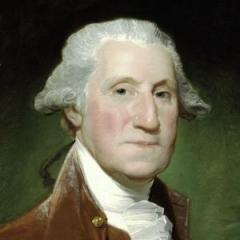
“Require nothing unreasonable of your officers and men, but see that whatever is required be punctually complied with. Reward and punish every man according to his merit, without partiality or prejudice; hear his complaints; if well founded, redress them; if otherwise, discourage them, in order to prevent frivolous ones. Discourage vice in every shape, and impress upon the mind of every man, from the first to the lowest, the importance of the cause, and what it is they are contending for.”
Source: Maxims of George Washington: Political, Military, Social, Moral, and Religious
“Men's minds are as variant as their faces. Where the motives of their actions are pure, the operation of the former is no more to be imputed to them as a crime, than the appearance of the latter; for both, being the work of nature, are alike unavoidable.”
Source: Maxims of Washington: Political, Social, Moral, and Religious
“The liberality of sentiment toward each other, which marks every political and religious denomination of men in this country, stands unparalleled in the history of nations.”
Source: The Papers of George Washington
“The views of men can only be known, or guessed at, by their words or actions.”
Source: The Writings of George Washington: pt. IV. Letters official and private, from the beginning of his presidency to the end of his life: (v. 10) May, 1789-November, 1794. (v. 11) November, 1794-December, 1799
“Do not conceive that fine clothes make fine men any more than fine feathers make fine birds.”
Source: The Quotable George Washington: The Wisdom of an American Patriot
“Conscience ... seldom comes to a man's aid while he is in the zenith of health and revelling in pomp and luxury upon illgotten spoils. It is generally the last act of his life, and it comes too late to be of much service to others here, or to himself hereafter.”
Source: The writings of George Washington from the original manuscript sources, 1745-1799
“A hundred thousand men, coming one after another, cannot move a Ton weight; but the united strength of 50 would transport it with ease.”
Source: Letters and Addresses,
“The most certain way to make a man your enemy is to tell him you esteem him such.”
Source: The writings of George Washington from the original manuscript sources, 1745-1799
“Nothing is too extravagant to expect from men who conceive they are ungratefully and unjustly dealt by.”
Source: Letters and Addresses,
“There never was a law yet made, I conceive, that hit the taste exactly of every man, or every part of the community; of course, if this be a reason for opposition, no law can be executed at all without force, and every man or set of men will in that case cut and carve for themselves; the consequences of which must be deprecated by all classes of men, who are friends to order, and to the peace and happiness of the country.”
Source: The Writings of George Washington: pt. IV. Letters official and private, from the beginning of his presidency to the end of his life: (v. 10) May, 1789-November, 1794. (v. 11) November, 1794-December, 1799
“A people contending for life and liberty are seldom disposed to look with a favorable eye upon either men or measures whose passions, interests or consequences will clash with those inestimable objects.”
Source: The writings of George Washington from the original manuscript sources, 1745-1799: prepared under the direction of the United States George Washington bicentennial commission and published by authority of Congress
“Life is always uncertain, and common prudence dictates to every man the necessity of settling his temporal concerns, while it is in his power, and while the mind is calm and undisturbed.”
Source: Recollections and private memoirs of Washington by his adopted son George Washington with a memoir of the author by his daughter; and illustrative and explanatory notes by Benson J. Loosing: With illustrations
“I can bear to hear of imputed or real errors. The man who wishes to stand well in the opinion of others must do this; because he is thereby enabled to correct his faults, or remove prejudices which are imbibed against him.”
Source: (v. 9) Containing correspondence from the time of resigning his commission as Commander-in-Chief of the Army, to that of his inauguration as president
“Differences in political opinions are as unavoidable as, to a certain point, they may perhaps be necessary; but it is exceedingly to be regretted that subjects cannot be discussed with temper on the one hand, or decisions submitted to without having the motives, which led to them, improperly implicated on the other; and this regret borders on chagrin when we find that men of abilities, zealous patriots, having the same general objects in view, and the same upright intentions to prosecute them, will not exercise more charity in deciding on the opinions and actions of one another.”
Source: The real George Washington
“Men of real talents in Arms have commonly approved themselves patrons of the liberal arts and friends to the poets, of their own as well as former times. In some instances by acting reciprocally, heroes have made poets, and poets heroes.”
Source: George Washington Remembers: Reflections on the French and Indian War
“Three things prompt men to a regular discharge of their duty in time of action: natural bravery, hope of reward, and fear of punishment.”
Source: Maxims of Washington: Political, Social, Moral, and Religious
“To place any dependence upon militia is assuredly resting upon a broken staff. Men just dragged from the tender scenes of domestic life, unaccustomed to the din of arms, totally unacquainted with every kind of military skill ... makes them timid and ready to fly from their own shadows.”
Source: Words of Washington
“Experience has taught us that men will not adopt and carry into execution measures the best calculated for their own good without the intervention of a coercive power.”
Source: Maxims of Washington: Political, Social, Moral, and Religious
“A person who is anxious to be a leader of the fashion, or one of the first to follow it, will certainly appear in the eyes of judicious men to have nothing better than a frequent change of dress to recommend him to notice.”
Source: The Writings of George Washington: pt.III. Private letters from the time Washington resigned his commission as commander-in-chief of the army to that of his inauguration as president of the United States: December, 1783-April, 1789. 1835
“If the minority, and a small one too, is suffered to dictate to the majority, after measures have undergone the most solemn discussions by the representatives of the people, and their will through this medium is enacted into a law, there can be no security for life, liberty, or property; nor, if the laws are not to govern, can any man know how to conduct himself in safety.”
Source: The Writings of George Washington: pt. IV. Letters official and private, from the beginning of his presidency to the end of his life: (v. 10) May, 1789-November, 1794. (v. 11) November, 1794-December, 1799
“It rarely happens otherwise than that a thorough-faced coquette dies in celibacy, as a punishment for her attempts to mislead others, by encouraging looks, words, or actions, given for no other purpose than to draw men on to make overtures that they may be rejected.”
Source: Letters and Addresses,
“There is no restraining men's tongues or pens when charged with a little vanity.”
Source: Maxims of Washington: Political, Social, Moral, and Religious
“I never say anything of a man that I have the smallest scruple of saying to him.”
Source: The Quotable George Washington: The Wisdom of an American Patriot
“Where is the man to be found who wishes to remain indebted for the defense of his own person and property to the exertions, the bravery, and the blood of others, without making one generous effort to repay the debt of honor and gratitude?”
Source: The Complete Works of George Washington: Military Journals, Rules of Civility, Writings on French and Indian War, Presidential Work, Inaugural Addresses, Messages to Congress, Letters & Biography
“When a man does all he can, though it succeeds not well, blame not him that did it.”
Source: The Writings of George Washington: pt. I. Official letters relating to the French war, and private letters before the American revolution: March, 1754-May, 1775
“In a free and republican government, you cannot restrain the voice of the multitude. Every man will speak as he thinks, or, more properly, without thinking, and consequently will judge of effects without attending to their causes.”
Source: Life
“It is our boast, that a man's religious tenets will not forfeit the protection of the Laws.”
Source: Maxims of Washington: Political, Social, Moral, and Religious
“In vain would that man claim the tribute of patriotism who should labor to subvert these great pillars.”
Source: Washington's Farewell Address to the People of the United States of America: Published in September, 1796
“A small knowledge of human nature will convince us, that, with far the greatest part of mankind, interest is the governing principle... Few men are capable of making a continual sacrifice of all views of private interest, or advantage, to the common good. It is vain to exclaim against the depravity of human nature on this account; the fact is so, the experience of every age and nation has proved it and we must in a great measure, change the constitution of man, before we can make it otherwise. No institution, not built on the presumptive truth of these maxims can succeed.”
“While all men within our territories are protected in worshipping the Deity according to the dictates of their consciences; it is rationally to be expected from them in return, that they will [demonstrate] the innocence of their lives and the beneficence of their actions; for no man, who is profligate in his morals, or a bad member of the civil community, can possibly be a true Christian, or a credit to his own religious society.”
“My opinion with respect to immigration is, that except of useful mechanics and some particular description of men and professions, there is no use of encouragement.”
“A slender acquaintance with the world must convince every man, that actions, not words, are the true criterion of the attachment of his friends, and that the most liberal professions of good will are very far from being the surest marks of it. I should be happy that my own experience had afforded fewer examples of the little dependence to be placed upon them.”
Source: The Life of General Washington: First President of the United States
“While I reiterate the professions of my dependence upon Heaven... I will observe that... no man who is profligate in his morals... can possibly be a true Christian.”
“The most enviable praise of all is just to be called an honest man.”
“The whole duty of man is summed up in obedience to God's will.”
“I consider it an indubitable mark of mean-spiritedness and pitiful vanity to court applause from the pen or tongue of man.”
Source: Travels in North-America, in the Years 1780-81-82
“The Commander in Chief directs that Divine service be performed every Sunday at 11 o'clock...It is expected that officers of all ranks will by their attendance set an example to their men.”
“Our conflict is not likely to cease so soon as every good man would wish. The measure of iniquity is not yet filled; and unless we can return a little more to first principles, and act a little more upon patriotic ground, I do not know when it will.”
Source: The writings of George Washington from the original manuscript sources, 1745-1799
“Associate with men of good quality if you esteem your own reputation; for it is better to be alone than in bad company.”
Source: The Writings of George Washington: pt. I. Official letters relating to the French war, and private letters before the American revolution: March, 1754-May, 1775
“The time is near at hand which must determine whether Americans are to be free men or slaves.”
“The marvel of all history is the patience with which men and women submit to burdens unnecessarily laid upon them by their governments.”
“I hope I shall possess firmness and virtue enough to maintain what I consider the most enviable of all titles, the character of an honest man.”
Source: The Quotable George Washington: The Wisdom of an American Patriot
“A slender acquaintance with the world must convince every man that actions, not words, are the true criterion of the attachment of friends.”
Source: The Quotable George Washington: The Wisdom of an American Patriot
“Few men have virtue to withstand the highest bidder.”
Source: The Writings of George Washington: Being His Correspondence, Addresses, Messages, and Other Papers, Official and Private, Selected and Published from the Original Manuscripts
“I can only say that there is not a man living who wishes more sincerely than I do to see a plan adopted for the abolition of slavery.”
Source: The Writings of George Washington: Being His Correspondence, Addresses, Messages, and Other Papers, Official and Private
“Let your Discourse with Men of Business be Short and Comprehensive.”
Source: Words of Washington
“The General hopes and trusts that every officer and man will endeavor to live and act as becomes a Christian soldier defending the dearest rights and liberties of his country.”
Source: The Writings of George Washington: Being His Correspondence, Addresses, Messages, and Other Papers, Official and Private, Selected and Published from the Original Manuscripts; with a Life of the Author, Notes, and Illustrations
“No people can be bound to acknowledge the invisible hand which conducts the affairs of men more than the people of the united States. Every step by which they have advanced to the character of an independent nation seems to have been distinguished by some token of providential agency”
Source: Washington's Political Legacies: With a Biographical Outline of His Life and Character
“No Man has a more perfect reliance on the all-wise and powerful dispensations of the Supreme Being than I have, nor thinks his aid more necessary...The man must be bad indeed who can look upon the events of the American Revolution without feeling the warmest gratitude towards the great Author of the Universe whose divine interposition was so frequently manifested in our behalf....In war He directed the sword, and in peace, He has ruled in our councils.”
“Where are our Men of abilities? Why do they not come forth to save their Country?”
Source: The writings of George Washington from the original manuscript sources, 1745-1799