Quotessence
Home / Authors / Margaret Mead
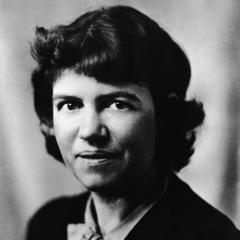
Margaret Mead

Margaret Mead Quotes

Cultural Anthropologist

Filter quotes by topic

Famous Margaret Mead Quotes

“where families suffer from disasters that are preventable, this is a measure of a whole nation's neglect. A society imperils its own future when, out of negligence or contempt, it overlooks the need of children to be reared in a family ... or when, in the midst of plenty, some families cannot give their children adequate food and shelter, safe activity and rest, and an opportunity to grow into full adulthood as people who can care for and cherish other human beings like themselves.”

“to the extent that either sex is disadvantaged, the whole culture is poorer, and the sex that, superficially, inherits the earth, inherits only a very partial legacy. The more whole the culture, the more whole each member, each man, each woman, each child will be.”

“Everybody's suffering is mine but not everybody's murdering ... I do not distinguish for one moment whether my child is in danger or a child in central Asia. But I will not accept responsibility for what other people do because I happen to belong to that nation or that race or that religion. I do not believe in guilt by association.”

“Every act of motherhood contains a dual intent, as the mother holds the child close and prepares it to move way from her, as she supports the child and stands it firmly on its own feet, and as she guards it against danger and sends it out across the yard, down by the stream, and across the traffic-crowded highway. Unless a mother can do both - gather her child close and turn her child out toward the world - she will fail in her purpose.”

“Sisters, while they are growing up, tend to be very rivalrous and as young mothers they are given to continual rivalrous comparisons of their several children. But once the children grow older, sisters draw closer together and often, in old age, they become each other's chosen and most happy companions. In addition to their shared memories of childhood and of their relationship to each other's children, they share memories of the same home, the same homemaking style, and the same small prejudices about housekeeping that carry the echoes of their mother's voice.”

“The protection of a ten-year-old girl from her father's advances is a necessary condition of social order, but the protection of the father from temptation is a necessary condition of his continued social adjustment. The protections that are built up in the child against desire for the parent become the essential counterpart to the attitudes in the parent that protect the child.”

“If we are to give our utmost effort and skill and enthusiasm, we must believe in ourselves, which means believing in our past and in our future, in our parents and in our children, in that particular blend of moral purpose and practical inventiveness which is the American character.”

“No skill, no special apti­tude, no vividness of imagination or precision of thinking would go unrecognized because the child who possessed it was of one sex rather than the other. No child would be relentlessly shaped to one pattern of behavior, but instead there should be many patterns, in a world that had learned to allow to each individual the pattern which was most congenial to his gifts.”

“Female animals defending their young are notoriously ferocious and lack the playful delight in combat which characterizes the mock combats of males of the same species. There seems very little ground for claiming that the mother of young children is more peaceful, more responsible, and more thoughtful for the welfare of the human race than is her husband or brother.”

“Children must be taught how to think, not what to think.”

“Samoa culture demonstrates how much the tragic or the easy solution of the Oedipus situation depends upon the inter-relationship between parents and children, and is not created out of whole cloth by the young child's biological impulses.”

“This is a precious possession which we cannot afford to tarnish, but society always is attempting to make the physician into a killer to kill the defective child at birth, to leave the sleeping pills beside the bed of the cancer patient ... It is the duty of society to protect the physicians from such requests.”

“The suffering of either sex - of the male who is unable, because of the way in which he was reared, to take the strong initiating or patriarchal role that is still demanded of him, or of the female who has been given too much freedom of movement as a child to stay placidly within the house as an adult - this suffering, this discrepancy, this sense of failure in an enjoined role, is the point of leverage for social change.”

“If they learn easily, they are penalized for being bored when they have nothing to do; if they excel in some outstanding way, they are penalized as being conspicuously better than the peer group. The culture tries to make the child with a gift into a one-sided person, to penalize him at every turn, to cause him trouble in making friends and to create conditions conducive to the development of a neurosis. Neither teachers, the parents of other children, nor the child peers will tolerate a Wunderkind.”

“Each home has been reduced to the bare essentials -- to barer essentials than most primitive people would consider possible. Only one woman's hands to feed the baby, answer the telephone, turn off the gas under the pot that is boiling over, soothe the older child who has broken a toy, and open both doors at once. She is a nutritionist, a child psychologist, an engineer, a production manager, an expert buyer, all in one. Her husband sees her as free to plan her own time, and envies her; she sees him as having regular hours and envies him.”

“Our treatment of both older people and children reflects the value we place on independence and autonomy. We do our best to make our children independent from birth. We leave them all alone in rooms with the lights out and tell them, 'Go to sleep by yourselves.' And the old people we respect most are the ones who will fight for their independence, who would sooner starve to death than ask for help.”