Quotessence
Home / Authors / Margaret Mead
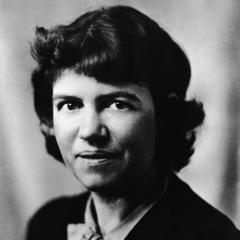
Margaret Mead

Margaret Mead Quotes

Cultural Anthropologist

Filter quotes by topic

Famous Margaret Mead Quotes

“Both men and women are conceived as merely capable of response to a situation that their society has already defined for them as sexual, and so the Arapesh feel that it is necessary to chaperon betrothed couples who are too young... with their definition of sex as a response to an external situation rather than as spontaneous desire, both men and women are regarded as helpless in the face of seduction. Parents warn their sons even more than they warn their daughters against permitting themselves to get into situations in which someone can make love to them.”

“Women should be permitted to volunteer for non-combat service... We have no real way of knowing whether the kinds of training that teach men both courage and restraint would be adaptable to women or effective in a crisis. But the evidence of history and comparative studies of other species suggest that women as a fighting body might be far less amenable to the rules that prevent war from becoming a massacre and, with the use of modern weapons, that protect the survival of all humanity. That is what I meant by saying that women in combat might be too fierce.”

“Laughter is man's most distinctive emotional expression. Man shares the capacity for love and hate, anger and fear, loyalty and grief, with other living creatures. But humour, which has an intellectual as well as an emotional element belongs to man”

“Just as the difference in height between males is no longer a realistic issue, now that lawsuits have been substituted for hand-to-hand encounters, so the difference in strength between men and women is no longer worth elaboration in cultural institutions.”

“to the extent that either sex is disadvantaged, the whole culture is poorer, and the sex that, superficially, inherits the earth, inherits only a very partial legacy. The more whole the culture, the more whole each member, each man, each woman, each child will be.”

“I think the important thing about sisters is that they share the same minute, familiar life-style, the same little sets of rules. Therefore they can keep house with each other late in life, because they share the same bunch of housewifely prejudices. The important thing about women today is, as they get older, they still keep house. It's one reason they don't die, but men die when they retire. Women just polish the teacups.”

“The city as a center where, any day in any year, there may be a fresh encounter with a new talent, a keen mind or a gifted specialist-this is essential to the life of a country. To play this role in our lives a city must have a soul-a university, a great art or music school, a cathedral or a great mosque or temple, a great laboratory or scientific center, as well as the libraries and museums and galleries that bring past and present together. A city must be a place where groups of women and men are seeking and developing the highest things they know.”

“When human beings have been fascinated by the contemplation of their own hearts, the more intricate biological pattern of the female has become a model for the artist, the mystic, and the saint. When mankind turns instead to what can be done, altered, built, invented, in the outer world, all natural properties of men, animals, or metals become handicaps to be altered rather than clues to be followed.”

“Human beings do not carry civilization in their genes. All that we do carry in our genes are certain capacities- the capacity to learn to walk upright, to use our brains, to speak, to relate to our fellow men, to construct and use tools, to explore the universe, and to express that exploration in religion, in art, in science, in philosophy.”

“The institution of marriage in all societies is a pattern within which the strains put by civilization on males and females alike must be resolved, a pattern within which men must learn, in return for a variety of elaborate rewards, new forms in which sexual spontaneity is still possible, and women must learn to discipline their receptivity to a thousand other considerations.”

“Coming to terms with the rhythms of women's lives means coming to terms with life itself, accepting the imperatives of the body rather than the imperatives of an artificial, man-made, perhaps transcendentally beautiful civilization. Emphasis on the male work-rhythm is an emphasis on infinite possibilities; emphasis on the female rhythms is an emphasis on a defined pattern, on limitation.”

“The prophet who fails to present a bearable alternative and yet preaches doom is part of the trap that he postulates. Not only does he picture us caught in a tremendous man-made or God-made trap from which there is no escape, but we must also listen to him day in, day out, describe how the trap is inexorably closing. To such prophecies the human race, as presently bred and educated and situated, is incapable of listening. So some dance and some immolate themselves as human torches; some take drugs and some artists spill their creativity in sets of randomly placed dots on a white ground.”

“Many women, particularly young women, have claimed the right to use the most explicit sex terms, including extremely vulgar ones, in public as well as private. But it is men, far more than women, who have been liberated by this change. For now that women use these terms, men no longer need to watch their own language in the presence of women. But is this a gain for women?”

“Chief among our gains must be reckoned this possibility of choice, the recognition of many possible ways of life, where other civilizations have recognized only one. Where other civilizations give a satisfactory outlet to only one temperamental type, be he mystic or soldier, business man or artist, a civilization in which there are many standards offers a possibility of satisfactory adjustment to individuals of many different temperamental types, of diverse gifts and varying interests.”