Quotessence
Home / Authors / Pope Francis
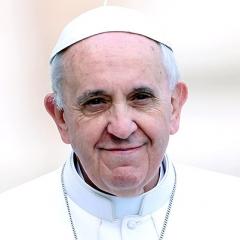
Pope Francis

Pope Francis Quotes

Author

Filter quotes by topic

Famous Pope Francis Quotes

“The worldwide financial and economic crisis seems to highlight their distortions and above all the gravely deficient human perspective, which reduces man to one of his needs alone, namely, consumption. Worse yet, human beings themselves are nowadays considered as consumer goods which can be used and thrown away.”

“"God is love". His is not a sentimental, emotional kind of love but the love of the Father who is the origin of all life, the love of the Son who dies on the Cross and is raised, the love of the Spirit who renews human beings and the world. Thinking that God is love does us so much good, because it teaches us to love, to give ourselves to others as Jesus gave himself to us and walks with us. Jesus walks beside us on the road through life.”

“And there is this fact of the twelve baskets: why twelve? What does it mean? Twelve is the number of the tribes of Israel, symbolically it represents all the people. And this tells us that when food is shared equally, with solidarity, nobody is devoid of the necessary, each community can meet the needs of the poorest. Human ecology and environmental ecology go hand in hand.”

“Let us remember Paul VI's words: "For the Catholic Church, no one is a stranger, no one is excluded, no one is far away" (Homily for the closing of the Second Vatican Council, 8 December 1965). Indeed, we are a single human family that is journeying on toward unity, making the most of solidarity and dialogue among peoples in the multiplicity of differences.”

“[T]he "home" represents the most precious human treasures, that of encounter, that of relations among people, different in age, culture and history, but who live together and together help one another to grow. For this reason, the "home" is a crucial place in life, where life grows and can be fulfilled, because it is a place in which every person learns to receive love and to give love.”

“The Church is likewise conscious of the responsibility which all of us have for our world, for the whole of creation, which we must love and protect. There is much that we can do to benefit the poor, the needy and those who suffer, and to favour justice, promote reconciliation and build peace. But before all else we need to keep alive in our world the thirst for the absolute, and to counter the dominance of a one-dimensional vision of the human person, a vision which reduces human beings to what they produce and to what they consume: this is one of the most insidious temptations of our time.”

“Christian hope is not a ghost and it does not deceive. It is a theological virtue and therefore, ultimately, a gift from God that cannot be reduced to optimism, which is only human. God does not mislead hope; God cannot deny himself. God is all promise.”

“Essential to the attainment of these national goals is the moral imperative of ensuring social justice and respect for human dignity. The great biblical tradition enjoins on all peoples the duty to hear the voice of the poor. It bids us to break the bonds of injustice and oppression which give rise to glaring, and indeed, scandalous social inequalities. Reforming the social structures which perpetuate poverty and the exclusion of the poor first requires a conversion of mind and heart.”

“May the deepest spiritual values of the Filipino people continue to find expression in your efforts to provide your fellow citizens with an integral human development. In this way, each person will be able to fulfill his or her potential, and thus contribute wisely and well to the future of this country.”

“There is no worse material poverty than one that does not allow for earning one’s bread and deprives one of the dignity of work. Youth unemployment, informality, and the lack of labor rights are not inevitable; they are the result of a previous social option, of an economic system that puts profit above man; if the profit is economic, to put it above humanity or above man, is the effect of a disposable culture that considers the human being in himself as a consumer good, which can be used and then discarded.”