Quotessence
Home / Authors / Pope Francis Books
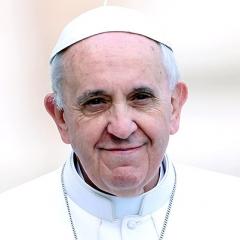
Pope Francis

Pope Francis Books

Author

Dilexit Nos

A source page for quotes linked to Pope Francis.
0 quotes

On the Family

A source page for quotes linked to Pope Francis.

0 quotes

Related Quotes

“Let's think of that moment when a woman washed the feet of Jesus with the nard, so expensive: it is a religious moment, a moment of gratitude, a moment of love. And he [Judas] stands apart with bitter criticism: 'But this could have been used for the poor!' This is the first reference that I have found, in the Gospel, to poverty as an ideology. The ideologue does not know what love is, because he does nt know how to give himself.”

“241. Nor does this mean calling for forgiveness when it involves renouncing our own rights, confronting corrupt officials, criminals or those who would debase our dignity. We are called to love everyone, without exception; at the same time, loving an oppressor does not mean allowing him to keep oppressing us, or letting him think that what he does is acceptable. On the contrary, true love for an oppressor means seeking ways to make him cease his oppression; it means stripping him of a power that he does not know how to use, and that diminishes his own humanity and that of others. Forgiveness does not entail allowing oppressors to keep trampling on their own dignity and that of others, or letting criminals continue their wrongdoing. Those who suffer injustice have to defend strenuously their own rights and those of their family, precisely because they must preserve the dignity they have received as a loving gift from God. If a criminal has harmed me or a loved one, no one can forbid me from demanding justice and ensuring that this person – or anyone else – will not harm me, or others, again. This is entirely just; forgiveness does not forbid it but actually demands it.”

“As religious leaders, we are called to be true "people of dialogue," to cooperate in building peace not as intermediaries but as authentic mediators. Intermediaries seek to give everyone a discount ultimately in order to gain something for themselves. However, the mediator is one who retains nothing for himself but rather spends himself generously until he is consumed, knowing that the only gain is peace. Each one of us is called to be an artisan of peace, by uniting and not dividing, by extinguishing hatred and not holding on to it, by opening paths to dialogue and not by constructing new walls! Let us dialogue and meet one another in order to establish a culture of dialogue in the world, a culture of encounter.”

“Will we let ourselves become a Church that calls and welcomes sinners with open arms, that gives courage and hope, or are we a Church closed in on herself? Are we a Church where the love of God dwells, where one cares for the other, where one prays for the other? A final question: what can I, a weak fragile sinner, do? God says to you, Do not be afraid of holiness; do not be afraid to aim high, to let yourself be loved and purified by God; do not be afraid to let yourself be guided by the Holy Spirit. Let us be infected by the holiness of God. Every Christian is called to sanctity...; and sanctity does not consist especially in doing extraordinary things, but in allowing God to act. It is the meeting of our weakness with the strength of his grace, it is saving faith in his action that allows us to live in charity, to do everything with joy and humility, for the glory of God and as a service to our neighbor.”

“There is a Marian "style" to the Church's work of evangelization. Whenever we look to Mary, we come to believe once again in the revolutionary nature of love and tenderness. in her we see that humility and tenderness ar enot virtues of the weak but of the strong, who need not treat others poorly in order to feel important themselves. Contemplating Mary, we realize that she who praised God for "bringing down the mighty from their thrones" and "sending the rich away empty" (Luke 1:52-53) is also the one who brings a homely warmth to our pursuit of justice. She is also the one who carefully keeps "all these things, pondering them in heart" (Luke 2:19). Mary is able to recognize the traces of God's Spirit in events great and small. She constantly contemplates the mystery of God in our world, in human history, and in our daily lives. She is the woman of prayer and work in Nazareth, and she is also Our Lady of Help, who sets out from her town "with haste" (Luke 1:39) to be of service to others. This interplay of justice and tenderness, of contemplation and concern for others, is what makes the ecclesial community look to Mary as a model of evangelization.”

“The light of love proper to faith can illumine the question of our own time-concerning truth. Truth, nowadays, is often reduced to the subjective authenticity of the individual, valid only to the life of the individual. A common truth intimidates us, for we identify it with the intransigent demands of totalitarian systems. But if truth is a truth of love, if it is a truth disclosed in personal encounter with the Other and with others, then it can be set free from its enclosure in individuals and become part of the common good. As a truth of love, it is not one that can be imposed by force; it is not a truth that stifles the individual. Since it is born of love, it can penetrate to the heart, to the personal core of each man and woman. Clearly, then, faith is not intransigent but grows in respectful coexistences with others. One who believes may not be presumptuous; on the contrary, truth leads to humility, because believers know that, rather than ourselves possessing truth, it is truth that embraces and possesses us. Far from making us inflexible, the security of faith sets us on a journey; it enables witness and dialogue with all.”

“For the Church, the option for the poor is primarily a theological category rather than a cultural, sociological, political, or philosophical one. God shows the poor "his first mercy." This divine preference has consequences for the faith life of all Christians, because we are called to have "this mind...which was in Jesus Christ" (Phil. 2:5). Inspired by this, the Church has made an option for the poor, which is understood as a "special form of primacy in the exercise of Christian charity, to which the whole tradition of the Church bears witness." This option - as Benedict XVI has taught - "is implicit in our Christian faith in a God who became poor for us, so as to enrich us with his poverty." This is why I want a Church that is poor and for the poor. They have much to teach us. Not only do they share in the sensus fidei, but in their difficulties they know the suffering Christ. We need to let ourselves be evangelized by them. The new evangelization is an invitation to acknowledge the saving power at work in their lives and to put them at the center of the Church's pilgrim way. We are called to find Christ in them, to lend our voice to their causes, but also to be their friends, to listen to them, to speak for them, and to embrace the mysterious wisdom that God wishes to share with us through them.”

“The urgent task of proclaiming the Gospel in our time demands that believers, and priests in particular, ensure that everyone be able to encounterJesus Christ made flesh, made man, made history.We must always take care never to lose sight of the “flesh” of Jesus Christ: that flesh made of passions, emotions and feelings, words that challenge and console, hands that touch and heal, looks that liberate and encourage, flesh made of hospitality, forgiveness, indignation, courage, fearlessness; in a word, love.”

“How many times do we hear: 'Come on, you Christians, be a little bit more normal, like other people, be reasonable!' This is real snake charmer's talk: 'Come on, just be like this, okay? A little bit more normal, don't be so rigid ...' But behind it is this: 'Don't come here with your stories, that God became man!' The Incarnation of the Word, that is the scandal behind all of this! We can do all the social work we want, and they will say: 'How great the Church is, it does such good social work." But if we say that we are doing it because those people are the flesh of Christ, then comes the scandal. And that is the truth, that is the revelation of Jesus: that presence of Jesus incarnate.”

“To put it simply: the Holy Spirit bothers us. Because he moves us, he makes us walk, he pushes the Church to go forward. And we are like Peter at the Transfiguration: 'Ah, how wonderful it is to be here like this, all together!' ... But don't bother us. We want the Holy Spirit to doze off ... we want to domesticate the Holy Spirit. And that's no good. because he is God, he is that wind which comes and goes and you don't know where. He is the power of God, he is the one who gives us consolation and strength to move forward. But: to move forward! And this bothers us. It's so much nicer to be comfortable.”

“Jesus no longer belongs to the past but lives in the present and is projected toward the future; Jesus is the everlasting "today" of God. This is how the newness of God appears to the women, the disciples, and all of us: as victory over sin, evil, and death - over everything that crushes life and makes it seem less human. And this is a message meant for me and for you, dear sister, you, dear brother. How often does Love have to tell us, "Why do you look for the living among the dead?" Our daily problems and worries can wrap us up in ourselves, in sadness and bitterness...and that is where death is. That is not the place to look for the One who is alive!”

“A child deserves to be born of that love, and not by any other means, for “he or she is not something owed to one, but is a gift”, which is “the fruit of the specific act of the conjugal love of the parents”. This is the case because, “according to the order of creation, conjugal love between a man and a woman, and the transmission of life are ordered to each other (cf. Gen 1:27-28). Thus the Creator made man and woman share in the work of his creation and, at the same time, made them instruments of his love, entrusting to them the responsibility for the future of mankind, through the transmission of human life”.”

“Dear Alessio, yes, I was an altar boy. And you? What part among the altar boys do you have? It’s easier to do now, you know: You might know that, when I was a kid, Mass was celebrated different than today. Back then, the priest faced the altar, which was next to the wall, and not the people. Then the book with which he said the Mass, the missal, was placed on the right side of the altar. But before reading of the Gospel it always had to be moved to the left side. That was my job: to carry it from right to left. It was exhausting! The book was heavy! I picked it up with all my energy but I wasn’t so strong; I picked it up once and fell down, so the priest had to help me. Some job I did! The Mass wasn’t in Italian then. The priest spoke but I didn’t understand anything. and neither did my friends. So for fun we’d do imitations of the priest, messing up the words a bit to make up weird sayings in Spanish. We had fun, and we really enjoyed serving Mass.”

“The act of deporting people who in many cases have left their own land for reasons of extreme poverty, insecurity, exploitation, persecution or serious deterioration of the environment, damages the dignity of many men and women, and of entire families, and places them in a state of particular vulnerability and defenselessness. What is built on the basis of force, and not on the truth about the equal dignity of every human being, begins badly and will end badly.”

“You can have flaws, be anxious and even be angry, but do not forget that your life is the greatest enterprise in the world. Only you can stop it from failing. You are appreciated, admired and loved by so many. Remember that being happy is not having a sky without storm, a road without accidents, a job without effort, a relationship without disappointments. “To be happy is to stop feeling like a victim and become the author of your own fate.” It's walking through deserts, but being able to find an oasis deep in the soul. Is thanking God every morning for the miracle of life. It’s kissing your children, cuddling your parents, having poetic moments with your friends, even when they hurt us. “Being happy is letting the creature that lives in each of us live, free, joyful and simple. You have the maturity to be able to say: "I've made mistakes". It's having the courage to say I'm sorry. It's having the sense to say "I need you". Is having the ability to say "I love you". May your life become a garden of opportunities for happiness... that in spring he may be a lover of joy and in winter a lover of wisdom. "And when you make a mistake, start over. Because only then will you be in love with life. You'll discover that being happy isn't having a perfect life. But use tears to irrigate tolerance. Use your defeats to train your patience. "Use your mistakes with the serenity of the sculptor. Use pain to tune into pleasure. Use obstacles to open the windows of intelligence. Never give up ... Above all never give up on the people that love you. Never give up on being happy, because life is an incredible spectacle.”