Quotessence
Home / Authors / Pope Francis
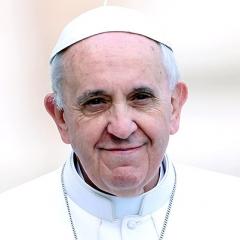
Pope Francis

Pope Francis Quotes

Author

Filter quotes by topic

Famous Pope Francis Quotes

“I have a dogmatic certainty: God is in every person's life. God is in everyone's life. Even if the life of a person has been a disaster, even if it is destroyed by vices, drugs or anything else - God is in this person's life. You can - you must - try to seek God in every human life.”

“Francis of Assisi tells us we should work to build peace. But there is no true peace without truth! There cannot be true peace if everyone is his own criterion, if everyone can always claim exclusively his own rights, without at the same time caring for the good of others, of everyone, on the basis of the nature that unites every human being on this earth.”

“Sometimes we are tempted to be that kind of Christian who keeps the Lord’s wounds at arm’s length. Yet Jesus wants us to touch human misery, to touch the suffering flesh of others. He hopes that we will stop looking for those personal or communal niches which shelter us from the maelstrom of human misfortune and instead enter into the reality of other people’s lives and know the power of tenderness. Whenever we do so, our lives become wonderfully complicated and we experience intensely what it is to be a people, to be part of a people.”

“Human beings are themselves considered consumer goods to be used and then discarded. We have created a “disposable” culture which is now spreading. It is no longer simply about exploitation and oppression, but something new. Exclusion ultimately has to do with what it means to be a part of the society in which we live; those excluded are no longer society’s underside or its fringes or its disenfranchised – they are no longer even a part of it. The excluded are not the “exploited” but the outcast, the “leftovers”.”

“We have created new idols. The worship of the ancient golden calf (cf. Ex 32:1-35) has returned in a new and ruthless guise in the idolatry of money and the dictatorship of an impersonal economy lacking a truly human purpose. The worldwide crisis affecting finance and the economy lays bare their imbalances and, above all, their lack of real concern for human beings; man is reduced to one of his needs alone: consumption.”

“All too often, as we know from experience, people do not choose life; they do not accept the gospel of life, but let themselves be led by ideologies and ways of thinking that block life, that do not respect life, because they are dictated by selfishness, self-interest, profit, power and pleasure and not by love. ... As a result, the Living God is replaced by fleeting human idols, which offer the intoxication of a flash of freedom, but in the end bring new forms of slavery and death.”

“Once capital becomes an idol and guides people's decisions, once greed for money presides over the entire socioeconomic system, it ruins society, it condemns and enslaves men and women, it destroys human fraternity, it sets people against one another and it even puts at risk our common home.”

“When we give help to the poor, we are not doing the work of aid agencies 'in a Christian way'. Those are good, it is a decent thing to do - aid work is good and quite human - but it is not Christian poverty, which St. Paul desires of us and preaches to us. Christian poverty is that I give of my own, and not of that which is left over - I give even that, which I need for myself, to the poor person, because I know that he enriches me. Why does the poor person enrich me? Because Jesus Himself told us that He is in the poor person.”

“Business is a noble vocation, directed to producing wealth and improving the world. It can be a fruitful source of prosperity for the area in which it operates, especially if it sees the creation of jobs as an essential part of its service to the common good. This common good also includes the earth... the environmental challenge we are undergoing, and its human roots, concern and affect us all.”

“Money must serve, not rule! The Pope loves everyone, rich and poor alike, but he is obliged in the name of Christ to remind all that the rich must help, respect and promote the poor. I exhort you to generous solidarity and a return of economics and finance to an ethical approach which favours human beings.”

“The moral problem of abortion is of a pre religious nature because the genetic code is written in a person at the moment of conception. A human being is there. I separate the topic of abortion from any specifically religious notions. It is a scientific problem. Not to allow the further development of a being which already has all the genetic code of a human being is not ethical. The right to life is the first among human rights. To abort a child is to kill someone who cannot defend himself.”

“No one must say that they cannot be close to the poor because their own lifestyle demands more attention to other areas. This is an excuse commonly heard in academic, business or professional, and even ecclesial circles. While it is quite true that the essential vocation and mission of the lay faithful is to strive that earthly realities and all human activity may be transformed by the Gospel, none of us can think we are exempt from concern for the poor and for social justice”

“Unfortunately, what is thrown away is not only food and dispensable objects, but often human beings themselves, who are discarded as 'unnecessary.' For example, it is frightful even to think there are children, victims of abortion, who will never see the light of day; children being used as soldiers, abused and killed in armed conflicts; and children being bought and sold in that terrible form of modern slavery which is human trafficking, which is a crime against humanity.”

“Just as the commandment 'Thou shalt not kill' sets a clear limit in order to safeguard the value of human life, today we also have to say 'thou shalt not' to an economy of exclusion and inequality. Such an economy kills. How can it be that it is not a news item when an elderly homeless person dies of exposure, but it is news when the stock market loses two points?”

“How precious is the family as the privileged place for transmitting the faith! Speaking about family life, I would like to say one thing: today, as Brazil and the Church around the world celebrate this feast of Saints Joachim and Anne, Grandparents Day is also being celebrated. How important grandparents are for family life, for passing on the human and religious heritage which is so essential for each and every society! How important it is to have intergenerational exchanges and dialogues, especially within the context of the family.”

“We human beings are not only the beneficiaries but also the stewards of other creatures. Thanks to our bodies, God has joined us so closely to the world around us that we can feel the desertification of the soil almost as a physical ailment, and the extinction of a species as a painful disfigurement. Let us not leave in our wake a swatch of destruction and death which will affect our own lives and those of future generations.”

“The popes have spoken of human ecology, closely linked to environmental ecology. We are living in a time of crisis: we see this in the environment, but above all we see this in mankind Man is not in charge today, money is in charge, money rules. God our Father did not give the task of caring for the earth to money, but to us, to men and women: we have this task! Instead, men and women are sacrificed to the idols of profit and consumption: it is the 'culture of waste.'”

“You should be real witnesses of a world of doing and acting differently. But in life it is difficult for everything to be clear, precise, outlined neatly. Life is complicated; it consists of grace and sin. He who does not sin is not human. We all make mistakes and we need to recognise our weakness. A religious who recognises himself as weak and a sinner does not negate the witness that he is called to give, rather he reinforces it, and this is good for everyone. What I expect of you therefore is to give witness. I want this special witness from religious.”

“I want to remind priests that the confessional must not be a torture chamber but rather an encounter with the Lord’s mercy which spurs us on to do our best. A small step, in the midst of great human limitations, can be more pleasing to God than a life which appears outwardly in order but moves through the day without confronting great difficulties. Everyone needs to be touched by the comfort and attraction of God’s saving love, which is mysteriously at work in each person, above and beyond their faults and failings.”

“Legal systems, at both the national and international level, are therefore required to recognize, guarantee and protect religious freedom, which is a right intrinsically inherent in human nature, in man's dignity as a free being, and is also an indicator of a healthy democracy and cone of the main sources of the legitimacy of the State. Religious freedom ... favors the development of relationships of mutual respect between the different Confessions and their healthy collaboration with the State and political society, without confusion of roles and without antagonism.”