Quotessence
Home / Authors / Pope Francis
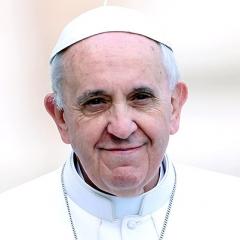
Pope Francis

Pope Francis Quotes

Author

Filter quotes by topic

Famous Pope Francis Quotes

“For the Church, the option for the poor is primarily a theological category rather than a cultural, sociological, political, or philosophical one. God shows the poor "his first mercy." This divine preference has consequences for the faith life of all Christians, because we are called to have "this mind...which was in Jesus Christ" (Phil. 2:5). Inspired by this, the Church has made an option for the poor, which is understood as a "special form of primacy in the exercise of Christian charity, to which the whole tradition of the Church bears witness." This option - as Benedict XVI has taught - "is implicit in our Christian faith in a God who became poor for us, so as to enrich us with his poverty." This is why I want a Church that is poor and for the poor. They have much to teach us. Not only do they share in the sensus fidei, but in their difficulties they know the suffering Christ. We need to let ourselves be evangelized by them. The new evangelization is an invitation to acknowledge the saving power at work in their lives and to put them at the center of the Church's pilgrim way. We are called to find Christ in them, to lend our voice to their causes, but also to be their friends, to listen to them, to speak for them, and to embrace the mysterious wisdom that God wishes to share with us through them.”

“The Bishops of the Philippines have asked that this year be set aside as the ‘Year of the Poor.’ I hope that this prophetic summons will challenge everyone, at all levels of society, to reject every form of corruption which diverts resources from the poor, and to make concerted efforts to ensure the inclusion of every man and woman and child in the life of the community.”

“If God, in the Christmas mystery, reveals himself not as One who remains on high and dominates the universe, but as the One who bends down, descends to the little and poor earth, it means that, to be like him, we should not put ourselves above others, but indeed lower ourselves, place ourselves at the service of others, become small with the small and poor with the poor. It is regrettable to see a Christian who does not want to lower himself, who does not want to serve. A Christian who struts about is ugly: this is not Christian, it is pagan.”

“When we give help to the poor, we are not doing the work of aid agencies 'in a Christian way'. Those are good, it is a decent thing to do - aid work is good and quite human - but it is not Christian poverty, which St. Paul desires of us and preaches to us. Christian poverty is that I give of my own, and not of that which is left over - I give even that, which I need for myself, to the poor person, because I know that he enriches me. Why does the poor person enrich me? Because Jesus Himself told us that He is in the poor person.”

“When we are generous in welcoming people and sharing something with them-some food, a place in our homes, our time-not only do we no longer remain poor: we are enriched. I am well aware that when someone needing food knocks at your door, you always find a way of sharing food; as the proverb says, one can always 'add more water to the beans'! Is it possible to add more water to the beans?...Always?...And you do so with love, demonstrating that true riches consist not in materials things, but in the heart!”

“The times talk to us of so much poverty in the world and this is a scandal. Poverty in the world is a scandal. In a world where there is so much wealth, so many resources to feed everyone, it is unfathomable that there are so many hungry children, that there are so many children without an education, so many poor persons. Poverty today is a cry.”

“Money must serve, not rule! The Pope loves everyone, rich and poor alike, but he is obliged in the name of Christ to remind all that the rich must help, respect and promote the poor. I exhort you to generous solidarity and a return of economics and finance to an ethical approach which favours human beings.”

“No one must say that they cannot be close to the poor because their own lifestyle demands more attention to other areas. This is an excuse commonly heard in academic, business or professional, and even ecclesial circles. While it is quite true that the essential vocation and mission of the lay faithful is to strive that earthly realities and all human activity may be transformed by the Gospel, none of us can think we are exempt from concern for the poor and for social justice”

“We are called to reach out to those who find themselves in the existential peripheries of our societies and to show particular solidarity with the most vulnerable of our brothers and sisters: the poor, the disabled, the unborn and the sick, migrants and refugees, the elderly and the young who lack employment.”

“As long as the problems of the poor are not radically resolved by rejecting the absolute autonomy of markets and financial speculation and by attacking the structural causes of inequality, no solution will be found for the world’s problems or, for that matter, to any problems.”

“The great danger in today's world, pervaded as it is by consumerism, is the desolation and anguish born of a complacent yet covetous heart, the feverish pursuit of frivolous pleasures, and a blunted conscience. Whenever our interior life becomes caught up in its own interests and concerns, there is no longer room for others, no place for the poor.”

“Jesus tells us what the 'protocol' is, on which we will be judged. It is the one we read in chapter 25 of Matthew's Gospel: I was hungry, I was thirsty, I was in prison, I was sick, I was naked and you helped me, clothed me, visited me, took care of me. Whenever we do this to one of our brothers, we do this to Jesus. Caring for our neighbor; for those who are poor, who suffer in body and in soul, for those who are in need. This is the touchstone.”

“In a very real way, the poor are our teachers. They show us that people’s value is not measured by their possessions or how much money they have in the bank. A poor person, a person lacking material possessions, always maintains his or her dignity. The poor can teach us much about humility and trust in God.”

“We have begun a throw away culture. This tendency is seen on the level of individuals and whole societies; and it is being promoted! In circumstances like these, solidarity, which is the treasure of the poor, is often considered counterproductive, opposed to the logic of finance and the economy. While the income of a minority is increasing exponentially, that of the majority is crumbling.”