Quotessence
Home / Authors / Theodore Roosevelt Books
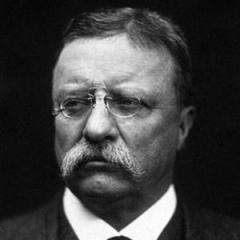
Theodore Roosevelt

Theodore Roosevelt Books

26th U.S. President

Thomas H. Benton

A source page for quotes linked to Theodore Roosevelt.
0 quotes

Related Quotes

“Courage, intellect, all the masterful qualities, serve but to make a man more evil if they are merely used for that man’s own advancement, with brutal indifference to the rights of others. It speaks ill for the community if the community worships these qualities and treats their possessors as heroes regardless of whether the qualities are used rightly or wrongly. It makes no difference as to the precise way in which this sinister efficiency is shown. It makes no difference whether such a man’s force and ability betray themselves in a career of money-maker or politician, soldier or orator, journalist or popular leader. If the man works for evil, then the more successful he is the more he should be despised and condemned by all upright and far-seeing men. To judge a man merely by success is an abhorrent wrong; and if the people at large habitually so judge men, if they grow to condone wickedness because the wicked man triumphs, they show their inability to understand that in the last analysis free institutions rest upon the character of citizenship, and that by such admiration of evil they prove themselves unfit for liberty.”

“It is not the critic who counts; not the man who points out how the strong man stumbles, or where the doer of deeds could have done them better. The credit belongs to the man who is actually in the arena, whose face is marred by dust and sweat and blood, who strives valiantly; who errs and comes short again and again; because there is not effort without error and shortcomings; but who does actually strive to do the deed; who knows the great enthusiasm, the great devotion, who spends himself in a worthy cause, who at the best knows in the end the triumph of high achievement and who at the worst, if he fails, at least he fails while daring greatly. So that his place shall never be with those cold and timid souls who know neither victory nor defeat.”

“Fellow-feeling. . .is the most important factor in producing a healthy political and social life. Neither our national nor our local civic life can be what it should be unless it is marked by the fellow-feeling, the mutual kindness, the mutual respect, the sense of common duties and common interests, which arise when men take the trouble to understand one another, and to associate together for a common object. A very large share of the rancor of political and social strife arises either from sheer misunderstanding by one section, or by one class, of another, or else from the fact that the two sections, or two classes, are so cut off from each other that neither appreciates the other’s passions, prejudices, and, indeed, point of view, while they are both entirely ignorant of their community of feeling as regards the essentials of manhood and humanity.”

“If we say of a boy or a man, "He is of good character," we mean that he does not do a great many things that are wrong, and we also mean that he does do a great many things which imply much effort of will and readiness to face what is disagreeable. He must not steal, he must not be intemperate, he must not be vicious in any way; he must not be mean or brutal; he must not bully the weak. In fact, he must refrain from whatever is evil. But besides refraining from evil, he must do good.”

“Bodily vigor is good, and vigor of intellect is even better, but far above both is character. It is true, of course, that a genius may, on certain lines, do more than a brave and manly fellow who is not a genius; and so, in sports, vast physical strength may overcome weakness, even though the puny body may have in it the heart of a lion. But, in the long run, in the great battle of life, no brilliancy of intellect, no perfection of bodily development, will count when weighed in the balance against that assemblage of virtues, active and passive, of moral qualities, which we group together under the name of character; and if between any two contestants, even in college sport or in college work, the difference in character on the right side is as great as the difference of intellect or strength the other way, it is the character side that will win.”

“There are many kinds of success in life worth having. It is exceedingly interesting and attractive to be a successful businessman, or railway man, or farmer, or a successful lawyer or doctor; or a writer, or a President, or a ranchman, or the colonel of a fighting regiment, or to kill grizzly bears and lions. But for unflagging interest and enjoyment, a household of children, if things go reasonably well, certainly makes all other forms of success and achievement lose their importance by comparison.”

“There is quite enough sorrow and shame and suffering and baseness in real life and there is no need for meeting it unnecessarily in fiction. As Police Commissioner it was my duty to deal with all kinds of squalid misery and hideous and unspeakable infamy, and I should have been worse than a coward if I had shrunk from doing what was necessary; but there would have been no use whatever in my reading novels detailing all this misery and squalor and crime, or at least in reading them as a steady thing. Now and then there is a powerful but sad story which really is interesting and which really does good; but normally the books which do good and the books which healthy people find interesting are those which are not in the least of the sugar-candy variety, but which, while portraying foulness and suffering when they must be portrayed, yet have a joyous as well as a noble side.”

“It is not the critic who counts; not the man who points out how the strong man stumbles, or where the doer of deeds could have done them better. The credit belongs to the man who is actually in the arena, whose face in marred by dust and sweat and blood; who strives valiantly; who errs, who comes short again and again, because there is no effort without error and shortcoming; but who does actually strive to do the deeds; who knows great enthusiasms, the great devotions; who spends himself in a worthy cause; who at the best knows in the end the triumph of high achievement, and who at the worst, if he fails, at least fails while daring greatly, so that his place shall never be with those cold and timid souls who neither know victory nor defeat. Shame on the man of cultivated taste who permits refinement to develop into fastidiousness that unfits him for doing the rough work of a workaday world. Among the free peoples who govern themselves there is but a small field of usefulness open for the men of cloistered life who shrink from contact with their fellows. Still less room is there for those who deride of slight what is done by those who actually bear the brunt of the day; nor yet for those others who always profess that they would like to take action, if only the conditions of life were not exactly what they actually are. The man who does nothing cuts the same sordid figure in the pages of history, whether he be a cynic, or fop, or voluptuary. There is little use for the being whose tepid soul knows nothing of great and generous emotion, of the high pride, the stern belief, the lofty enthusiasm, of the men who quell the storm and ride the thunder. Well for these men if they succeed; well also, though not so well, if they fail, given only that they have nobly ventured, and have put forth all their heart and strength. It is war-worn Hotspur, spent with hard fighting, he of the many errors and valiant end, over whose memory we love to linger, not over the memory of the young lord who 'but for the vile guns would have been a valiant soldier.”

“It is all-essential to the continuance of our healthy national life that we should recognize this community of interest among our people. The welfare of each of us is dependent fundamentally upon the welfare of all of us, and therefore in public life that man is the best representative of each of us who seeks to do good to each by doing good to all; in other words, whose endeavor it is not to represent any special class and promote merely that class's selfish interests, but to represent all true and honest men of all sections and all classes and to work for their interests by working for our common country.”

“The right to regulate the use of wealth in the public interest is universally admitted. Let us admit also the right to regulate the terms and conditions of labor, which is the chief element of wealth, directly in the interest of the common good. The fundamental thing to do for every man is to give him a chance to reach a place in which he will make the greatest possible contribution to the public welfare. Understand what I say there. Give him a chance, not push him up if he will not be pushed. Help any man who stumbles; if he lies down, it is a poor job to try to carry him; but if he is a worthy man, try your best to see that he gets a chance to show the worth that is in him. No man can be a good citizen unless he has a wage more than sufficient to cover the bare cost of living, and hours of labor short enough so after his day’s work is done he will have time and energy to bear his share in the management of the community, to help in carrying the general load. We keep countless men from being good citizens by the conditions of life by which we surround them. August 31, 1910”

“Of one man in especial, beyond any one else, the citizens of a republic should beware, and that is of the man who appeals to them to support him on the ground that he is hostile to other citizens of the republic, that he will secure for those who elect him, in one shape or another, profit at the expense of other citizens of the republic… It makes no difference whether he appeals to class hatred or class interest, to religious or antireligious prejudice. The man who makes such an appeal should always be presumed to make it for the sake of furthering his own interest. The very last thing an intelligent and self-respecting member of a democratic community should do is to reward any public man because that public man says that he will get the private citizen something to which this private citizen is not entitled, or will gratify some emotion or animosity which this private citizen ought not to possess… If a public man tries to get your vote by saying that he will do something wrong in your interest, you can be absolutely certain that if ever it becomes worth his while he will do something wrong against your interest.”

“Patriotism,” said Theodore Roosevelt, “means to stand by the country. It does not mean to stand by the President or any other public official save exactly to the degree in which he himself stands by the country. … Every man,” said President Roosevelt, “who parrots the cry of ‘stand by the President’ without adding the proviso ‘so far as he serves the Republic’ takes an attitude as essentially unmanly as that of any Stuart royalist who championed the doctrine that the King could do no wrong. No self-respecting and intelligent free man could take such an attitude.”

“The President is merely the most important among a large number of public servants. He should be supported or opposed exactly to the degree which is warranted by his good conduct or bad conduct, his efficiency or inefficiency in rendering loyal, able, and disinterested service to the nation as a whole. Therefore it is absolutely necessary that there should be full liberty to tell the truth about his acts, and this means that it is exactly as necessary to blame him when he does wrong as to praise him when he does right. Any other attitude in an American citizen is both base and servile. To announce that there must be no criticism of the President, or that we are to stand by the President, right or wrong, is not only unpatriotic and servile, but is morally treasonable to the American public. Nothing but the truth should be spoken about him or any one else. But it is even more important to tell the truth, pleasant or unpleasant, about him than about any one else.”

“Right here let me make as vigorous a plea as I know how in favor of saying nothing that we do not mean, and of acting without hesitation up to whatever we say. A good many of you are probably acquainted with the old proverb: 'Speak softly and carry a big stick -- you will go far.' If a man continually blusters, if he lacks civility, a big stick will not save him from trouble; and neither will speaking softly avail, if back of the softness there does not lie strength, power. In private life there are few beings more obnoxious than the man who is always loudly boasting; and if the boaster is not prepared to back up his words his position becomes absolutely contemptible. So it is with the nation. It is both foolish and undignified to indulge in undue self-glorification, and, above all, in loose-tongued denunciation of other peoples.”

“If this country is really to go forward along the path of social and economic justice, there must be a new party of nationwide and non-sectional principles, a party where the titular national chiefs and the real state leaders shall be in genuine accord, a party in whose counsels the people shall be supreme, a party that shall represent in the nation and the several states alike the same cause, the cause of human rights and of governmental efficiency. At present both the old parties are controlled by professional politicians in the interests of the privileged classes, and apparently each has set up as its ideal of business and political development a government by financial despotism tempered by make-believe political assassination. Democrat and Republican alike, they represent government of the needy many by professional politicians in the interests of the rich few. This is class government, and class government of a peculiarly unwholesome kind.”