Quotessence
Home / Authors / Thomas Jefferson
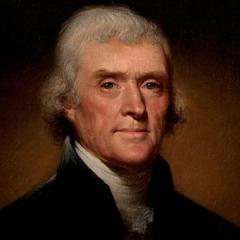
Thomas Jefferson

Thomas Jefferson Quotes

3rd U.S. President

Filter quotes by topic

Famous Thomas Jefferson Quotes

“A free people [claim] their rights as derived from the laws of nature, and not as the gift of their chief magistrate.”

“Under the law of nature, all men are born free, every one comes into the world with a right to his own person, which includes the liberty of moving and using it at his own will. This is what is called personal liberty, and is given him by the Author”

“Born in other countries, yet believing you could be happy in this, our laws acknowledge, as they should do, your right to join us in society, conforming, as I doubt not you will do, to our established rules. That these rules shall be as equal as prudential considerations will admit, will certainly be the aim of our legislatures, general and particular.”

“It is not only vain, but wicked, in a legislator to frame laws in opposition to the laws of nature, and to arm them with the terrors of death. This is truly creating crimes in order to punish them.”

“Whenever there are in any country uncultivated lands and unemployed poor, it is clear that the laws of property have been so far extended as to violate natural right. The earth is given as a common stock for man to labor and live on. The small landowners are the most precious part of a state”

“The clergy, by getting themselves established by law and in-grafted into the machine of government, have been a very formidable engine against the civil and religious rights of man.”

“Believing with you that religion is a matter which lies solely between man and his God, that he owes account to none other for his faith or his worship, that the legislative powers of government reach actions only, and not opinions, I contemplate with sovereign reverence that act of the whole American people which declared that their legislature should 'make no law respecting an establishment of religion, or prohibiting the free exercise thereof,' thus building a wall of separation between church and State.”

“We have solved, by fair experiment, the great and interesting question whether freedom of religion is compatible with order in government and obedience to the laws. And we have experienced the quiet as well as the comfort which results from leaving every one to profess freely and openly those principles of religion which are the inductions of his own reason and the serious convictions of his own inquiries.”

“I consider the government of the United States as interdicted by the Constitution from intermeddling with religious institutions, their doctrines, discipline, or exercises. This results not only from the provision that no law shall be made respecting the establishment or free exercise of religion, but from that also which reserves to the States the powers not delegated to the United States. Certainly, no power to prescribe any religious exercise or to assume authority in any religious discipline has been delegated to the General Government. It must then rest with the States.”

“Why suspend the habeas corpus in insurrections and rebellions? Examine the history of England. See how few of the cases of the suspension of the habeas corpus law have been worthy of that suspension. They have been either real treasons, wherein the parties might as well have been charged at once, or sham plots, where it was shameful they should ever have been suspected. Yet for the few cases wherein the suspension of the habeas corpus has done real good, that operation is now become habitual and the minds of the nation almost prepared to live under its constant suspension.”

“The mobs of the great cities add just so much to the support of pure government as sores do to the strength of the human body. It is the manners and spirit of a people which preserve a republic in vigor. A degeneracy in these is a canker which soon eats to the heart of its laws and constitution.”

“The Habeas Corpus secures every man here, alien or citizen, against everything which is not law, whatever shape it may assume.”

“It is left... to the juries, if they think the permanent judges are under any bias whatever in any cause, to take on themselves to judge the law as well as the fact. They never exercise this power but when they suspect partiality in the judges; and by the exercise of this power they have been the firmest bulwarks of English liberty.”

“If the question [before justices of the peace] relate to any point of public liberty, or if it be one of those in which the judges may be suspected of bias, the jury undertake to decide both law and fact.”

“By nature's law, every man has a right to seize and retake by force his own property taken from him by another, by force of fraud. Nor is this natural right among the first which is taken into the hands of regular government after it is instituted. It was long retained by our ancestors. It was a part of their common law, laid down in their books, recognized by all the authorities, and regulated as to circumstances of practice.”

“It is a moot question whether the origin of any kind of property is derived from nature at all. It is agreed by those who have seriously considered the subject that no individual has, of natural right, a separate property in an acre of land, for instance. By a universal law, indeed, whatever, whether fixed or movable, belongs to all men equally and in common is the property for the moment of him who occupies it; but when he relinquishes the occupation, the property goes with it. Stable ownership is the gift of social law, and is given late in the progress of society.”

“Most codes extend their definitions of treason to acts not really against one's country. They do not distinguish between acts against the government, and acts against the oppressions of the government. The latter are virtues, yet have furnished more victims to the executioner than the former. Real treasons are rare; oppressions frequent. The unsuccessful strugglers against tyranny have been the chief martyrs of treason laws in all countries.”

“I sincerely wish you may find it convenient to come here. the pleasure of the trip will be less than you expect, but the utility greater. it will make you adore your own country, it's soil, it's climate, it's equality, liberty, laws, people & manners. my god! how little do my countrymen know.”

“I discharge every person under punishment or prosecution under the Sedition Law, because I considered, and now consider, that law to be a nullity as absolute and palpable as if Congress had ordered us to fall down and worship a golden image.”

“When, in the course of human events, it becomes necessary for one people to dissolve the political bands which have connected them with another, and to assume among the powers of the earth the separate and equal station to which the laws of nature and of nature's God entitle them, a decent respect to the opinions of mankind requires that they should declare the causes which impel them to the separation.”

“In America, no other distinction between man and man had ever been known but that of persons in office exercising powers by authority of the laws, and private individuals. Among these last, the poorest laborer stood on equal ground with the wealthiest millionaire, and generally on a more favored one whenever their rights seem to jar.”

“[T]he true key for the construction of everything doubtful in a law is the intention of the law-makers. This is most safely gathered from the words, but may be sought also in extraneous circumstances provided they do not contradict the express words of the law.”

“[T]he opinion which gives to the judges the right to decide what laws are constitutional and what not, not only for themselves, in their, own sphere of action, but for the Legislature and Executive also in their spheres, would make the Judiciary a despotic branch.”

“The instability of our laws is really an immense evil. I think it would be well to provide in our constitutions that there shall always be a twelve-month between the ingross-ing a bill & passing it: that it should then be offered to its passage without changing a word: and that if circum-stances should be thought to require a speedier passage, it should take two thirds of both houses instead of a bare majority.”

“If [God] has made it a law in the nature of man to pursue his own happiness, He has left him free in the choice of place as well as mode, and we may safely call on the whole body of English jurists to produce the map on which nature has traced for each individual the geographical line which she forbids him to cross in pursuit of happiness.”

“The principles on which we engaged, of which the charter of our independence is the record, were sanctioned by the laws of our being, and we but obeyed them in pursuing undeviatingly the course they called for. It issued finally in that inestimable state of freedom which alone can ensure to man the enjoyment of his equal rights.”

“Laws abridging the natural right of the citizen should be restrained by rigorous constructions within their narrowest limits.”

“The true fountains of evidence [are] the head and heart of every rational and honest man. It is there nature has written her moral laws, and where every man may read them for himself.”

“The question whether the judges are invested with exclusive authority to decide on the constitutionality of a law has been heretofore a subject of consideration with me in the exercise of official duties. Certainly there is not a word in the Constitution which has given that power to them more than to the Executive or Legislative branches.”