Quotessence
Home / Authors / Vernon L. Smith Biography
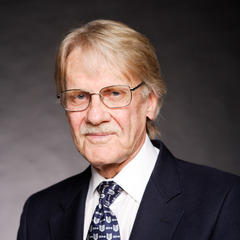
Vernon L. Smith

Vernon L. Smith Biography

Professor

Related Quotes

“Gregg: What do you think is the most significant thing that people of faith can offer to the world of economic science? Smith: It’s that virtue must be part of the way we approach everything. In Adam Smith, virtue was self-command. That idea is that in maturation, people are always marking. When we cross their space, they are marking to us what they resent or the things that they like. We learn, then, these forms of virtue that all have Christian roots. In a time of chaos and violence and evil the ultimate answers to our society’s problems must come down to individuals and their moral responsibilities. Yes, it is important that there are rules of society and that our laws be consistent with that, but law only works if you enforce it. But there is no way you can enforce everything. The nice thing about a country like the United States is that you can still pick up a newspaper form in front of the drug store before the store opens and just leave the money for it: You can go to a farm vegetable stand when no one is there, see the vegetables with the prices, take your vegetables and leave your money. That’s self-command.”

“Most consumers believe that because prices in these industries are state regulated they are protected from the “evils of capitalism.” It is just the opposite, but both the regulators and the companies regulated have powerful incentives to nourish that misbelief. [...] Some people delude themselves into thinking they can manage markets better than market forces can. They try it, but it’s not sustainable. That made me realize that many of the basic things we believed about economics were wrong.”

“Samuel Gregg: Certainly, Smith notes, Einstein was right to claim that the theories designed by humans are important tools for comprehending reality. Yet before there is theory, Smith adds, there is thought and reason, a logical sequence that, he says, finds it parallel in the opening verse of the gospel of John: “In the beginning was the Word [Logos], and the Word was with God, and the Word was God” (1:1 KJV).”

“As Einstein once said, “It is the theory which decides what can be observed.” But I must add that prior to theory there is what we call “thinking”—a systematic form of consciousness deeply driven by the unconscious that enables understanding and experimental predictions The parallel is expressed in John 1:1, “In the beginning was the Word, and the Word was with God, and the Word was God” (KJV). For humans, all beginnings are in thought or reason. And in the reductionist search for reality, science can only identify mind, first in thing shopped for, then in the assurance of unseen evidence.”

“I think we have put a lot of emphasis on, of course, material wellbeing. By human economic betterment we mean material betterment. That’s economic enterprise, and that’s what Adam Smith worked out in his second book. But the first book had to do with human social betterment—all the things we do to make our lives better because we grow up in a social world. We learn in growing up that some actions are hurtful to others and they resent it, and some actions are beneficial to others, and they feel good about that and they tend to reward the beneficial actions. Those two sources account for a lot of the norms that we live by. Also, Adam Smith understood that—and I think this is remarkable—he understood that the downside was potentially far greater than the upside. So there is a fundamental asymmetry between gain and loss. And he didn’t just postulate that; he derived it from the idea there is an asymmetry between our joy and our sorrow. He got it from more fundamental considerations. Psychologists did not discover that until some 150 to 200 years later.”

“Samuel Gregg: Smith underscores, however, that the Scots also focused on another form of rationality: the reasonableness that is embodied and conveyed through time by un-designed habits, customs, and rules. We often do not fully understand the importance of such traditions, as Edmund Burke noted, until we dispose of them. A hallmark of Smith’s work is his study of how such knowledge helps to mold political and economic outcomes. One Means by which such knowledge has been conveyed through time, Smith states, is religion. In a long footnote to his Nobel lecture, Smith stressed religion’s role in shaping the morality needed for cohesive social behavior.”

“The point I want to emphasize is that science is about physical and biological mechanisms, about discovering how things work, about engineering, about theories that describe and can predict observations that we experience entirely through our senses or their extension through instruments. It is the instruments of science that supply us with the indirect evidence of things not seen. It is like Plato’s allegory of the ave, in which reality can only be experienced as shadows on the cave wall. An experimental physicist says that he measures the “spin” of an electron, but in actuality, he records certain effects on a screen and uses the theory (his faith) to calculate its meaning as a measurement.”

“Samuel Gregg: Smith’s experiments have also provided considerable evidence that, as he wrote in a 1994 paper, “economic agents can achieve efficient outcomes which are not part of their intention.” Many will recognize this as one of the central claims of The Wealth of Nations, the book written by Smith’s famous namesake two and a half centuries ago. Interestingly, Adam Smith’s argument was not one that Vernon Smith had been inclined to accept before beginning his experimental research. As the latter went on to say in his 1994 paper, fey outside of the Austrian and Chicago traditions believed it, circa 1956. Certainly, I was not primed to believe it, having been raised by a socialist mother, and further handicapped (in this regard) by a Harvard education.” Given, however, what his experiments revealed about what he called “the error in my thinking,” Smith changed his mind. Truth was what mattered—not ego or preexisting ideological commitments.”

“In his 2001 book, Economics as Religion, economist Robert Nelson recounted the ways in which economics came to operate in society with its own religion-like structure. Nelson argues that modern economics has operated in many ways as a secularized version of Protestant theology in which the primary evil is economics scarcity and in which deliverance from this evil (and the attainment of heaven on earth) will come through application of economic science to promote efficiency (and fairness) in production and distribution. In this worldview, economists, as technical advisors to governmental managers, serve as a new “scientific” priesthood effecting a secular salvation of human society through the application of constructivist reason, the sort of reasoning that seeks to deliberately design choices and institutions to generate what are perceived as “optimal” outcomes. Here, then, within the very discipline to which Vernon Smith has devoted his life’s work, there seems to be a persistent tendency if not to outright materialism then to a reduction of human rationality within constructivist constraints. As Smith acknowledges, “predominantly, both economists and psychologists are reluctant to allow that naive and unsophisticated agents can achieve socially optimal ends without a comprehensive understanding of the whole, as well as their individual parts, implemented by deliberate action. There is no magic.”

“Gregg: I notice you did not use the word greed in that answer. When many people hear “self-interest,” they think “greed”. So are you suggesting that a Smithian approach actually has nothing to do with greed at all when it comes to self-interest properly understood? Smith: It’s not a matter of greed. It’s a matter of, as Smith says, the individual being fitter than anyone else to take care of himself or herself in terms of knowing what he or she wants and in making judgments about that. And so, knowing that other people are also self-interested, I know what action I take would be hurtful to them. And then I take that into account. In other words, being self-interested is an input to our socializing process. There are many experimental economists and behavioral economists who want to explain that with a utility function so that if I am other-regarding, it’s because I am taking into account your reward as well as mine. Adam Smith says no. Adam Smith is right. It is not in the utility function. That’s the difference between an emphasis on outcomes and process.”