Quotessence
Home / Quotes / Quote by Amartya Sen

Quote by Amartya Sen

Work

Development as Freedom

This book delves into the philosophical and practical aspects of development, examining how it intersects with the idea of freedom. It discusses the historical and contemporary contexts of development and freedom, offering insights into the potential for individuals and communities to achieve both. more

Author
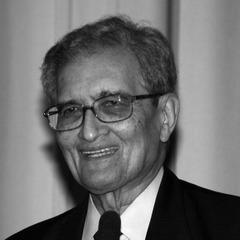
Amartya Sen
Amartya Sen

Amartya Sen is an Indian economist renowned for his contributions to welfare economics, development economics, and ethics. He won the Nobel Prize in Economics in 1979 and is considered one of the most outstanding economists of the 20th century. more

You May Also Like

“The general uncertainty about the prospects of medical treatment is socially handled by rigid entry requirements. These are designed to reduce the uncertainty in the mind of the consumer as to the quality insofar as this is possible. I think this explanation, which is perhaps the naive one, is much more tenable than any idea of a monopoly seeking to increase incomes.”

“No longer enslaved or made dependent by force of law, the great majority are so by force of property; they are still chained to a place, to an occupation, and to conformity with the will of an employer, and debarred by the accident of birth to both the enjoyments, and from the mental and moral advantages, which others inherit without exertion and independently of desert. That this is an evil equal to almost any of those against which mankind have hitherto struggles, the poor are not wrong in believing.”

“Even those who identify themselves as libertarians follow an overtly anti-rationalist philosophy, as even a brief acquaintance with the work of Friedrich Hayek should make clear. The argument against reason in this literature is straightforward: it is impossible for any individual to acquire enough reliable information to make a rational decision, any actions founded on rational thought will therefore be delusional, any attempts at reason should therefore regarded as dangerous, and all action should instead be guided by tradition.”

“I'll tell you what I'd do if it were up to me: I would establish a strictly controlled distribution network through which I would make most drugs, excluding the most dangerous ones like crack, legally available. Initially I would keep the prices low enough to destroy the drug trade. Once that objective was attained I would keep raising the prices, very much like the excise duty on cigarettes, but I would make an exception for registered addicts in order to discourage crime. I would use a portion of the income for prevention and treatment. And I would foster social opprobrium of drug use.”

“[What Hayek] does not see, or will not admit, [is] that a return to "free" competition means for the great mass of people a tyranny probably worse, because more irresponsible, than that of the State. The trouble with competitions is that somebody wins them. Professor Hayek denies that free capitalism necessarily leads to monopoly, but in practice that is where it has led, and since the vast majority of people would far rather have State regimentation than slumps and unemployment, the drift towards collectivism is bound to continue if popular opinion has any say in the matter.”

“These days, however, the main problem comes from the right - from conservatives who, unlike most economists, really do think that the free market is always right - to such an extent that they refuse to believe even the most overwhelming scientific evidence if it seems to suggest a justification for government action.”

“Unfortunately for ethical egoism, the claim that we will all be better off if every one of us does what is in his or her own interest is incorrect. This is shown by what are known as "prisoner's dilemma" situations, which are playing an increasingly important role in discussions of ethical theory... At least on the collective level, therefore, egoism is self-defeating - a conclusion well brought out by Parfit in his aforementioned Reasons and Persons.”