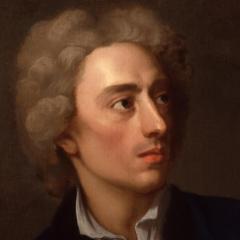
“Some place the bliss in action, some in ease,
Those call it pleasure, and contentment these.”
Source: The Works of Alexander Pope, Esq: Moral essays
“When I die, I should be ashamed to leave enough to build me a monument if there were a wanting friend above ground. I would enjoy the pleasure of what I give by giving it alive and seeing another enjoy it.”
Source: The Works: Including Several Hundred Unpublished Letters, and Other New Materials
“Good-humor only teaches charms to last,
Still makes new conquests and maintains the past.”
“What then remains, but well our power to use,
And keep good-humor still whate'er we lose?
And trust me, dear, good-humor can prevail,
When airs, and flights, and screams, and scolding fail.”
Source: The Works of Alexander Pope: With a Memoir of the Author, Notes, and Critical Notes on Each Poem
“Whate'er the passion, knowledge, fame, or pelf,
Not one will change his neighbor with himself.”
Source: An Essay on Man: In Four Epistles, to Henry St. John, Lord Bolingbroke : to which is Added, The Universal Prayer, with Other Poems
“Ten censure wrong for one who writes amiss.”
Source: The Poetical Works of Alexander Pope
“A perfect Judge will read each work of Wit
With the same spirit that its author writ:
Survey the Whole, nor seek slight faults to find
Where nature moves, and rapture warms the mind.”
Source: A Select Collection of Poems: Viz. An Essay on Man; An Essay on Criticism; The Messiah; &c. &c. ... To which are Prefixed, An Account of the Life of the Author
“I lose my patience, and I own it too,
When works are censur'd, not as bad but new;
While if our Elders break all reason's laws,
These fools demand not pardon but Applause.”
Source: The Works of Alexander Pope: Esq., with His Last Corrections, Additions, and Improvements; as They Were Delivered to the Editor a Little Before His Death; Together with the Commentaries and Notes of Mr. Warburton
“And you, my Critics! in the chequer'd shade,
Admire new light thro' holes yourselves have made.”
Source: The Works of Alexander Pope, Esq: ...
“Cavil you may, but never criticise.”
Source: The Works of Alexander Pope, Esq: In Eight Volumes, Complete
“Oh! if to dance all night, and dress all day,
Charm'd the small-pox, or chas'd old age away;
. . . .
To patch, nay ogle, might become a saint,
Nor could it sure be such a sin to paint.”
Source: The Works of Alexander Pope
“Why did I write? What sin to me unknown dipped me in ink, my parents , or my own?”
Source: Alexander Pope: Selected Poetry and Prose
“A saint in crape is twice a saint in lawn.”
“Oft in dreams invention we bestow to change a flounce or add a furbelow.”
Source: The Poetical Works of Alexander Pope
“What is fame? a fancied life in others' breath.”
Source: The Works: Including Several Hundred Unpublished Letters, and Other New Materials
“To pardon those absurdities in ourselves which we cannot suffer in others is neither better nor worse than to be more willing to be fools ourselves than to have others so.”
Source: The works of Alexander Pope. With a selection of explanatory notes, and the account of his life by dr. Johnson
“Fickle Fortune reigns, and, undiscerning, scatters crowns and chains.”
Source: The Poetical Works of Alexander Pope
“Fortune in men has some small diff'rence made,
One flaunts in rags, one flutters in brocade,
The cobbler apron'd, and the parson gown'd,
The friar hooded, and the monarch crown'd.”
Source: The Poetical Works of Alexander Pope Edited with Notes and Introductory Memoir by Adolphus William Ward
“To Him no high, no low, no great, no small;
He fills, He bounds, connects and equals all!”
Source: The Works of Alexander Pope, Esq., with Notes and Illustrations, by Himself and Others. To which are Added, a New Life of the Author, an Estimate of His Poetical Character and Writings, and Occasional Remarks by William Roscoe, Esq
“Mankind is unamendable.”
Source: The Works of Alexander Pope Esq
“We ought, in humanity, no more to despise a man for the misfortunes of the mind than for those of the body, when they are such as he cannot help; were this thoroughly considered we should no more laugh at a man for having his brains cracked than for having his head broke.”
Source: The works of Alexander Pope. With a selection of explanatory notes, and the account of his life by dr. Johnson
“Trade it may help, society extend,
But lures the Pirate, ant corrupts the friend:
It raises armies in a nation's aid,
But bribes a senate, and the land's betray'd.”
“Music the fiercest grief can charm,
And fate's severest rage disarm. Music can soften pain to ease,
And make despair and madness please;
Our joys below it can improve,
And antedate the bliss above.”
Source: The poetical works of Alexander Pope. Ed. by H.F. Cary, with a biogr. notice of the author
“By music minds an equal temper know,
Nor swell too high, nor sink too low.
. . . .
Warriors she fires with animated sounds.
Pours balm into the bleeding lover's wounds.”
Source: The poetical works of Alexander Pope. Ed. by H.F. Cary, with a biogr. notice of the author
“A tree is a nobler object than a prince in his coronation-robes.”
Source: The Major Works
“Pretty conceptions, fine metaphors, glittering expressions, and something of a neat cast of verse are properly the dress, gems, or loose ornaments of poetry.”
Source: The Works of Alexander Pope, Esq. In Verse and Prose: Containing the Principal Notes of Drs. Warburton and Warton: Illustrations, and Critical and Explanatory Remarks, by Johnson, Wakefield, A. Chalmers, F.S.A. and Others. To which are Added, Now First Published, Some Original Letters, with Additional Observations, and Memoirs of the Life of the Author
“Jarring interests of themselves create the according music of a well-mixed state.”
Source: Alexander Pope: Selected Poetry and Prose
“Old politicians chew on wisdom past,
And totter on in business to the last.”
“A fellow feeling makes us wondrous kind.”
“A fly, a grape-stone, or a hair can kill.”
“All seems infected that th' infected spy,
As all looks yellow to the jaundiced eye.”
“Tis all in vain to keep a constant pother
About one vice and fall into another.”
“For forms of faith let graceless zealots fight; his can't be wrong whose life is in the right.”
Source: The works of Alexander Pope. With his last corrections, additions, and improvements. Publ. by mr. Warburton. With occasional notes
“Self-love, the spring of motion, acts the soul;
Reason's comparing balance rules the whole.
Man, but for that no action could attend,
And, but for this, were active to no end:
Fix'd like a plant on his peculiar spot,
To draw nutrition, propagate, and rot;
Or, meteor-like, flame lawless thro' the void,
Destroying others, by himself destroy'd.”
Source: Essay on Man and Other Poems
“True self-love and social are the same.”
“It is very natural for a young friend and a young lover to think the persons they love have nothing to do but to please them.”
Source: Letters of Alexander Pope and Several Eminent Persons from the Year 1705 to 1735
“Sleep and death, two twins of winged race,
Of matchless swiftness, but of silent pace.”
Source: The Iliad of Homer
“Though triumphs were to generals only due, crowns were reserved to grace the soldiers too.”
Source: An Essay on Criticism
“Man, like the generous vine, supported lives; the strength he gains is from the embrace he gives.”
Source: Essay on Man and Other Poems
“Wholesome solitude, the nurse of sense!”
Source: The works of Alexander Pope. Containing the principal notes of drs. Warburton and Warton [&c.]. To which are added, some original letters, with additional observations, and memoirs, by W.L. Bowles
“No craving void left aching in the soul.”
“And empty heads console with empty sound.”
Source: The Poetical Works of Alexander Pope: Epistle to Dr. Arbuthnot, being the prologue to the satires. Satires, epistles, and odes of Horace imitated. Epitaphs. The Dunciad, in four books
“Who taught that heaven-directed spire to rise?”
Source: The works of Alexander Pope. With notes by dr. Warburton
“There is no study that is not capable of delighting us after a little application to it.”
“Never elated while one man's oppress'd;
Never dejected while another's blessed.”
Source: The works of Alexander Pope. With notes by dr. Warburton
“Talk what you will of taste, my friend, you'll find two of a face as soon as of a mind.”
Source: The Works of Alexander Pope, Esq: Satires. On receiving from the Right Honourable the Lady Frances Shirley, a standish and two pens. A fragment of an unpublished satire of Pope intitled One thousand seven hundred and forty. The plan of an epic poem, to have been written in blank verse, and intitled Brutus. Preface to Homer's Iliad. Postscript to the Odyssey
“Taste, that eternal wanderer, which flies
From head to ears, and now from ears to eyes.”
Source: Delphi Complete Works of Alexander Pope (Illustrated)
“I am satisfied to trifle away my time, rather than let it stick by me.”
Source: The Works of Alexander Pope: New Ed. Including Several Hundred Unpublished Letters, and Other New Materials, Collected in Part by John Wilson Croker. With Introd. and Notes by Whitwell Elwin
“Still when the lust of tyrant power succeeds, some Athens perishes, or some Tully bleeds.”
Source: The Poetical Works of Alexander Pope Edited with Notes and Introductory Memoir by Adolphus William Ward
“That each from other differs, first confess; next that he varies from himself no less.”
Source: The Works of Alexander Pope