Quotessence
Home / Authors / Benjamin Franklin Books
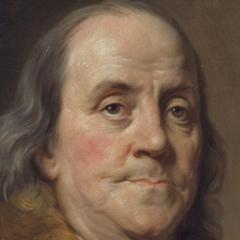
Benjamin Franklin

Benjamin Franklin Books

Founding Father of the United States

Writings

A source page for quotes linked to Benjamin Franklin.
0 quotes

Animal Magnetism

A source page for quotes linked to Benjamin Franklin.

0 quotes

Related Quotes

“In all your Amours you should prefer old Women to young ones. You call this a Paradox, and demand my Reasons. They are these: 1. Because as they have more Knowledge of the World and their Minds are better stor’d with Observations, their Conversation is more improving and more lastingly agreable. 2. Because when Women cease to be handsome, they study to be good. To maintain their Influence over Men, they supply the Diminution of Beauty by an Augmentation of Utility. They learn to do a 1000 Services small and great, and are the most tender and useful of all Friends when you are sick. Thus they continue amiable. And hence there is hardly such a thing to be found as an old Woman who is not a good Woman. 3. Because there is no hazard of Children, which irregularly produc’d may be attended with much Inconvenience. 4. Because thro’ more Experience, they are more prudent and discreet in conducting an Intrigue to prevent Suspicion. The Commerce with them is therefore safer with regard to your Reputation. And with regard to theirs, if the Affair should happen to be known, considerate People might be rather inclin’d to excuse an old Woman who would kindly take care of a young Man, form his Manners by her good Counsels, and prevent his ruining his Health and Fortune among mercenary Prostitutes. 5. Because in every Animal that walks upright, the Deficiency of the Fluids that fill the Muscles appears first in the highest Part: The Face first grows lank and wrinkled; then the Neck; then the Breast and Arms; the lower Parts continuing to the last as plump as ever: So that covering all above with a Basket, and regarding only what is below the Girdle, it is impossible of two Women to know an old from a young one. And as in the dark all Cats are grey, the Pleasure of corporal Enjoyment with an old Woman is at least equal, and frequently superior, every Knack being by Practice capable of Improvement. 6. Because the Sin is less. The debauching a Virgin may be her Ruin, and make her for Life unhappy. 7. Because the Compunction is less. The having made a young Girl miserable may give you frequent bitter Reflections; none of which can attend the making an old Woman happy. 8thly and Lastly They are so grateful!!”

“How grossly are they mistaken in imagining slavery to be disallowed by the Alcoran! Are not the two precepts, to quote no more, Masters treat your slaves with kindness: Slaves serve your masters with cheerfulness and fidelity, clear proofs to the contrary? Nor can the plundering of infidels be in that sacred book forbidden, since it is well known from it, that God has given the world and all that it contains to his faithful Mussulmen, who are to enjoy it of right as fast as they can conquer it. Let us then hear no more of this detestable proposition, the manumission of christian slaves, the adoption of which would, by depreciating our lands and houses, and thereby depriving so many good citizens of their properties, create universal discontent, and provoke insurrections, to the endangering of government, and producing general confusion.”

“In reality there is perhaps no one of our natural Passions so hard to subdue as Pride. Disguise it, struggle with it, beat it down, stifle it, mortify it as much as one pleases, it is still alive, and will every now and then peep out and show itself. You will see it perhaps often in this History. For even if I could conceive that I had compleatly overcome it, I should probably be proud of my Humility.”

“Some guns were fired to give notice that the departure of the balloon was near. ... Means were used, I am told, to prevent the great balloon's rising so high as might endanger its bursting. Several bags of sand were taken on board before the cord that held it down was cut, and the whole weight being then too much to be lifted, such a quantity was discharged as would permit its rising slowly. Thus it would sooner arrive at that region where it would be in equilibrio with the surrounding air, and by discharging more sand afterwards, it might go higher if desired. Between one and two o'clock, all eyes were gratified with seeing it rise majestically from above the trees, and ascend gradually above the buildings, a most beautiful spectacle. When it was about two hundred feet high, the brave adventurers held out and waved a little white pennant, on both sides of their car, to salute the spectators, who returned loud claps of applause. The wind was very little, so that the object though moving to the northward, continued long in view; and it was a great while before the admiring people began to disperse. The persons embarked were Mr. Charles, professor of experimental philosophy, and a zealous promoter of that science; and one of the Messrs Robert, the very ingenious constructors of the machine. {While U.S. ambassador to France, writing about witnessing, from his carriage outside the garden of Tuileries, Paris, the first manned balloon ascent using hydrogen gas by Jacques Charles on the afternoon of 1 Dec 1783. A few days earlier, he had watched the first manned ascent in Montgolfier's hot-air balloon, on 21 Nov 1783.}”

“We stand at the crossroads, each minute, each hour, each day, making choices. We choose the thoughts we allow ourselves to think, the passions we allow ourselves to feel, and the actions we allow ourselves to perform. Each choice is made in the context of whatever value system we have selected to govern our lives. In selecting that value system, we are, in a very real way, making the most important choice we will ever make. Those who believe there is one God who made all things and who governs the world by this providence will make many choices different from those who do not. Those who hold in reverence that being who gave them life and worship Him through adoration, prayer, and thanksgiving will make choices different from those who do not. Those who believe that mankind are all of a family and that the most acceptable service of God is doing good to man will make many choices different from those who do not. Those who believe in a future state in which all that is wrong here will be made right will make many choices different from those who do not. Those who subscribe to the morals of Jesus will make many choices different from those who do not. Since the foundation of all happiness is thinking rightly, and since correct action is dependent on correct opinion, we cannot be too careful in choosing the value system we allow to govern our thoughts and actions. And to know that God governs in the affairs of men, that He hears and answers prayers, and that He is a rewarder of them that diligently seek Him, is, indeed, a powerful regulator of human conduct.”

“We hold these truths to be self-evident. {Franklin's edit to the assertion in Thomas Jefferson's original wording, 'We hold these truths to be sacred and undeniable' in a draft of the Declaration of Independence changes it instead into an assertion of rationality. The scientific mind of Franklin drew on the scientific determinism of Isaac Newton and the analytic empiricism of David Hume and Gottfried Wilhelm Leibniz. In what became known as 'Hume's Fork' the latters' theory distinguished between synthetic truths that describe matters of fact, and analytic truths that are self-evident by virtue of reason and definition.}”

“That bodies should be lent us, while they can afford us pleasure, assist us in acquiring knowledge, or doing good to our fellow creatures, is a kind and benevolent act of God - when they become unfit for these purposes and afford us pain instead of pleasure-instead of an aid, become an encumbrance and answer none of the intentions for which they were given, it is equally kind and benevolent that a way is provided by which we may get rid of them. Death is that way.”

“Cowards can handle Arms, can strike where they are sure to meet with no Return, can wound, mangle and murder; but it belongs to brave Men to spare, and to protect.”

“Slavery is such an atrocious debasement of human nature, that its very extirpation, if not performed with solicitous care, may sometimes open a source of serious evils. The unhappy man who has been treated as a brute animal, too frequently sinks beneath the common standard of the human species. The galling chains, that bind his body, do also fetter his intellectual faculties, and impair the social affections of his heart… To instruct, to advise, to qualify those, who have been restored to freedom, for the exercise and enjoyment of civil liberty… and to procure for their children an education calculated for their future situation in life; these are the great outlines of the annexed plan, which we have adopted. [For the Pennsylvania Society for Promoting the Abolition of Slavery, 1789]”

“I am for doing good to the poor, but I differ in opinion of the means. I think the best way of doing good to the poor, is not making them easy in poverty, but leading or driving them out of it. In my youth I travelled much, and I observed in different countries, that the more public provisions were made for the poor, the less they provided for themselves, and of course became poorer. And, on the contrary, the less was done for them, the more they did for themselves, and became richer.”

“You desire to know something of my Religion. It is the first time I have been questioned upon it: But I do not take your Curiosity amiss, and shall endeavour in a few Words to gratify it... I have, with most of the present Dissenters in England, some Doubts as to his [Jesus'] divinity; tho' it is a question I do not dogmatize upon, having never studied it, and I think it needless to busy myself with it now, when I expect soon an Opportunity of knowing the Truth with less Trouble. [Letter to Ezra Stiles, March 9, 1790]”

“And soon after I procured Xenophons memorable things of Socrates, wherein there are many examples of the same method [socratic method]. I was charged with it, adopted it, dropped my abrupt contradiction and positive argumentation, and put on the humble inquire. And being then, from reading Shaftesbury in Collins, made a doubter, as I already was in many points of our religious doctrines, I found this method safest for myself and very embarrassing to those against whom I used it; therefore, I took a delight in it, practiced it continually, and grew very artful and expert in drawing people, even of superior knowledge, into concessions the consequences of which they did not foresee, entangling them in difficulties out of which they could not extricate themselves, and so obtaining victories that neither myself nor my cause always deserved.”

“My Parents had early given me religious Impressions, and brought me through my Childhood piously in the Dissenting Way. But I was scarce 15 when, after doubting by turns of several Points as I found them disputed in the different Books I read, I began to doubt of Revelation itself. Some Books against Deism fell into my Hands; they were said to be the Substance of Sermons preached at Boyle's Lectures. It happened that they wrought an Effect on me quite contrary to what was intended by them: For the Arguments of the Deists which were quoted to be refuted, appeared to me much Stronger than the Refutations. In short I soon became a thorough Deist. [Part I, p. 45 of autobiography]”