Quotessence
Home / Authors / Bertrand Russell
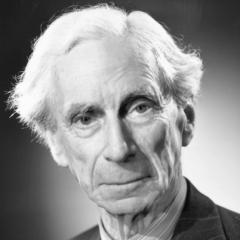
Bertrand Russell

Bertrand Russell Quotes

Philosopher

Filter quotes by topic

Famous Bertrand Russell Quotes

“The world of being is unchangeable, rigid, exact, delightful to the mathematician, the logician, the builder of metaphysical systems, and all who love perfection more than life. The world of existence is fleeting, vague, without sharp boundaries, without any clear plan or arrangement, but it contains all thoughts and feelings, all the data of sense, and all physical objects, everything that can do either good or harm, everything that makes any difference to the value of life and the world. According to our temperaments, we shall prefer the contemplation of the one or of the other.”

“Pure mathematics consists entirely of assertions to the effect that, if such and such a proposition is true of anything, then such and such another proposition is true of that thing. It is essential not to discuss whether the first proposition is really true, and not to mention what the anything is, of which it is supposed to be true. [...] Thus mathematics may be defined as the subject in which we never know what we are talking about, nor whether what we are saying is true. People who have been puzzled by the beginnings of mathematics will, I hope, find comfort in this definition, and will probably agree that it is accurate.”

“Bacon not only despised the syllogism, but undervalued mathematics, presumably as insufficiently experimental. He was virulently hostile to Aristotle , but he thought very highly of Democritus , Although he did not deny that the course of nature exemplifies a Divine purpose, he objected to any admixture of teleological explanation in the actual investigation of phenomena; everything, he held, should be explained as following necessarily from efficient causes .”

“It seems to me now that mathematics is capable of an artistic excellence as great as that of any music, perhaps greater; not because the pleasure it gives (although very pure) is comparable, either in intensity or in the number of people who feel it, to that of music, but because it gives in absolute perfection that combination, characteristic of great art, of godlike freedom, with the sense of inevitable destiny; because, in fact, it constructs an ideal world where everything is perfect and yet true.”

“... the word "theory" ... was originally an Orphic word, which Cornford interprets as "passionate sympathetic contemplation" ... For Pythagoras, the "passionate sympathetic contemplation" was intellectual, and issued in mathematical knowledge ... To those who have reluctantly learnt a little mathematics in school this may seem strange; but to those who have experienced the intoxicating delight of sudden understanding that mathematics gives, from time to time, to those who love it, the Pythagorean view will seem completely natural.”

“It seems to us unwise to have insisted on teaching geometry to the younger Dionysius, tyrant of Syracuse, in order to make him a good king, but from Plato's point of view it was essential. He was sufficiently Pythagorean to think that without mathematics no true wisdom is possible.”

“I like mathematics because it is not human and has nothing particular to do with this planet or with the whole accidental universe - because, like Spinoza's God, it won't love us in return.”

“Mathematics, rightly viewed, possesses not only truth, but supreme beauty a beauty cold and austere, like that of sculpture, without appeal to any part of our weaker nature, without the georgeous trappings of painting or music, yet sublimely pure, and capable of a stern perfection such as only the greatest art can show. The true spirit of delight, the exaltation, the sense of being more than Man, which is the touchstone of the highest excellence, is to be found in mathematics as surely as in poetry.”

“Of these austerer virtues the love of truth is the chief, and in mathematics, more than elsewhere, the love of truth may find encouragement for waning faith. Every great study is not only an end in itself, but also a means of creating and sustaining a lofty habit of mind; and this purpose should be kept always in view throughout the teaching and learning of mathematics.”

“Ordinary language is totally unsuited for expressing what physics really asserts, since the words of everyday life are not sufficiently abstract. Only mathematics and mathematical logic can say as little as the physicist means to say.”

“At the age of eleven, I began Euclid, with my brother as my tutor. This was one of the great events of my life, as dazzling as first love. I had not imagined there was anything so delicious in the world. From that moment until I was thirty-eight, mathematics was my chief interest and my chief source of happiness.”