Quotessence
Home / Authors / Bertrand Russell
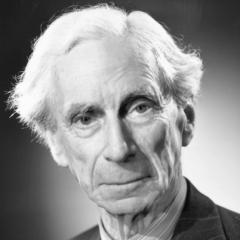
Bertrand Russell

Bertrand Russell Quotes

Philosopher

Filter quotes by topic

Famous Bertrand Russell Quotes

“Message to the Future (1959) - Bertrand Russel “I should like to say two things, one intellectual and one moral. The intellectual thing I should want to say is this: When you are studying any matter, or considering any philosophy, ask yourself only what are the facts and what is the truth that the facts bear out. Never let yourself be diverted either by what you wish to believe, or by what you think would have beneficent social effects if it were believed. But look only, and solely, at what are the facts. That is the intellectual thing that I should wish to say. The moral thing I should wish to say… I should say love is wise, hatred is foolish. In this world which is getting more closely and closely interconnected we have to learn to tolerate each other, we have to learn to put up with the fact that some people say things that we don’t like. We can only live together in that way and if we are to live together and not die together we must learn a kind of charity and a kind of tolerance which is absolutely vital to the continuation of human life on this planet.” “The good life is one inspired by love and guided by knowledge.”

“When one admits that nothing is certain one must, I think, also admit that some things are much more nearly certain than others. It is much more nearly certain that we are assembled here tonight than it is that this or that political party is in the right. Certainly there are degrees of certainty, and one should be very careful to emphasize that fact, because otherwise one is landed in an utter skepticism, and complete skepticism would, of course, be totally barren and completely useless.”

“Owing to the identification of religion with virtue, together with the fact that the most religious men are not the most intelligent, a religious education gives courage to the stupid to resist the authority of educated men, as has happened, for example, where the teaching of evolution has been made illegal. So far as I can remember, there is not one word in the Gospels in praise of intelligence; and in this respect ministers of religion follow gospel authority more closely than in some others.”

“You could take up the line that some of the gnostics took up - a line which I often thought was a very plausible one - that as a matter of fact this world that we know was made by the devil at a moment when God was not looking. There is a good deal to be said for that, and I am not concerned to refute it.”

“History is valuable, to begin with, because it is true; and this, though not the whole of its value, is the foundation and condition of all the rest. That all knowledge, as such, is in some degree good, would appear to be at least probable; and the knowledge of every historical fact possesses this element of goodness, even if it posses no other.”

“Science tells us what we can know but what we can know is little and if we forget how much we cannot know we become insensitive of many things of very great importance. Theology, on the other hand induces a dogmatic belief that we have knowledge where in fact we have ignorance and by doing so generates a kind of impertinent insolence towards the universe. Uncertainty in the presence of vivid hopes and fears is painful, but must be endured if we wish to live without the support of comforting fairy tales.”

“Very many people spend money in ways quite different from those that their natural tastes would enjoin, merely because the respect of their neighbors depends upon their possession of a good car and their ability to give good dinners. As a matter of fact, any man who can obviously afford a car but genuinely prefers travels or a good library will in the end be much more respected than if he behaved exactly like everyone else.”

“People are said to believe in God, or to disbelieve in Adam and Eve. But in such cases what is believed or disbelieved is that there is an entity answering a certain description. This, which can be believed or disbelieved is quite different from the actual entity (if any) which does answer the description. Thus the matter of belief is, in all cases, different in kind from the matter of sensation or presentation, and error is in no way analogous to hallucination. A hallucination is a fact, not an error; what is erroneous is a judgment based upon it.”

“When I say that children should be told about sex, I do not mean that they should be told only the bare physiological facts; they should be told whatever they wish to know. There should be no attempt to represent adults as more virtuous than they are, or sex as occurring only in marriage. There is no excuse for deceiving children. And when, as must happen in conventional families, they find that their parents have lied, they lose confidence in them, and feel justified in lying to them.”

“It seems to me now that mathematics is capable of an artistic excellence as great as that of any music, perhaps greater; not because the pleasure it gives (although very pure) is comparable, either in intensity or in the number of people who feel it, to that of music, but because it gives in absolute perfection that combination, characteristic of great art, of godlike freedom, with the sense of inevitable destiny; because, in fact, it constructs an ideal world where everything is perfect and yet true.”

“In astronomy, the law of gravitation is plainly better worth knowing than the position of a particular planet on a particular night, or even on every night throughout a year. There are in the law a splendour and simplicity and sense of mastery which illuminate a mass of otherwise uninteresting details. But in history the matter is far otherwise. Historical facts, many of them, have an intrinsic value, a profound interest on their own account, which makes them worthy of study, quite apart from any possibility of linking them together by means of causal laws.”

“The question of "unreality"is a very important one. Misled by grammar, the great majority of those logicians who have dealt with this question have dealt with it on mistaken lines. They have regarded grammatical form as a surer guide in analysis than, in fact, it is. And they have not known what differences in grammatical form are important.”

“Admit at least one painful truth to yourself every day. Teach yourself to feel that life would still be worth living even if you were not immeasurably superior to all your friends. Exercises of this sort, prolonged through several years, will at last enable you to admit facts without flinching, and will, in so doing, free you from the empire of fear over a very large field.”

“In view of the fact that in any future world war nuclear weapons will certainly be employed, and that such weapons threaten the continued existence of mankind, we urge the governments of the world to realize, and to acknowledge publicly, that their purpose cannot be furthered by a world war, and we urge them, consequently, to find peaceful means for the settlement of all matters of dispute between them.”

“The fact that a belief has a good moral effect upon a man is no evidence whatsoever in favor of its truth. I'm not contending in a dogmatic way that there is not a God. What I'm contending is that we don't know that there is. I don't like the word "absolute." I don't think there is anything absolute whatever. The moral law, for example, is always changing. At one period in the development of the human race, almost everybody thought cannibalism was a duty.”

“If a man is offered a fact which goes against his instincts, he will scrutinize it closely, and unless the evidence is overwhelming, he will refuse to believe it. If, on the other hand, he is offered something which affords a reason for acting in accordance to his instincts, he will accept it even on the slightest evidence. The origin of myths is explained in this way.”

“If the ordinary wage-earner worked four hours a day, there would be enough for everybody, and no unemployment — assuming a certain very moderate amount of sensible organization. This idea shocks the well-to-do, because they are convinced that the poor would not know how to use so much leisure.”

“One of the commonest things to do with savings is to lend them to some Government. In view of the fact that the bulk of the public expenditure of most civilized Governments consists in payment for past wars or preparation for future wars, the man who lends his money to a Government is in the same position as the bad men in Shakespeare who hire murderers. The net result of the man's economical habits is to increase the armed forces of the State to which he lends his savings. Obviously it would be better if he spent the money, even if he spent it in drink or gambling.”

“Love is wise; hatred is foolish. In this world, which is getting more and more closely interconnected, we have to learn to tolerate each other, we have to learn to put up with the fact that some people say things that we don't like. We can only live together in that way. But if we are to live together, and not die together, we must learn a kind of charity and a kind of tolerance, which is absolutely vital to the continuation of human life on this planet.”

“You find this curious fact, that the more intense has been the religion of any period and more profound has been the dogmatic belief, the greater has been the cruelty and the worse has been the state of affairs. In the so called age of faith, when men really did believe the Christian religion in all its completeness, there was the Inquisition, with its tortures; there were millions of unfortunate women burnt as witches; and there was every kind of cruelty practised upon all sorts of people in the name of religion.”

“When a man acts in ways that annoy us we wish to think him wicked, and we refuse to face the fact that his annoying behavior is the result of antecedent causes which, if you follow them long enough, will take you beyond the moment of his birth, and therefore to events for which he cannot be held responsible by any stretch of imagination... When a motorcar fails to start, we do not attribute its annoying behavior to sin, we do not say, you are a wicked motorcar, and you shall not have any more gasoline until you go.”

“Almost all education has a political motive: it aims at strengthening some group, national or religious or even social, in the competition with other groups. It is this motive, in the main, which determines the subjects taught, the knowledge offered and the knowledge withheld, and also decides what mental habits the pupils are expected to acquire. Hardly anything is done to foster the inward growth of mind and spirit; in fact, those who have had the most education are very often atrophied in their mental and spiritual life.”